
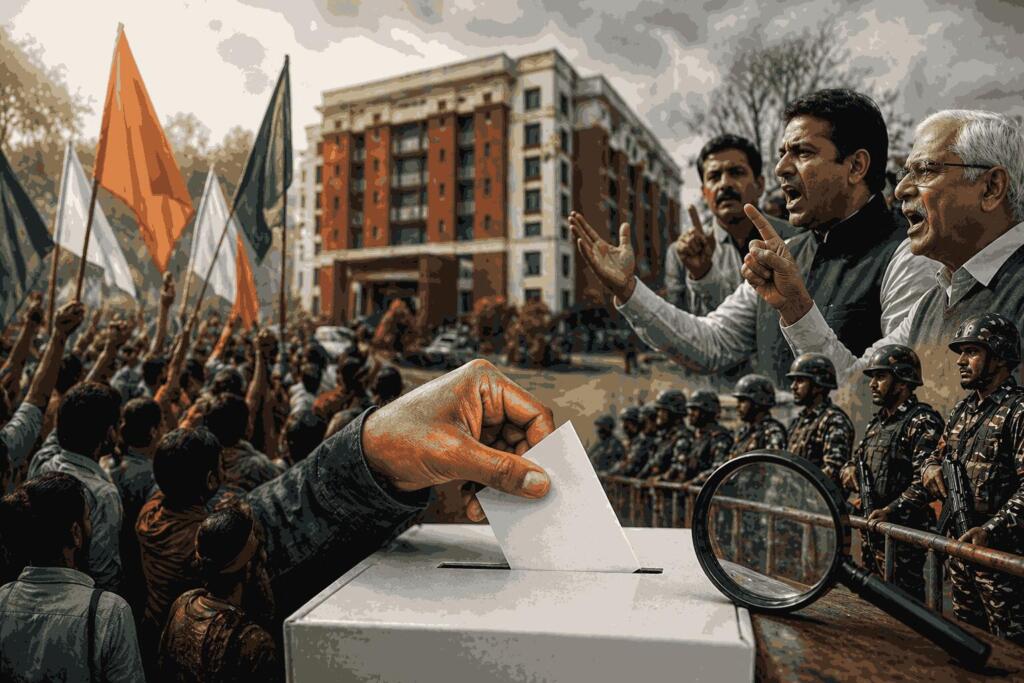
Even before a single vote has been counted, the political temperature around the Bengal election, 2026 has already begun to rise—this time not just on the ground, but in the narrative space. Allegations, counter-allegations, and preemptive criticism of the Election Commission of India have started surfacing, with sections of the opposition appearing to prepare their stance well ahead of the final verdict.
The phenomenon is not entirely new, but its timing is striking. Traditionally, disputes regarding electoral conduct emerge after polling irregularities or results are declared. However, in the current Bengal election, 2026, the tone seems to have shifted. Political voices are raising questions about the impartiality and functioning of the Election Commission even before the full electoral process has unfolded. This early skepticism raises a fundamental question: is this a genuine concern about electoral integrity, or a strategic move to shape public perception in advance?
The opposition’s rhetoric suggests a growing distrust in institutions that are meant to function as neutral arbiters of democracy. By questioning the Election Commission early, political actors may be attempting to build a narrative that cushions them against an unfavorable outcome. In highly competitive electoral environments, perception often becomes as critical as reality. If voters are led to believe that the process itself is compromised, the legitimacy of the result can be contested regardless of the actual conduct of polling.
At the same time, it is important to recognize that concerns about electoral fairness cannot be dismissed outright. The Bengal election, 2026 is being conducted in a politically charged atmosphere, with memories of past violence and allegations of malpractice still fresh. In such a context, scrutiny of institutions like the Election Commission is not only inevitable but necessary. The challenge lies in distinguishing between constructive criticism and preemptive delegitimization.
Security arrangements, including the deployment of central forces, have been extensive this time. In many sensitive districts, the presence of such forces has encouraged higher voter turnout and relatively orderly polling conditions. This visible effort to ensure free and fair voting stands in contrast to claims that the process is being compromised. The Election Commission has repeatedly emphasized its commitment to neutrality, pointing to logistical measures and monitoring mechanisms designed to uphold electoral integrity.
Yet, narratives often evolve independently of ground realities. In the age of rapid information flow, political messaging spreads quickly, shaping opinions before facts can fully emerge. By the time polling concludes, a section of the electorate may already be influenced by claims questioning the Election Commission’s role. This makes the institution’s task even more complex—not only must it conduct elections fairly, but it must also maintain public confidence amid competing narratives.
The Bengal election, 2026 thus becomes a test not just of political strength, but of institutional resilience. The Election Commission finds itself navigating a delicate balance: ensuring strict enforcement of rules while also addressing perceptions of bias. Transparency, timely communication, and visible action against violations become critical tools in this effort.
Another dimension to consider is the broader impact of such preemptive criticism. When political actors begin to question the credibility of the Election Commission before the process is complete, it risks normalizing distrust in democratic institutions. Over time, this can erode the very foundation of electoral democracy, where acceptance of results is as important as the act of voting itself.
However, it would be simplistic to view the situation in purely adversarial terms. Elections in large and diverse regions like West Bengal are inherently complex. Administrative challenges, logistical hurdles, and localized tensions can create situations that invite criticism. The role of the Election Commission, therefore, is not only to manage these challenges but also to demonstrate accountability in addressing them.
As the Bengal election, 2026 progresses, the interplay between political narratives and institutional actions will continue to shape public discourse. Whether the early criticism of the Election Commission proves to be justified or exaggerated will ultimately depend on how the electoral process unfolds in its entirety.
For now, one thing is clear: the battle is not confined to polling booths alone. It extends into the realm of perception, where trust, credibility, and narrative control play decisive roles. In this environment, the Election Commission’s ability to uphold both the reality and the perception of fairness will be crucial.
In the end, the strength of any democracy lies in the confidence its citizens place in its institutions. The Bengal election, 2026 offers an opportunity to reinforce that confidence—provided that both political actors and the Election Commission act with responsibility, restraint, and a commitment to the democratic process.