
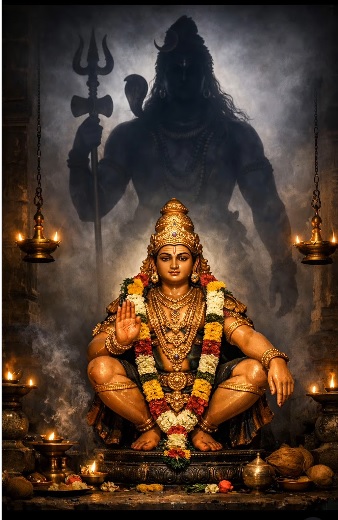
The debate over whether Ayyappa is merely a “forest” or “village” deity has resurfaced in recent discourse, but historical evidence—from inscriptions to classical Tamil literature—tells a far more layered and profound story. Far from being confined to a single social or geographical identity, the deity emerges from a complex continuum of traditions that bridge folk worship, temple culture, and pan-Indian theology.
At the heart of this discussion lies the figure of Ayyappa, also known as Dharmasastha, a deity associated with righteousness, discipline, and spiritual balance. Over centuries, his identity has evolved, absorbing multiple strands of belief systems while maintaining continuity across regions. This fluidity is not unusual within the broader framework of Indian religious traditions, where local and universal forms often coexist rather than conflict.
Historical inscriptions provide some of the earliest clues to understanding this evolution. Records from the early medieval period indicate that forms of the deity—referred to as Ayyan, Ayyanar, or Shasta—were already known across South India. For instance, inscriptions from the time of the Chola rulers explicitly identify Ayyappa with Shasta, suggesting a recognized theological continuity rather than fragmentation.
Further evidence comes from Tamil regions, where epigraphic records and hero stones dating back to the early centuries of the Common Era refer to similar deities. These inscriptions often depict guardian figures associated with protection, warfare, and local governance, linking Ayyappa to a broader tradition of warrior-protector gods. This directly challenges the notion that he was confined to isolated or purely tribal worship.
Tamil literary sources add another important dimension. Early devotional traditions and classical texts refer to Shasta as an established deity, integrated into mainstream religious life. Over time, these references expanded, reflecting a deity worshipped across different social strata and regions. The absence of rigid boundaries between “folk” and “classical” traditions in these texts indicates that Ayyappa was never restricted to a marginal status.
In fact, the evolution of Ayyappa appears to be a case study in synthesis rather than segregation. Scholars note that the deity likely emerged from early forms of Shasta worship, which themselves drew from both indigenous and Sanskritic traditions. This blending allowed the deity to be simultaneously rooted in local practices and integrated into broader theological frameworks.
The connection between Ayyappa and Ayyanar further illustrates this continuity. While Ayyanar is often associated with village guardian shrines in Tamil Nadu, historical records suggest that the two share common origins and iconography. Over time, regional variations developed, but these did not erase the underlying unity. Instead, they enriched the tradition, allowing it to adapt to different cultural contexts.
By the early medieval period, the worship of Ayyappa had already transcended simple categorization. In Kerala, the deity became closely associated with temple traditions and was incorporated into the sacred geography of major pilgrimage centers. Meanwhile, in Tamil regions, parallel traditions continued, reflecting both continuity and diversity.
The later development of the Sabarimala tradition further expanded the reach and significance of Ayyappa. Here, the deity came to be associated with the concept of Hariharaputra—the son of Shiva and Vishnu—symbolizing the unity of different sectarian traditions. This theological evolution reinforced the idea that Ayyappa was not confined to a single narrative but represented a broader spiritual synthesis.
What emerges from inscriptions, literature, and temple traditions is a consistent pattern: Ayyappa cannot be reduced to a simplistic label. The attempt to categorize him solely as a “forest deity” overlooks the depth and diversity of historical evidence. Instead, he represents a continuum where local traditions, classical theology, and lived practices intersect.
This has important implications for how religious history is interpreted. The tendency to impose rigid categories—such as tribal versus classical or local versus mainstream—often distorts the reality of how traditions evolve. In the case of Ayyappa, the evidence points to a dynamic process of integration, where multiple influences coexist and reinforce each other.
Moreover, the widespread appeal of Ayyappa across social and regional boundaries underscores his role as a unifying figure. From village shrines to major pilgrimage centers, the deity’s presence reflects a shared cultural and spiritual heritage that transcends narrow classifications.
In conclusion, the historical record—spanning inscriptions, Tamil texts, and evolving traditions—clearly challenges the notion of Ayyappa as a marginal or isolated deity. Instead, he stands as a testament to the layered and interconnected nature of Indian religious history, where continuity and diversity are not opposites but complementary forces shaping a living tradition.