
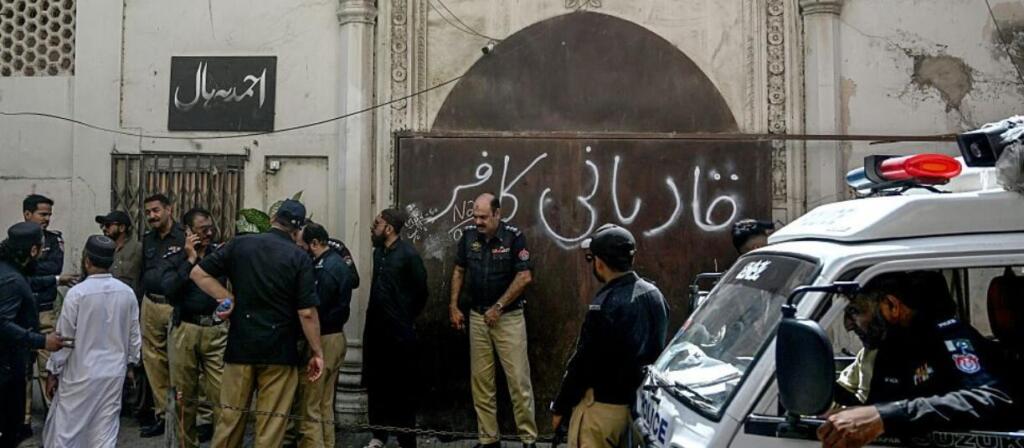
The troubles of Ahmadis in Pakistan are not merely those of a religious minority, their story is about how law, identity, and everyday life intersect to produce systemic marginalisation.
Over the last five decades, legal frameworks and social hostility have transformed the Ahmadiyya community’s faith into a criminal liability. Pakistan’s laws have restricted not just their religious practices, but also their individual dignity, political participation, and personal safety.
Criminalising Faith: The Post-1984 Reality
The Ahmadiyya community’s defining legal moment came through Ordinance XX, promulgated on 26 April 1984 under the military rule of General Zia-ul-Haq. Formally titled the Anti-Islamic Activities of the Quadiani Group, Lahori Group and Ahmadis (Prohibition and Punishment) Ordinance, it amended Pakistan’s Penal Code by introducing Sections 298-B and 298-C, which effectively criminalised the public expression of Ahmadiyya faith.
The ordinance prohibits Ahmadis from calling themselves Muslims, preaching their beliefs, using Islamic terminology, or in the law’s own words “posing as Muslims.” Violations carry penalties of up to three years’ imprisonment and fines.
In practice, this translates into sweeping restrictions. Ahmadis cannot call their places of worship “mosques,” recite the call to prayer publicly, use the traditional Islamic greeting, publicly quote from the Quran, or display Islamic inscriptions. Even Ahmadi wedding invitations, gravestones, and personal greetings have fallen under legal scrutiny. Expressing the Kalima, the Muslim declaration of faith, is itself a criminal offence for Ahmadis.
Human rights monitors note that virtually any public act of worship, devotion, or propagation by an Ahmadi can be treated as a criminal offence. Since 1984, over 4,400 cases have been registered against Ahmadis under Pakistan’s anti-blasphemy and anti-Ahmadi laws, according to documented cumulative data.
Exclusion Beyond Religion: Civic and Political Marginalisation
Ahmadi marginalisation extends well beyond religious practice into civic life. In 1985, General Zia restructured Pakistan’s electoral system, placing non-Muslims on separate electoral rolls and allowing them to vote only for non-Muslim candidates, who comprised just 5% of National Assembly seats.
For Ahmadis, this arrangement is particularly invidious: registering on the non-Muslim rolls requires them to renounce their self-identification as Muslims. Most choose to abstain from the electoral process entirely, resulting in effective disenfranchisement.
This legal exclusion is compounded by the constitutional foundation laid a decade earlier. The Second Constitutional Amendment of September 1974, passed under Prime Minister Zulfikar Ali Bhutto, declared Ahmadis non-Muslims under Pakistani law. Ordinance XX then built upon this, imposing criminal penalties for Ahmadis who publicly identified with Islam.
Together, the two measures gave the Pakistani state exclusive authority to determine the legal meaning of the word “Muslim,” an authority it has used against a community that sincerely regards itself as Islamic.
Discrimination also operates informally across education and employment. Social stigma, reinforced by legal labelling, limits access to opportunities and exposes Ahmadis to harassment. In routine situations, renting homes, running businesses, attending schools, Ahmadis frequently conceal their identity to avoid hostility.
The result is a layered exclusion, political, social, legal, and psychological. The constant need for self-censorship erodes any sense of belonging, turning faith into a source of risk rather than comfort.
Violence and Unequal Protection
The human cost of this framework is documented and severe. Between 1984 and December 2023, 277 Ahmadis were murdered and 478 assaulted, according to the Ahmadiyya Muslim Foreign Mission.
Since 1984, Pakistani authorities have sealed, halted, or demolished over 100 Ahmadi places of worship, denied cemetery burial to at least 65 Ahmadis, and exhumed the bodies of 39 others. In 2023 alone, between 36 and 44 places of worship and over 100 graves and gravestones were vandalised.
The deadliest single act of violence occurred on 28 May 2010, when the Pakistani Taliban launched coordinated suicide attacks on two Ahmadi mosques in Lahore during Friday prayers, killing 86 worshippers. It remains one of the worst terrorist attacks in Pakistan’s recent history, and the most devastating assault specifically targeting Ahmadis.
Compounding the violence is a pattern of impunity. Human rights reports consistently document that law enforcement often fails to protect Ahmadis or to prosecute perpetrators effectively. In many cases, state authorities have themselves enforced discrimination, preventing Ahmadi religious gatherings, ordering the alteration or demolition of their places of worship, and in some instances attending as mobs carry out desecration. The line between state and societal restriction has become deeply blurred.
Humanising the Experience
Behind the laws and statistics are people navigating profoundly constrained lives. An Ahmadi child learning to avoid religious expression at school, a family quietly modifying their burial rites, a professional concealing their faith to hold a job, these are not exceptional circumstances but ordinary realities shaped by systemic exclusion.
The gravity of that exclusion is visible even in death. The grave of Pakistan’s only Nobel laureate, physicist Abdus Salam, has been desecrated, the word “Muslim” chiselled from his headstone, because he was Ahmadi.
Toward Accountability and Reform
Addressing the Ahmadi plight requires more than legal reform, though legal reform is indispensable. Repealing or amending discriminatory provisions, including Ordinance XX and the separate electoral roll system, is essential. Equally necessary are equal protection under the law, genuine accountability for violence, and an end to official complicity in persecution.
International human rights frameworks, including the UN Human Rights Council, have called for the repeal of Ordinance XX. For Pakistan, aligning its laws with its international obligations would not only protect Ahmadis but demonstrate a commitment to the democratic and pluralistic ideals its constitution also, at least nominally, enshrines.