
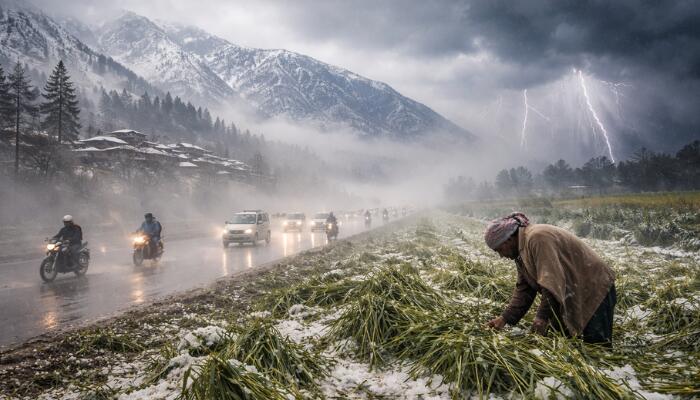
Back-to-back western disturbances have extended winter conditions into late March across northern and central India, bringing fresh snowfall in the hills, dense fog in the plains, and widespread rain that is disrupting daily life and damaging crops. The India Meteorological Department has attributed this unusual spell to a series of strong weather systems arriving in quick succession, later than typically expected.
For many across North India, March is no longer behaving like March. Instead of the usual transition towards summer, large parts of the region are experiencing conditions more typical of peak winter. Snow has returned to the hills, fog has reappeared across the plains, and steady rain accompanied by occasional hail has unsettled both cities and rural landscapes.
Temperatures have dipped sharply in several states, including Delhi, Rajasthan, Uttar Pradesh and Madhya Pradesh, in some areas falling nearly 10 degrees Celsius below the seasonal average. Moisture-laden air combined with low wind speeds has allowed fog to persist well beyond its usual winter window, reducing visibility, delaying trains and slowing road traffic during peak hours.
Meteorologists say the explanation lies in the behaviour of western disturbances, weather systems that originate near the Mediterranean and typically shape North India’s winter weather. This year, not only have these systems been more frequent, but they have also remained active later into March. Hill states such as Jammu and Kashmir, Himachal Pradesh and Uttarakhand have recorded fresh spells of snowfall, while the plains continue to face repeated rounds of thunderstorms, lightning and gusty winds.
The timing has proven particularly difficult for farmers. In several parts of Rajasthan and neighbouring regions, unseasonal rain and hail have struck standing rabi crops just as the harvest season approaches. Wheat and pulses, which are especially sensitive to excess moisture at this stage, are at risk of both yield and quality losses. Even brief spells of hail or strong winds can flatten crops, leaving farmers anxious after months of investment and labour.
Urban life has also slowed under the weight of this extended winter. Late-season fog has reduced visibility on roads and disrupted rail schedules, while intermittent rain has made daily commuting unpredictable. In parts of Madhya Pradesh, thunderstorms and strong winds have added to the disruption, while Uttar Pradesh has reported widespread rain and hail, prolonging the chill across the region.
The unusual weather has also prompted a broader question: is nature correcting itself, or is this a sign of deeper climatic shifts? Experts caution against viewing the pattern as a simple reset. Instead, they point to increasing variability in weather systems, where once predictable seasonal cycles are becoming less reliable. Extended winters, sudden temperature drops, and unseasonal rainfall are now occurring more frequently.
For now, forecasts suggest that these unsettled conditions may persist through the end of March. For those waiting for the certainty of summer, the changing skies are a reminder that the rhythm of the seasons may no longer be as dependable as it once was.