
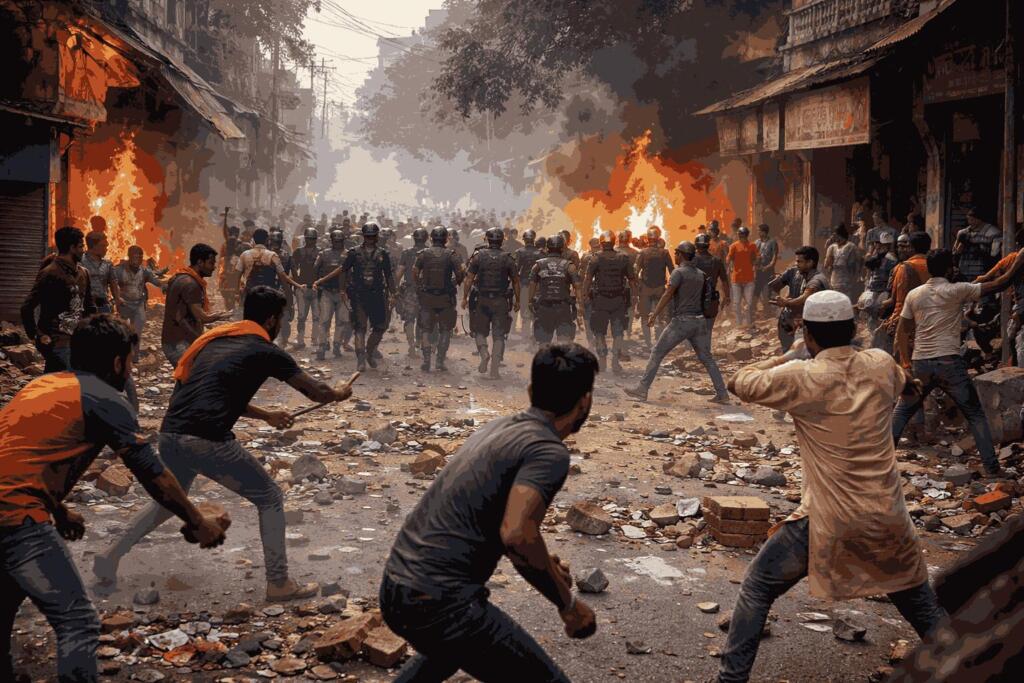
Tensions flared once again in eastern India as West Bengal violence erupted in the Jangipur area of Murshidabad district during a Ram Navami procession, highlighting persistent fault lines that continue to surface during religious events. The incident, which unfolded on March 27, 2026, quickly escalated from a local altercation into a broader clash involving two groups, prompting a heavy police response and raising concerns about law and order in sensitive regions.
According to multiple reports, the West Bengal violence began when a Ram Navami procession passed through a locality in Jangipur and an altercation broke out. What started as a dispute soon spiralled into stone-pelting between groups, creating panic and chaos in the area. Authorities confirmed that several shops and public properties were damaged during the clashes, underlining the intensity of the confrontation. (www.ndtv.com)
The situation worsened rapidly, forcing police and central forces to intervene. A lathi charge was carried out to disperse the crowd and regain control. At least 15 people were reported injured in the violence, indicating the seriousness of the incident and the scale at which it unfolded. The administration moved swiftly to deploy additional forces, including units of the Rapid Action Force, to prevent further escalation and maintain order.
In the immediate aftermath of the West Bengal violence, prohibitory orders were imposed in parts of the Jangipur police district, including Raghunathganj. Officials stated that the situation is now under control, with continuous patrolling and route marches being conducted to reassure residents and deter any further unrest. Authorities also initiated arrests and raids targeting individuals suspected of involvement in the clashes.
Eyewitness accounts and preliminary reports suggest that the trigger for the West Bengal violence was linked to tensions during the procession route, a recurring flashpoint in several such incidents across the country. Officials noted that the altercation intensified quickly, with both sides engaging in stone-pelting, leading to injuries and property damage. The speed at which the situation deteriorated underscores the fragile nature of communal harmony in certain pockets.
The incident has also drawn political reactions. Some leaders alleged that the West Bengal violence may have been pre-planned, while others called for strict administrative action against those responsible. At the same time, local authorities and civic leaders have appealed for calm, urging residents not to fall prey to rumours or provocations that could inflame tensions further.
Importantly, this is not an isolated occurrence. Murshidabad district has witnessed multiple episodes of unrest in recent years, often linked to religious processions or legislative controversies. Past incidents have involved stone-pelting, arson, and large-scale displacement, pointing to a pattern that raises deeper questions about governance, policing, and community relations. The recurrence of such disturbances adds context to the latest West Bengal violence, suggesting underlying issues that remain unresolved.
Security arrangements across West Bengal had already been heightened ahead of Ram Navami celebrations, with authorities anticipating potential flashpoints. Despite these precautions, the outbreak of West Bengal violence in Jangipur indicates gaps in preventive measures and intelligence gathering. It also reinforces the need for coordinated efforts between local administration, law enforcement, and community leaders to ensure peaceful observance of religious events.
As normalcy gradually returns to the affected areas, the focus now shifts to accountability and prevention. Investigations are underway to identify those responsible, and officials have reiterated their commitment to taking strict legal action. However, beyond immediate enforcement, the incident raises broader concerns about maintaining communal harmony in a diverse and densely populated state.
The latest episode of West Bengal violence serves as a stark reminder of how quickly tensions can escalate when underlying distrust and provocations intersect with public gatherings. While the situation in Murshidabad is currently under control, the challenge for authorities lies in ensuring that such incidents do not recur—and that festivals meant for celebration do not become triggers for conflict.