
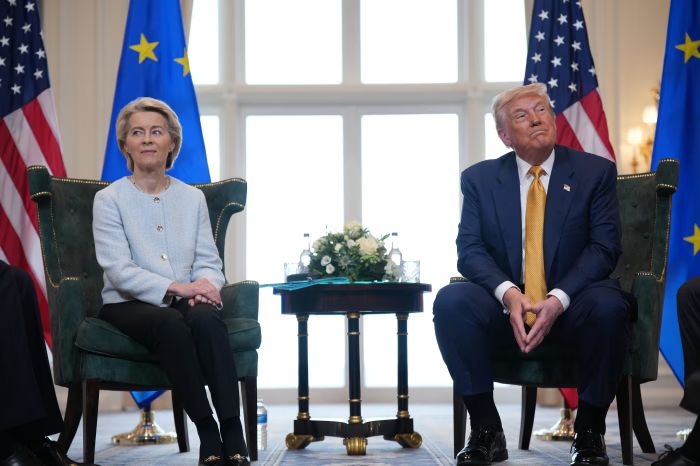
Tensions between the United States and the European Union have escalated after Washington hinted that Europe could lose favorable access to American energy supplies if it fails to ratify a key transatlantic trade agreement. The warning comes at a critical time, as European lawmakers prepare to vote on the deal later this week.
Since reducing imports of Russian fossil fuels, the European bloc has increasingly turned to American liquefied natural gas (LNG) to meet its energy needs. Countries like Germany have become particularly dependent, with reports indicating that the vast majority of their LNG imports now originate from the United States.
This shift has raised concerns about long-term energy security and pricing. Critics argue that replacing relatively cheaper Russian pipeline gas with US LNG has significantly increased costs for European industries and consumers alike.
The situation has been further complicated by geopolitical instability in the Middle East, particularly tensions involving Iran, which have contributed to global energy price volatility. As a result, Europe finds itself navigating a complex and increasingly expensive energy landscape.
Political Divisions Within the EU
The looming vote in the European Parliament has exposed divisions within the EU. While some policymakers support the deal as a necessary step to strengthen transatlantic ties and ensure energy security, others have voiced concerns over its economic implications.
Critics argue that the agreement disproportionately favors the United States by imposing tariffs on European exports while granting American goods easier access to EU markets. Additionally, the massive energy purchase commitment has been described by some lawmakers as a strategic overreach that could lock Europe into long-term dependency.
At the same time, there are growing calls within parts of Europe to reconsider the bloc’s stance on Russian energy. However, the European Commission has reaffirmed its plan to completely phase out Russian fossil fuel imports by 2027, despite mounting economic pressures.
Moscow’s Response and Global Implications
Officials in Russia have been quick to criticize the EU’s energy strategy. Kirill Dmitriev warned that Europe could face an “energy price tsunami” due to what he described as misguided policies. He also indicated that Russia has redirected its energy exports toward other markets, potentially leaving Europe at a disadvantage in the future.
The broader implications of the situation extend beyond Europe. The evolving dynamic highlights how energy has become a powerful geopolitical tool, with major players leveraging supply chains to achieve strategic objectives.
A Defining Moment for Transatlantic Relations
As the European Parliament prepares to cast its vote, the outcome could have far-reaching consequences for both economic and geopolitical relations between the US and EU.
Approval of the deal would likely solidify the United States’ position as Europe’s primary energy supplier, while rejection could introduce uncertainty into an already fragile energy market.
Ultimately, the situation underscores a critical reality: in today’s interconnected world, energy security and trade policy are deeply intertwined. The decisions made in Brussels this week may not only shape Europe’s economic trajectory but also redefine the balance of power in global energy politics.