
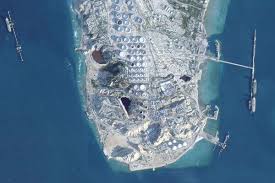
U.S. forces launched heavy airstrikes on Iran’s Kharg Island, hitting military installations while sparing the nation’s crucial oil infrastructure. The strikes mark a sharp escalation in the West Asia conflict and have sent global energy markets into turbulence, highlighting the irreplaceable role of the island in Iran’s oil exports.
Kharg Island: Small Size, Massive Impact
Despite covering only 20 square kilometres, Kharg Island controls nearly 90–95 percent of Iran’s crude exports. Situated 28 kilometres off Bushehr province in the northern Persian Gulf, the rocky limestone island stretches eight kilometres long and five kilometres wide. Its isolation inspired celebrated Iranian writer Jalal Al-e-Ahmad to call it the “Orphan Pearl of the Persian Gulf,” a symbol of both its solitude and immense value. Former U.S. President Donald Trump labelled it Iran’s “crown jewel,” underscoring its strategic and economic significance.
The island hosts storage tanks, deep-water berths, loading terminals, and a network of pipelines connecting major oil fields, including Ahvaz, Marun, and Gachsaran. Offshore fields including Aboozar, Forouzan, and Dorood supply crude to Kharg via subsea pipelines, which feed storage facilities holding around 30 million barrels. Analysts warn that even minor disruptions could choke Iran’s oil exports, sending Brent crude prices soaring above $100 per barrel.
A Historic Island Amid Industrial Dominance
Kharg is more than an industrial hub. It houses the 7th-century Mir Mohammad Shrine, Achaemenid inscriptions at Mir Aram Shrine, Zoroastrian burial sites, Christian graves, Sassanid-era tombs, and the remains of a Dutch fort from 1747. This blend of cultural and industrial significance makes the island a unique yet high-stakes target.
Targeted Strikes, Strategic Warning
U.S. airstrikes hit radar installations, air defence systems, and posts tied to the Islamic Revolutionary Guard Corps. Donald Trump stated, “For reasons of decency, I have chosen NOT to wipe out the Oil Infrastructure on the Island… but [we] could hit oil infrastructure next if Tehran keeps disrupting energy flows.” The remark signals that Kharg’s energy facilities remain a potential target if tensions escalate further.
Global Oil Markets on Alert
The attack has triggered immediate volatility in oil markets. Iran normally exports around 1.7 million barrels per day, and any disruption at Kharg could remove much of that supply. The Strait of Hormuz, through which 20 percent of global oil passes, has already faced partial disruptions, raising fears of prices reaching $120–$150 per barrel. Analysts from JP Morgan and Pickering Energy Partners warn that damaging Kharg’s specialised terminals could delete two million barrels per day from global supply, keeping energy markets on edge.
Iran has warned of retaliation against regional energy infrastructure, potentially targeting Saudi Arabia or the United Arab Emirates. For now, the world watches Kharg Island closely, a small island with a giant impact, as the Gulf teeters on the edge of a wider energy and geopolitical crisis.