
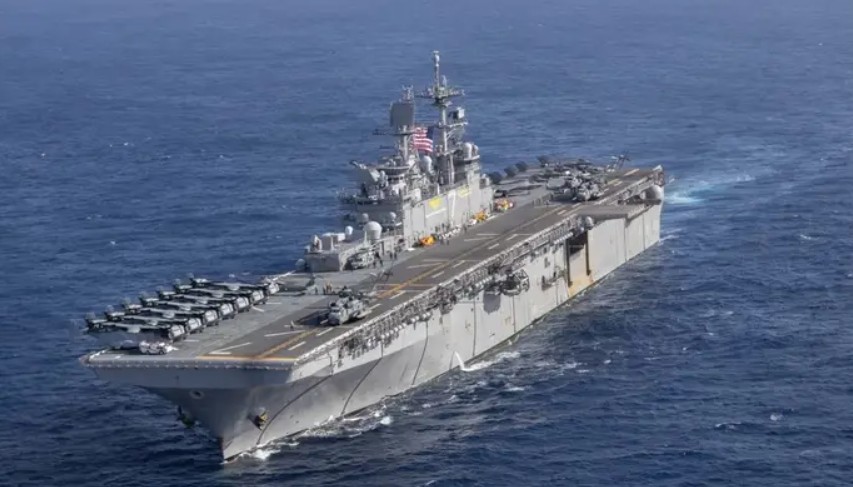
The US Navy’s massive amphibious assault ship, USS Tripoli, is set to enter the warzone in the North Arabian Sea, potentially altering the dynamics of the ongoing US-Israel-Iran conflict and challenging Iran’s chokehold over the strategic Strait of Hormuz.
According to media reports, the 50,000-ton ship, carrying over 2,000 marines from the 31st Marine Expeditionary Unit (MEU), could play a key role in ensuring freedom of navigation through the vital oil corridor, which has been under threat since hostilities began on February 28.
Currently south of Sri Lanka in the southern Indian Ocean, USS Tripoli is on course to join the USS Abraham Lincoln carrier strike group in the Gulf of Oman, expected to enter the war theatre around March 22–23.
At 844 feet long, the ship is equipped with F-35 fighter jets, MV-22 Osprey tiltrotors, MH-60S Seahawk helicopters, and landing ship decks (LSDs) capable of deploying Marines directly on enemy territory.
USS Tripoli’s Role in the Gulf Conflict
The direction of the ongoing war may hinge on the deployment of USS Tripoli, with a strong possibility that it could be used to secure the Strait of Hormuz for international oil shipping.
At just 33 kilometers wide at its narrowest point, the strait allows Iran to exert significant control over shipping and manipulate global oil prices. Ensuring free navigation in the region is a critical interest not only for the US but for the global energy market.
While the possibility of US troops landing in the Persian Gulf seems high, the exact course of action will depend on evolving threats, including Iranian missile, drone, and attack craft activity targeting shipping.
One scenario includes a US-led coalition operating under the UN flag to secure the strait, while another involves Marines landing on Iran’s Kharg Island to control oil storage and ensure uninterrupted shipping. The US has already targeted Iranian naval, missile, drone, and artillery positions along the Persian Gulf coast, including Kharg Island.
Strategic and Economic Implications
President Trump has kept options open regarding troop deployment. “No, I’m not putting troops anywhere … If I were, I certainly would not tell you, but I am not putting troops,” he told reporters, underscoring the fluid nature of the situation.
Meanwhile, India is actively engaging with Gulf nations and Europe to seek an early resolution while ramping up domestic LPG production to nearly 38 percent to cushion the impact on consumers and industry.
With Tehran showing no signs of backing down, the US may be left with limited options to challenge Iran’s control of the Strait of Hormuz. Experts warn that a full closure could trigger a global energy crisis, making a decisive intervention crucial for international stability.
The arrival of USS Tripoli could mark a pivotal moment in ensuring the strait remains open and preventing a potential spike in oil and petroleum product prices.