
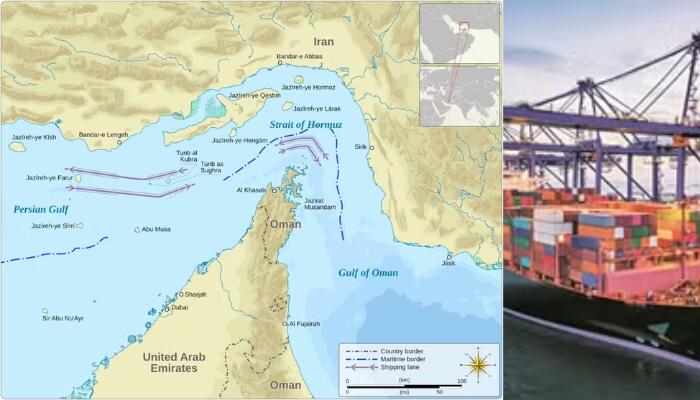
Growing tensions in West Asia have renewed international concern over the security of the Strait of Hormuz, a narrow maritime passage that carries a large share of the world’s oil supply each day. The possibility of instability in the region has unsettled global energy markets and drawn fresh attention to the strategic importance of this vital shipping corridor.
The Strait of Hormuz links the Persian Gulf with the Gulf of Oman, which opens into the Arabian Sea. The waterway lies between Iran to the north and the Musandam Peninsula belonging to Oman to the south. Despite its narrow width, the route handles an enormous volume of energy shipments and is widely recognised as the most important oil chokepoint in the global energy system.
Energy estimates indicate that roughly one-fifth of global petroleum liquids consumption passes through the strait every day. In practical terms, that amounts to close to 20 million barrels of crude oil and petroleum products transported through the corridor daily. The heavy concentration of tanker traffic in such a confined waterway means that even minor disruptions can quickly affect international supply chains.
Recent geopolitical tensions involving Iran, Israel and the United States have heightened fears that military escalation or shipping disruptions could threaten oil flows through the strait. Energy markets have reacted sensitively to these developments, with crude prices responding sharply to shifts in the regional security environment. Analysts warn that prolonged instability could push prices higher and intensify inflationary pressures across the global economy.
A Strategic Artery of Global Oil Trade
The significance of the Strait of Hormuz lies not only in its geography but also in the scale of energy transport that depends on it. Oil exports from major Gulf producers, including Saudi Arabia, Iraq and the United Arab Emirates, travel through the strait before reaching energy markets in Asia, Europe and beyond.
Because there are limited alternative routes capable of handling comparable volumes of crude shipments, the strait remains a critical artery for global trade. Shipping companies, insurers, and policymakers closely monitor developments in the region, aware that even short interruptions could tighten global supply and trigger volatility in energy prices.
Implications for India’s Energy Security
For India, developments around the Strait of Hormuz carry direct economic consequences. The country imports roughly 85 per cent of its crude oil requirements, and a significant share of these imports originates from Gulf producers whose shipments pass through the strait before reaching Indian refineries.
Oil from suppliers such as Saudi Arabia, Iraq and the United Arab Emirates forms an essential component of India’s energy supply. Any disruption to tanker movement in the region could increase India’s energy import bill and place pressure on domestic fuel prices upward.
Higher crude prices also carry broader macroeconomic implications. They can widen the country’s current account deficit, contribute to inflation and complicate fiscal planning at a time when governments attempt to balance economic growth with price stability.
Geopolitics and the Fragility of Energy Supply
The renewed focus on the Strait of Hormuz highlights the deep connection between geopolitics and the global economy. Conflicts in strategically sensitive regions can rapidly ripple through international trade networks, financial markets and energy systems.
As tensions in West Asia continue to evolve, governments and energy planners around the world are watching developments closely. For energy-dependent economies such as India, the situation serves as a reminder that instability in distant maritime corridors can quickly translate into economic challenges at home.