
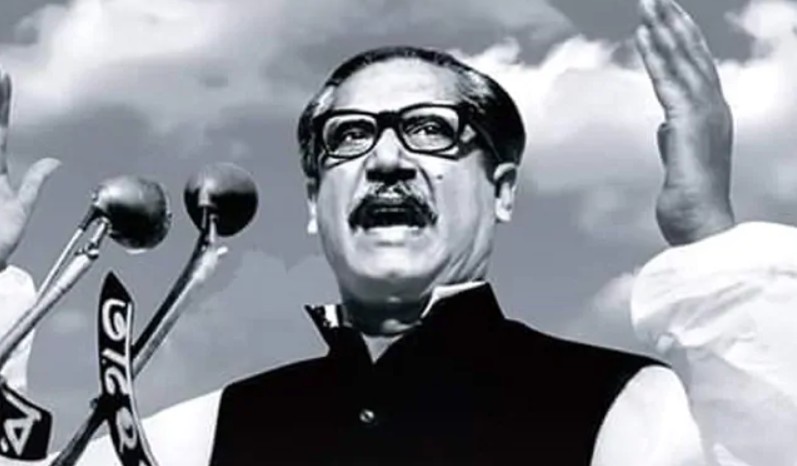
On March 7, 1971, more than a million Bengalis packed Dhaka’s Ramna Race Course, now Suhrawardy Udyan still raw from the Pakistani military’s recent killings. Dhaka’s streets had barely dried from the blood spilled in the February shootings at Dhaka University.
Standing before that vast, grief-stricken crowd, Sheikh Mujibur Rahman said what everyone already felt in their bones–“This time the struggle is for our freedom, this time the struggle is for our Independence.”
He told people to turn their homes into fortresses. He told government workers to take orders from no one but him. He called for hartals and refusal to pay taxes, essentially setting up a government of his own inside East Pakistan.
The speech is today recognised by UNESCO as part of the world’s documentary heritage. More than that, it was the moment that pointed Bangladesh toward the Liberation War that would, nine months later, make it a free country.
Backdrop of Pakistani Massacres
To understand why that speech hit the way it did, you have to understand what had already happened. The Awami League had just won 167 of 169 seats in East Pakistan’s 1970 elections.
Bengalis were the majority population. By every measure, power should have passed to them. The West Pakistani establishment refused to accept it. When Yahya Khan’s government postponed the National Assembly session on March 1, it confirmed what many already suspected, that no election result was ever going to be honoured.
What followed wasn’t spontaneous anger. It was organised. Intellectuals, students and Hindus were being targeted in what would later be understood as the groundwork for Operation Searchlight. Mujib’s speech wasn’t a pep rally.
It was effectively a declaration of independence, laying out 14 conditions while making clear that his people were preparing for something much larger. When he ended with “Joy Bangla,” the crowd understood. The memory of those recent killings was still too fresh for it to mean anything less.
Escalation of Atrocities in 1971
On the night of March 25, the Pakistan Army dropped any remaining pretence and launched a full-scale military campaign against its own civilian population. The International Commission of Jurists and Time magazine both placed it among the worst atrocities of the twentieth century.
In Dhaka alone, estimates put the death toll for that single night at between 25,000 and 30,000 people. Across Bangladesh, the numbers range from 300,000 in Pakistan’s own accounting to 3 million according to Bangladeshi records. Between 200,000 and 400,000 women were raped. These weren’t collateral casualties, they were the point.
The Mukti Bahini guerrillas fought back as hard as they could, fuelled in large part by Mujib’s call to resist. But the Pakistan Army had local help the Razakars, Bengalis who collaborated and pointed fingers at their own neighbours.
The mass graves at Jinjira, Mirpur and Chuknagar are still there. Ten million people crossed into India rather than stay and face what was coming. India eventually intervened directly, and by December 16 it was over. Bangladesh was free.
Fading Memory of Sheikh Mujib’s Legacy
Something uncomfortable is happening in Bangladesh today. The generation that is now driving the country’s political energy the young people who led the 2025 protests, who get their information from social media, largely doesn’t feel connected to 1971.
Many of them see the history of that period, including Mujib’s speech, as government propaganda rather than something that actually happened to real people. Textbooks sit unopened. TikTok trends ridicule the era’s sacrifices. Politicians focus on who’s useful now, not on who killed whom fifty years ago.
The Mukti Bahini veterans are dying. Most of them never received the recognition they deserved, and their stories are disappearing with them. Mujib’s idea of Sonar Bangla, a golden Bengal, feels almost quaint now. The roar of that speech has become background noise, something mentioned in official ceremonies and largely ignored everywhere else.
Growing Ties with Pakistan Post-1971
In August 2025, Pakistan’s Foreign Minister Ishaq Dar flew to Dhaka. It was the first visit of its kind in over a decade. Trade agreements were signed. Diplomatic visa arrangements were made. Several institutional cooperation deals were formalised.
Around the same time, Pakistani defence delegations were making their own visits, including officials from Heavy Industries Taxila, who sat down with Bangladesh Army Chief Waker Uz Zaman to discuss arms cooperation.
Pakistan’s ISI sent a delegation too, and talks began on intelligence-sharing. There are now negotiations in progress over the potential sale of JF-17 Thunder fighter jets and trainer aircraft to Bangladesh.
These are facts worth sitting with. The country that carried out a genocide against Bangladesh is now being courted as a defence partner. And the conversation in Bangladesh is, for the most part, not about the contradiction.
Generational Shifts and Amnesia
Part of what makes this possible is that younger Bangladeshis simply don’t know or don’t feel the history the way older generations did. Some Gen Z protesters have taken up the chant “India Out,” which happens to be exactly the kind of rhetoric Pakistan has always been happy to encourage.
It glosses over an inconvenient reality: India sheltered 10 million Bangladeshi refugees in 1971 and helped capture nearly 93,000 Pakistani soldiers. Without India’s intervention, the outcome of that war is not certain.
Meanwhile, Jamaat-e-Islami, banned after independence because its members collaborated with the Pakistani military has made its way back into parliament as an opposition party.
Mujib had envisioned a secular, progressive Bangladesh. After his assassination in 1975, leaders like Hussain Muhammad Ershad began dismantling the constitutional and political framework that reflected that vision, opening the door to Islamist politics and, eventually, to a warming of ties with the very country that tried to destroy Bangladesh.
Call for Justice and Remembrance
Sheikh Mujib spoke on March 7, 1971, with Pakistani guns already pointed at his people. What he said that day mattered — it still matters. But remembering it requires actual effort, not just annual ceremonies.
People have real expectations of BNP and Tarique Rahman to lead that effort honestly. Schools need to teach what actually happened in 1971, without softening it for political convenience.
Real memorials need to be built, not grand structures that nobody visits, but places that tell the truth. “Joy Bangla” should mean something more than a slogan at a rally.
The deals being signed with Pakistan are not just diplomatic transactions. They are a statement about what Bangladesh has decided to forget. A country that cannot face its own history clearly is a country that will keep repeating the mistakes that history warns against.