
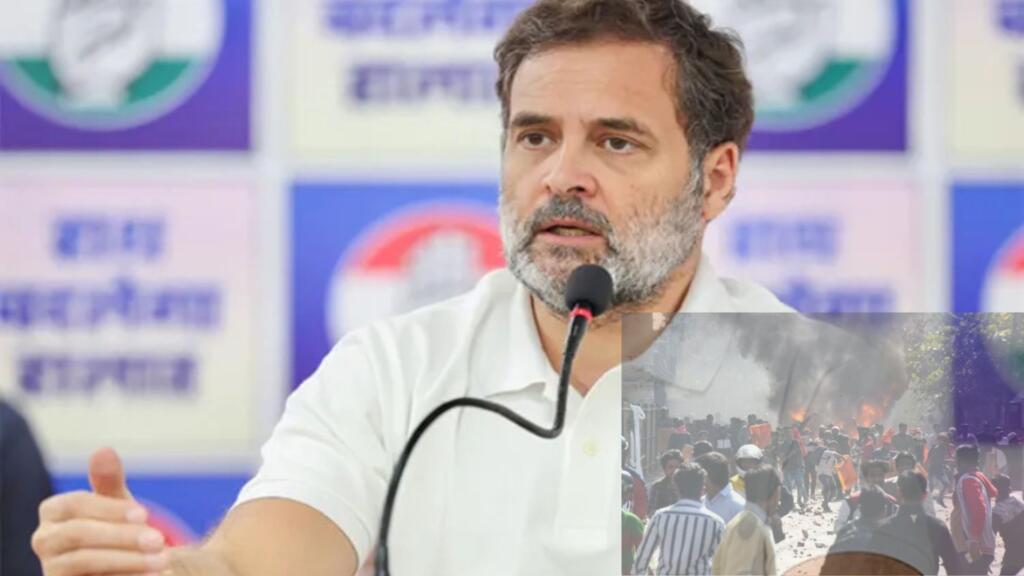
The recent remarks by Rahul Gandhi on the violence in Uttam Nagar have ignited a fierce political debate, with critics accusing him of attempting to reshape the narrative to suit a broader agenda. In a tweet written in Hindi, Rahul Gandhi spoke about the tragic loss of a young man named Tarun and the suffering of a family allegedly facing harassment. However, detractors argue that Rahul Gandhi’s intervention was less about empathy and more about advancing a carefully crafted political message.
According to Rahul Gandhi’s statement, the people of Uttam Nagar have “paid a heavy price” due to the violence, emphasizing that neither further bloodshed nor communal tensions are desired by ordinary citizens. Yet, critics point out that Rahul Gandhi quickly shifted the blame toward the ruling establishment, accusing the BJP and its ecosystem of fostering hatred and benefiting from unrest. This framing, they argue, deliberately simplifies a complex situation while portraying one side exclusively as aggressors.
The controversy deepens when examining how Rahul Gandhi positioned the victims and perpetrators. By highlighting selective aspects of the incident, Rahul Gandhi is being accused of presenting a narrative that, in the eyes of his opponents, attempts to cast certain groups as victims while downplaying or ignoring other dimensions of the violence. This, critics claim, reflects a broader pattern of political messaging aimed at consolidating specific voter bases.
Another significant aspect of the criticism revolves around what many describe as an attempt by Rahul Gandhi to appeal to minority sentiments. His emphasis on unity, brotherhood, and love—while seemingly universal values—has been interpreted by detractors as part of a larger strategy of Muslim appeasement politics. They argue that Rahul Gandhi’s rhetoric often aligns with a narrative that seeks to position minority communities as under threat, thereby mobilizing political support through fear and identity.
Furthermore, Rahul Gandhi’s tweet linked the violence to larger national issues, including defense, energy security, food security, and strategic sovereignty. He suggested that the government benefits from keeping the country divided along religious lines so that these critical questions are not raised. Critics, however, contend that this leap from a localized incident to national policy failures is indicative of an attempt to politicize tragedy rather than address its root causes.
The timing of Rahul Gandhi’s statement has also drawn scrutiny. Coming amid heightened political tensions, his remarks are seen by opponents as an effort to seize the narrative quickly and influence public perception. By doing so, Rahul Gandhi is accused of reinforcing a narrative that aligns with his party’s ideological positioning while simultaneously attacking the credibility of the government.
Supporters of Rahul Gandhi, on the other hand, argue that his call for unity—“Jodo Jodo, Bharat Jodo”—is consistent with his broader political campaign emphasizing harmony and inclusivity. They maintain that highlighting communal harmony in times of tension is not only appropriate but necessary. However, critics remain unconvinced, asserting that such messaging often comes packaged with selective outrage and strategic omissions.
The Uttam Nagar incident, therefore, has become more than just a local law-and-order issue. It has evolved into a battleground for competing political narratives, with Rahul Gandhi at the center of the storm. His critics insist that his portrayal of events risks distorting reality, while his supporters view him as a voice advocating peace and accountability.
Ultimately, the debate underscores a larger question about political discourse in India: how tragedies are interpreted, framed, and used in the public sphere. Whether Rahul Gandhi’s remarks were a genuine appeal for unity or a calculated political move remains a matter of perspective. What is clear, however, is that such interventions continue to shape public opinion and deepen the divide in an already polarized environment.