
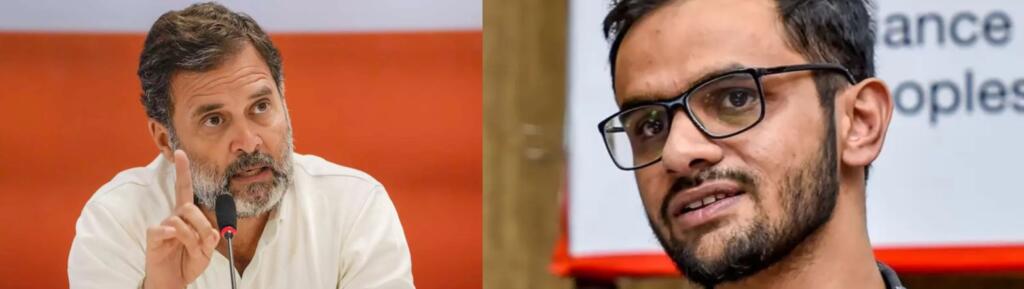
The name Umar Khalid has once again entered India’s political spotlight, as fresh demands emerge for his nomination to the Rajya Sabha. The controversy surrounding Umar Khalid has intensified following appeals from several Muslim organisations in Rajasthan urging the Congress party to consider his candidature for the Upper House. This development has triggered a wider debate on political representation, legal accountability, and the evolving nature of identity-based politics in India.
At the heart of the issue lies a formal appeal made to Congress leadership, highlighting what these groups describe as a lack of Muslim representation in Parliament from Rajasthan. According to reports, organisations argued that nominating Umar Khalid would signal a commitment to constitutional values and inclusive politics. They pointed out that Muslims constitute a notable share of the state’s population but currently have little to no representation in the Rajya Sabha from the region. (OpIndia)
However, the demand has not been without controversy. Umar Khalid, a former student leader from Jawaharlal Nehru University, has been in judicial custody since 2020 in connection with the Delhi riots case. His legal situation remains a subject of intense public and political debate. While supporters portray Umar Khalid as a vocal activist and advocate for civil liberties, critics question the appropriateness of elevating an individual facing serious legal charges to a legislative position.
The timing of the demand is also politically significant. With multiple Rajya Sabha seats from Rajasthan set to fall vacant in 2026, political parties are carefully calculating their choices. The indirect election system for the Rajya Sabha, where Members of Legislative Assemblies cast votes, adds another layer of strategic decision-making. (Wikipedia) In this context, the proposal to nominate Umar Khalid has become not just a question of representation, but also a test of political messaging.
Supporters of the move emphasize the importance of representation in a लोकतांत्रিক framework. They argue that Umar Khalid’s nomination could help address longstanding concerns about minority underrepresentation in national politics. Some have also framed the demand as recognition of the electoral support extended by Muslim voters to the Congress party in recent elections. (National Herald) For them, Umar Khalid represents a broader aspiration for political inclusion.
On the other hand, critics argue that such a move could send a controversial signal, particularly given the unresolved legal proceedings. The association of Umar Khalid with the 2020 Delhi riots case continues to shape public perception. Opponents contend that elevating a figure embroiled in such allegations could raise questions about standards of public office and accountability.
The debate also reflects a deeper ideological divide in Indian politics. For some, Umar Khalid symbolizes dissent and resistance against state policies, particularly during the protests against the Citizenship Amendment Act. For others, his name is linked to contentious events that have left lasting scars on the social fabric. This dual perception makes Umar Khalid a highly polarizing figure, capable of evoking strong reactions across the political spectrum.
Beyond the immediate controversy, the issue raises broader questions about the intersection of law, politics, and identity. Should political representation prioritize community demands, even when the individual concerned is facing legal scrutiny? Or should legal accountability take precedence over symbolic representation? These are questions that extend far beyond the case of Umar Khalid and touch upon the core principles of democratic governance.
The Congress party now finds itself in a delicate position. Accepting the demand could strengthen its outreach among certain voter groups, but it may also invite criticism from opponents and sections of the public. Rejecting it, on the other hand, could risk alienating segments that seek greater representation. In this balancing act, Umar Khalid has become more than just an individual—he is now a symbol of competing political narratives.
As the Rajya Sabha elections approach, the controversy surrounding Umar Khalid is likely to intensify. The outcome will not only determine his political future but may also influence how parties navigate the complex terrain of representation, accountability, and public perception.
In conclusion, the debate over Umar Khalid underscores the evolving dynamics of Indian politics, where identity, law, and electoral strategy intersect in increasingly complex ways. Whether or not Umar Khalid ultimately enters Parliament, the discussion itself highlights the challenges of reconciling democratic ideals with political realities.