
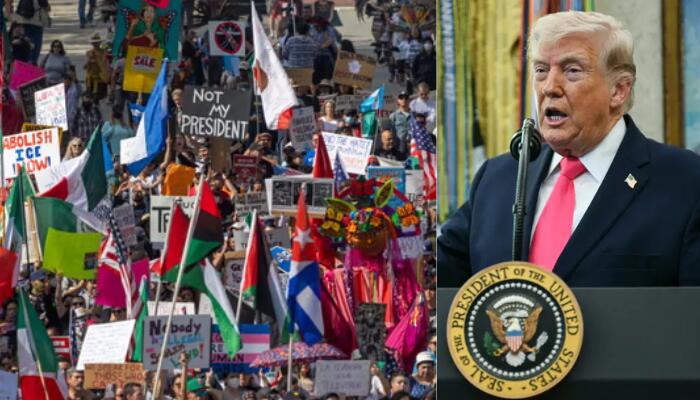
Large-scale “No Kings” protests took place across the United States and parts of Europe, with thousands of people gathering to express opposition to President Donald Trump’s policies, including the war in Iran, federal immigration enforcement, and the perceived expansion of executive authority.
The demonstrations, described by organisers as the third iteration of the movement, were held in more than 3,100 locations across all 50 states. Major cities such as New York, Washington DC, Los Angeles, Boston, Nashville and Houston saw significant turnout, while smaller towns also reported sizeable gatherings. Minnesota emerged as a focal point, where thousands assembled at the State Capitol in St Paul.
The Minnesota rally followed the deaths of two American citizens, Renee Nicole Good and Alex Pretti, who were shot by federal immigration agents earlier this year. Their deaths have contributed to ongoing criticism of immigration enforcement practices under the Trump administration.
Musician Bruce Springsteen performed at the St Paul event, including his song “Streets of Minneapolis,” which was written in response to the incident. Public figures such as Robert De Niro, Joan Baez, Jane Fonda and Senator Bernie Sanders also attended. Protesters displayed banners and signs addressing a range of issues, including immigration, governance and civil liberties.
Nationwide demonstrations largely peaceful with isolated incidents
In Washington DC, protesters marched from the Lincoln Memorial to the National Mall, carrying placards and chanting slogans associated with the movement. In New York City, large crowds gathered in Times Square and marched through Midtown Manhattan, prompting road closures.
While organisers stated that the protests were largely peaceful, some cities reported incidents. In Los Angeles, clashes occurred near a federal detention facility after objects were thrown at law enforcement personnel. Authorities used non-lethal measures, including tear gas, to disperse crowds, and arrests were made. The Department of Homeland Security reported that officers were injured during the confrontation. Additional arrests were reported in Dallas following minor altercations involving counter-protesters.
Several states mobilised National Guard units as a precaution, although no widespread unrest was reported.
Political responses reflect sharp divisions
The protests drew criticism from Republican leaders. White House spokesperson Abigail Jackson characterised the demonstrations as lacking broad public support and referred to them as “Trump Derangement Therapy Sessions”. The National Republican Congressional Committee also criticised the protests, describing them as platforms for extreme views.
Organisers, however, stated that the demonstrations were intended to raise concerns about policy decisions and governance. They cited issues such as rising living costs, immigration enforcement measures, and the use of executive powers as key motivations behind the protests.
President Trump has defended his actions, stating that they are necessary to address national challenges. He has rejected accusations that his leadership style resembles authoritarian rule.
Demonstrations extend beyond US borders
Protests were also reported in several international cities. In London, demonstrators carried signs opposing far-right politics and racism. In Paris, several hundred people, including American expatriates, gathered at the Bastille. In Rome, protests included criticism of domestic political leadership alongside opposition to military actions related to Iran.
The scale and geographic spread of the demonstrations indicate sustained mobilisation around political and policy concerns, with organisers suggesting that further protests may follow.