
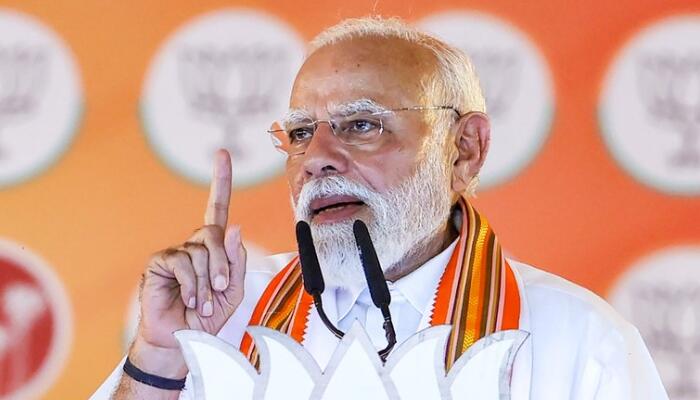
Prime Minister Narendra Modi mounted an aggressive political offensive in Kerala, accusing the CPI(M)-led Left Democratic Front and the Congress-led United Democratic Front of perpetuating a cycle of corruption that has, he said, kept the state “trapped” for decades. Addressing a charged rally ahead of the 9 April polls, he declared that the BJP-led National Democratic Alliance is no longer on the margins but emerging as Kerala’s only viable governing alternative.
Projecting confidence, Modi asserted that the NDA would form the next government in the state, a significant claim in a region where the BJP has struggled electorally for nearly four decades. He said the political atmosphere in Kerala was undergoing a visible transformation, marked by growing support among youth, women, and farmers, whom he described as increasingly aligning with the BJP and the NDA.
A Direct Challenge to Kerala’s Two-Front Dominance
Sharpening his critique, Modi alleged that the LDF and the UDF have operated within a tacit arrangement, alternating power while allowing corruption to continue unchecked. “For a few years the LDF runs the government and fills its pockets, and after that the UDF comes and continues the loot,” he said, arguing that such a pattern has denied Kerala genuine progress.
Turning to the frequent accusations traded between the two alliances, he said both sides branding each other as the BJP’s “B-team” only reinforces that the BJP is the “real A-team” in Kerala’s political contest. He added that the intensity of attacks against the BJP reflects fear, claiming that both alliances are wary of the exposure of past wrongdoing if the NDA comes to power.
Allegations of Debt Burden and Corruption
Escalating his attack, Modi said Kerala’s public debt has crossed Rs 5 lakh crore and has risen more than threefold over the past decade under the Left government. He questioned where the money had gone, alleging that it had benefited political leaders rather than the public.
He promised that an NDA government would investigate every major scam linked to both the LDF and the UDF, recover the “looted” money and redirect it towards development. Modi also highlighted that Kerala has received significantly higher central assistance under the NDA government compared with previous Congress-led regimes.
Congress–Left Nexus Beyond Kerala
Seeking to expose what he described as political opportunism, Modi pointed out that the Congress and the Left are allies in several states, including Bihar, Jharkhand, Andhra Pradesh, Manipur, Tripura, Assam and Tamil Nadu, while presenting themselves as rivals in Kerala. He cautioned voters against what he termed this “double standard”, urging them to remain vigilant.
Development Push and Local Connect
Shifting focus to development, Modi underscored key projects in Palakkad, including the establishment of Kerala’s first IIT, railway station upgrades, highway modernisation and the development of a smart industrial city. He said the region had not witnessed adequate progress under previous representatives.
Highlighting cultural ties, he referred to the Kalpathy Temple, often compared with Kashi, noting his own association as a Member of Parliament from Varanasi and framing it as a shared heritage link.
Women’s Safety and Governance
The Prime Minister also raised concerns over women’s safety, citing recent allegations involving Congress leaders, including Palakkad MLA Rahul Mamkootathil, and another case involving a party councillor. He said such incidents reflect a broader failure of governance and accountability.
Emphasising the NDA’s focus on women-led development, he pointed to initiatives in financial inclusion, healthcare and housing, along with the passage of the Nari Shakti Vandan Act to enhance women’s representation in legislatures.
Decisive Moment for Kerala Politics
Recalling the previous Assembly election, Modi noted that BJP candidate E Sreedharan had finished second in Palakkad, describing the outcome as disappointing. He urged voters to rally behind BJP candidate Shobha Surendran, positioning the upcoming election as a decisive moment for change.
With a calibrated mix of sharp political attack and development messaging, Modi’s address sought to redefine Kerala’s electoral battle as a clear choice between entrenched power structures and a new political alternative led by the NDA.