
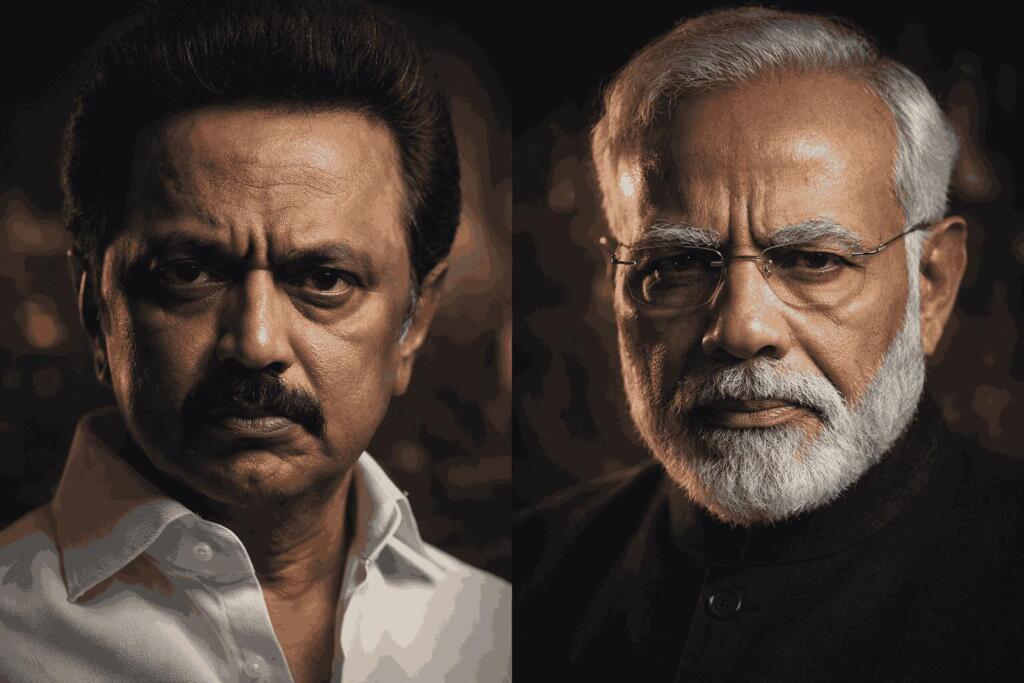
Recent remarks by MK Stalin about international geopolitics have sparked criticism and debate, with observers arguing that his comments were aimed at attacking the central government but ended up revealing gaps in understanding complex global dynamics. The controversy began after MK Stalin attempted to draw connections between global conflicts and India’s foreign policy, particularly while criticizing the leadership of Prime Minister Narendra Modi.
The comments made by MK Stalin reportedly sought to portray the Union government’s diplomatic approach as misguided and harmful to India’s interests. However, critics say the attempt backfired. Instead of strengthening his argument, MK Stalin’s remarks raised questions about whether regional political leaders should approach sensitive geopolitical issues with greater caution and clarity. Analysts note that international relations involve intricate diplomatic strategies, security considerations, and long-term policy objectives that often require nuanced understanding.
The controversy arose when MK Stalin tried to frame certain global developments as evidence of failures by the Modi government in handling foreign policy. According to reports, his statements suggested that India was being drawn into complicated international tensions due to the Centre’s decisions. Critics quickly pointed out that the assertions lacked a clear understanding of the geopolitical realities shaping India’s relations with major powers and regional actors. The episode, they argue, illustrates how domestic political rivalries can sometimes spill into debates about international affairs.
Observers also argue that MK Stalin’s comments were largely political in tone, aimed at mobilizing opposition sentiment against the central government. Political analysts note that it is not unusual for state leaders to criticize national policies, particularly when elections or political positioning are involved. However, when such criticism involves global conflicts and strategic partnerships, it can generate controversy and scrutiny from both policy experts and the public.
The debate surrounding MK Stalin’s remarks highlights the broader challenge of discussing geopolitics in the context of domestic politics. International relations often involve complex calculations involving military alliances, economic partnerships, diplomatic negotiations, and regional stability. Experts emphasize that these factors cannot easily be reduced to simplified narratives intended for political criticism. When leaders comment on such matters without sufficient context, it can lead to misunderstandings or misinterpretations among the public.
India’s foreign policy in recent years has focused on balancing relationships with major powers while protecting national interests in an increasingly polarized global environment. This approach includes maintaining strategic partnerships, strengthening economic ties, and ensuring security cooperation with multiple countries. Analysts argue that the decisions taken by the central government are often shaped by long-term strategic considerations rather than short-term political motivations.
Against this backdrop, critics claim that MK Stalin’s attempt to connect global tensions with domestic political narratives may have oversimplified the realities of international diplomacy. They argue that foreign policy debates require careful attention to facts, context, and the broader strategic picture. Without that foundation, political commentary can risk appearing uninformed or misleading.
Supporters of MK Stalin, however, contend that elected leaders have every right to question and critique the policies of the central government. They argue that open debate and accountability are essential elements of democracy. From this perspective, raising concerns about foreign policy decisions—even if controversial—can contribute to broader public discussion about India’s role in global affairs.
Nevertheless, the episode demonstrates how quickly political commentary on geopolitics can become contentious. Experts suggest that discussions on international relations benefit from informed dialogue, clear communication, and an appreciation of the complexities involved. As India continues to play a growing role on the world stage, the responsibility of political leaders to engage thoughtfully with global issues becomes even more significant.
Ultimately, the controversy surrounding MK Stalin’s remarks underscores the delicate balance between political criticism and responsible discourse on international affairs. While democratic debate remains vital, geopolitical matters often require careful analysis and accurate understanding to avoid confusion or unintended consequences. As the discussion continues, the incident serves as a reminder that foreign policy debates carry implications that extend far beyond domestic political rivalries.