
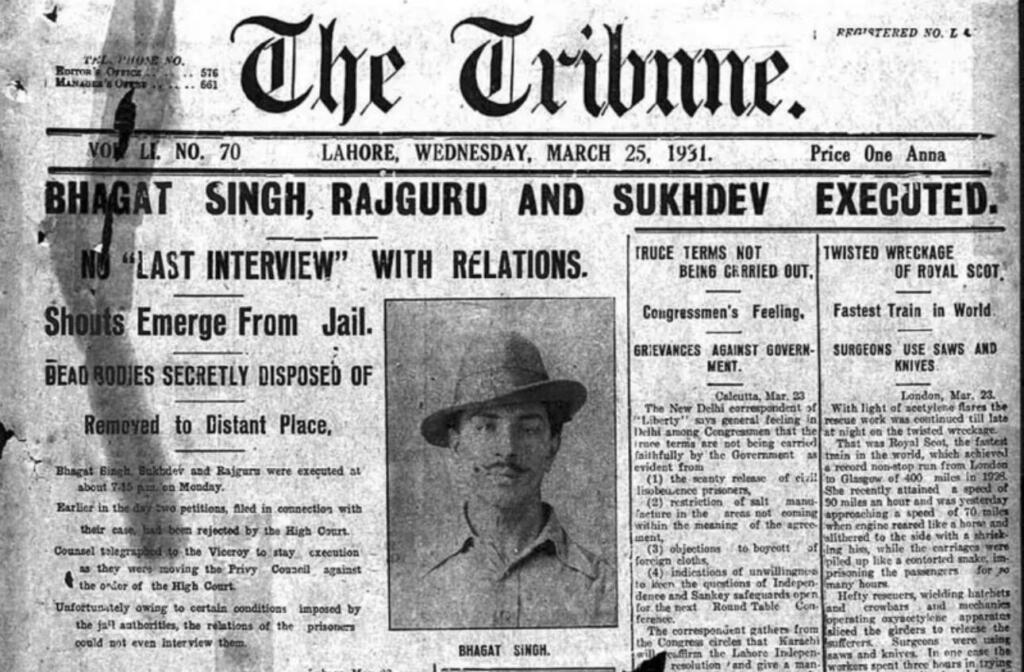
Each year on March 23, India pauses not merely to recall the execution of Bhagat Singh, but to reflect on the deeper meaning of sacrifice. His Balidan Diwas is not an occasion for mourning alone, rather it stands as a powerful reminder of a life defined by clarity of purpose, unwavering discipline, and an unyielding sense of duty toward the nation.
At just twenty-three, Bhagat Singh did not simply confront death, he embraced it with conviction, having already fulfilled the purpose he had set for his life. The morning of March 23, 1931, at Lahore Central Jail began like any other quiet, routine, and uneventful yet, as the day unfolded, it would come to be remembered as one of the most significant and tragic days in India’s struggle for independence.
The calm was disrupted when Warden Charat Singh ordered all prisoners to return to their cells by 4:00 PM, far earlier than usual. He offered no explanation, merely stating that the directive had come from higher authorities.
Confusion spread among the inmates and soon after, the jail barber, Barkat, passed by the cells whispering ominously, “Bhagat Singh, Rajguru, and Sukhdev will be hanged tonight.” The words sent a wave of shock and disbelief through the prison.
Inside their cells, Bhagat Singh and his comrades remained unaware that a clandestine decision had been made to execute them a day earlier than scheduled. Originally set for March 24, 1931, their execution was secretly advanced as an act widely seen as an attempt by the British authorities to avoid public unrest.
The Final Hours
Bhagat Singh, lodged in Cell No. 14, had spent his imprisonment immersed in books and revolutionary thought. Even in his final moments, he was reading a biography of Lenin. When officials came to escort him to the gallows, he calmly responded, “Wait a moment let one revolutionary meet another. Shortly after, he tossed the book aside and declared, Now, let us go.”
Before the execution, all three men were weighed and instructed to bathe. They were then dressed in black garments, their faces left uncovered as per their wishes and they requested not to be handcuffed, a request that was granted.
When they stepped out of their cells, they embraced one another and walked toward the gallows with unwavering composure. Bhagat Singh stood in the center, flanked by Sukhdev on his left and Rajguru on his right, their arms interlocked in solidarity.
As they advanced, Bhagat Singh began to sing, “Dil se niklegi na mar kar watan ki ulfat, Meri mitti se bhi khushboo-e-watan aayegi.” (“Even in death, my love for my motherland will not fade; From my ashes, the fragrance of the nation will rise.”)
A British Deputy Commissioner present at the scene watched in astonishment. Turning toward him, Bhagat Singh remarked, “You are fortunate to witness how Indian revolutionaries embrace death with joy for the sake of their ideals.”
Upon reaching the gallows, the executioner identified as Masih proceeded with trembling hands. The revolutionaries kissed the nooses placed around their necks and raised resounding slogans, “Inquilab Zindabad!” (“Long live the revolution!”)
Their voices echoed through the prison, joined by fellow inmates chanting lines such as “Sarfaroshi ki Tamanna ab hamare dil mein hai” and “Hindustan Azad Ho.” The atmosphere was charged with defiance, courage, and an unshakable spirit of resistance.
At precisely 7:33 PM, the magistrate signaled the execution. The platform was released, and Bhagat Singh, Rajguru, and Sukhdev were hanged meeting death with remarkable courage and dignity.
The gravity of the moment deeply affected those present. One Indian officer reportedly refused to identify the bodies of the executed revolutionaries, an act of quiet defiance for which he was immediately dismissed and detained. Shortly thereafter, medical officers Lieutenant Colonel J.J Nelson and Lieutenant Colonel NS Sodhi confirmed their deaths.
Aftermath and Secrecy
Even in death, the British authorities feared the power these revolutionaries held over the public imagination. Concerned that their execution might ignite widespread rebellion, they resorted to secrecy and haste.
The bodies were reportedly dismembered, placed into sacks, and transported under the cover of darkness to Ferozepur. There, an attempt was made to cremate them using kerosene. However, when local villagers noticed the flames and approached, the authorities fled in panic, discarding the half-burnt remains into the Sutlej River.
The villagers later recovered the remains and performed the last rites with dignity and reverence, ensuring that the martyrs received the honor they were denied in death.
A Final Testament
On March 20, 1931, Bhagat Singh had written a letter to the Governor of Punjab, requesting that he be treated as a prisoner of war and executed by firing squad rather than by hanging. His appeal was not granted.
In another letter dated March 22, 1931, addressed to his comrades, he wrote, “I, too, have a desire to live, and I do not wish to conceal it. But I have never felt tempted to escape the gallows. I await my final test with eagerness.”
Legacy of Sacrifice
On that fateful evening of March 23, 1931, a 23-year-old Bhagat Singh and his companions laid down their lives, igniting a flame of resistance that would burn across the nation. Their sacrifice stirred the conscience of millions and intensified the momentum of India’s freedom movement.
The legacy of their courage did not end with their deaths, it became a rallying cry for generations to come, ultimately contributing to India’s independence.
This article was originally published on January 8, 2023, and has been republished on the occasion of Martyrs’ Day in tribute to these immortal heroes.