
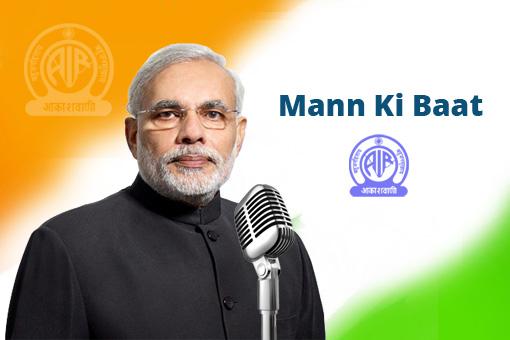
India’s flagship radio outreach programme Mann ki Baat has once again come under the spotlight, this time for its financial performance. According to recent information obtained through a Right to Information (RTI) query, the programme has generated over ₹5 crore in revenue since 2023 without incurring any expenditure on advertisements. The findings present an unusual case of a government-led communication initiative that not only sustains itself but also produces earnings.
Launched in 2014 by Prime Minister Narendra Modi, Mann ki Baat was conceived as a direct communication channel between the government and citizens. Broadcast monthly through All India Radio and other platforms, the programme quickly gained traction as a mass outreach tool. Over time, Mann ki Baat evolved beyond a simple address, becoming a cultural and communicative fixture that reaches millions across urban and rural India.
The RTI data, covering the period from January 2023 to January 2026, reveals that Mann ki Baat generated approximately ₹5.33 crore in revenue. The earnings show a steady upward trajectory, with ₹16.6 lakh recorded in early 2023, rising to ₹1.17 crore in 2023–24, ₹1.63 crore in 2024–25, and peaking at ₹2.36 crore in 2025–26 (up to January). (OpIndia) This consistent growth indicates increasing engagement and monetisation potential, even in an era dominated by digital media.
What makes the findings particularly noteworthy is the complete absence of advertising expenditure. In response to the RTI query, the Central Bureau of Communication clarified that no funds were spent on promoting Mann ki Baat across print, television, radio, or digital platforms during this period. (OpIndia) This effectively means that the programme’s visibility and reach have been achieved organically, without relying on paid publicity.
The financial model of Mann ki Baat is distinct compared to conventional media programming. While it does not feature traditional commercial advertising breaks, it generates revenue through sponsorships and institutional partnerships associated with its broadcast. Earlier RTI responses have also indicated that the programme has consistently brought in revenue for public broadcasters, particularly All India Radio, thereby contributing to its financial sustainability.
Over the years, Mann ki Baat has played a significant role in reviving interest in radio broadcasting in India. At a time when radio listenership was declining due to the rise of smartphones and streaming platforms, the programme brought renewed attention to the medium. Its wide dissemination across multiple channels, including television simulcasts and digital streaming, has further expanded its audience base.
The RTI revelations also highlight a broader contrast in government communication spending. Public outreach campaigns often involve substantial advertising budgets to ensure visibility across platforms. In this context, the performance of Mann ki Baat stands out as an exception—demonstrating that a programme can achieve both reach and revenue without direct promotional expenditure.
Supporters of the initiative argue that its success lies in its format and consistency. By focusing on themes such as social initiatives, grassroots innovations, and citizen participation, Mann ki Baat has cultivated a loyal listener base. The programme’s conversational tone and emphasis on storytelling have also contributed to its popularity, distinguishing it from more formal government communications.
However, the programme has not been without criticism. Some analysts and surveys have suggested that actual listenership may not be as widespread as official claims indicate, pointing to varying levels of engagement across regions. Despite these debates, the revenue figures suggest that Mann ki Baat continues to hold commercial and institutional value within the broadcasting ecosystem.
Importantly, the RTI data reinforces the idea that Mann ki Baat has transitioned from being merely a communication tool to becoming a financially viable broadcast property. Its ability to generate crores in revenue without advertising expenditure challenges conventional assumptions about media economics, particularly in the public sector.
As the flagship radio outreach programme continues to air regularly, its dual role as a communication platform and revenue-generating programme is likely to remain a subject of discussion. Whether viewed as an innovative model of public outreach or as a unique case within government broadcasting, the programme’s financial performance adds a new dimension to its legacy.
In the evolving landscape of media and governance, Mann ki Baat stands as a notable example of how traditional formats like radio can still command influence—and even profitability—without relying on modern advertising machinery.