
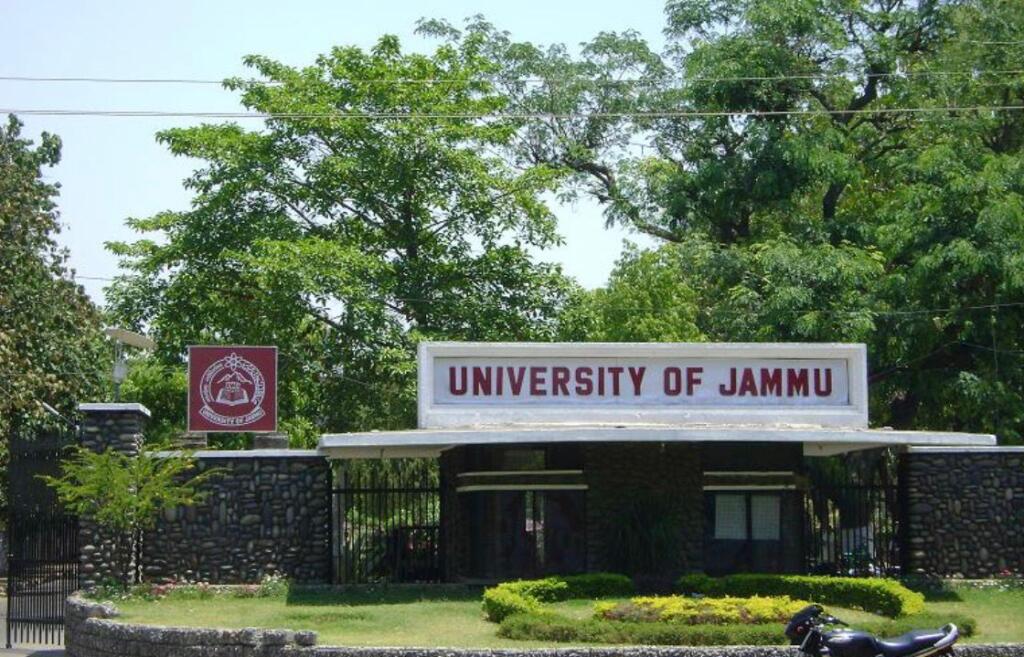
A fresh controversy has erupted at the University of Jammu after a departmental panel recommended removing topics related to Muhammad Ali Jinnah, Sir Syed Ahmad Khan, and Muhammad Iqbal from its MA Political Science syllabus.
According to media reports, the recommendation was made by the Departmental Affairs Committee (DAC), with the final decision set to be taken at the Board of Studies meeting on March 24.
The issue has triggered sharp reactions from student groups and political parties, turning what began as an academic revision into a wider ideological debate.
At the heart of the controversy is the inclusion of Jinnah’s political thought in a paper titled “Minorities and the Nation,” where he is presented in the context of minority politics, an approach that has drawn criticism from some quarters.
The Akhil Bharatiya Vidyarthi Parishad (ABVP) staged protests on campus, demanding the removal of these topics.
The organization argued that “academic freedom should not come at the cost of national sentiments and historical facts.”
ABVP’s Jammu and Kashmir state secretary Sannak Srivats reportedly said that earlier academic references to Jinnah were confined to the Two-Nation Theory, linking him directly to the Partition of India.
“Now he is being presented as a leader of minorities, which is unacceptable,” he said.
Academic Rationale and Institutional Stand
The university’s Political Science department, however, has defended the inclusion. Department head Baljeet Singh Man maintained that the syllabus revision was guided by academic considerations and aligns with national standards set by the University Grants Commission (UGC).
He emphasized that the intent is to expose students to multiple schools of thought rather than promote any single narrative. Officials also pointed out that the revised syllabus is part of a broader effort to modernize course content in line with evolving academic frameworks across Indian universities. Following the controversy, the university administration constituted a committee to review the concerns raised.
Political Reactions and Allegations
The issue has also taken a political turn. Senior Congress leader Namrata Sharma alleged that the controversy is being “deliberately manufactured.”
She noted that the draft syllabus, prepared in 2025, had included not only Jinnah but also figures like Vinayak Damodar Savarkar and Madhav Sadashiv Golwalkar, and remained unchallenged for nearly a year. “Why is this being made an issue now?” she questioned.
The debate reflects a broader ideological divide over how historical and political figures should be represented in academic curricula—whether through a critical lens, a nationalist framework, or a pluralistic academic approach.
Past Flashpoints Add Context
This is not the first time the university’s Political Science department has been at the center of controversy. In 2018, outrage erupted after a video surfaced in which Bhagat Singh was described as a terrorist by a faculty member, prompting widespread criticism and protests.
Such incidents have contributed to heightened sensitivity around how historical figures are portrayed in academic spaces, particularly in politically charged contexts.
NCERT Controversies Mirror the Debate
The ongoing row at Jammu University comes amid similar debates at the national level involving the NCERT. On February 24, NCERT released a new Class 8 Social Science textbook titled “Exploring Society: India and Beyond Part 2,” intended for the 2026–27 academic session.
The book included a section on “Corruption in the Judiciary” within the chapter “The Role of the Judiciary in Our Society.” Rather than focusing primarily on judicial hierarchy and access to justice, the content highlighted systemic challenges such as corruption and case backlogs.
The chapter sparked controversy, leading to the book being banned, with even the Chief Justice of India raising objections.
Partition Narrative Dispute
In another contentious development, an NCERT module attributed responsibility for the India–Pakistan Partition to Jinnah, the Indian National Congress, and Lord Mountbatten.
The Congress strongly objected to this interpretation as Party leader Pawan Khera stated that the Partition was the result of a “jugalbandi” between the Hindu Mahasabha and the Muslim League, rejecting the narrative presented in the module.
The developments at Jammu University and within NCERT underscore an ongoing national debate over the boundaries of academic freedom, the role of historical interpretation, and the influence of politics on education.
As the Board of Studies prepares to take a final call, the outcome is likely to have implications beyond a single syllabus, potentially shaping how contentious historical figures are engaged with in Indian academia going forward.