
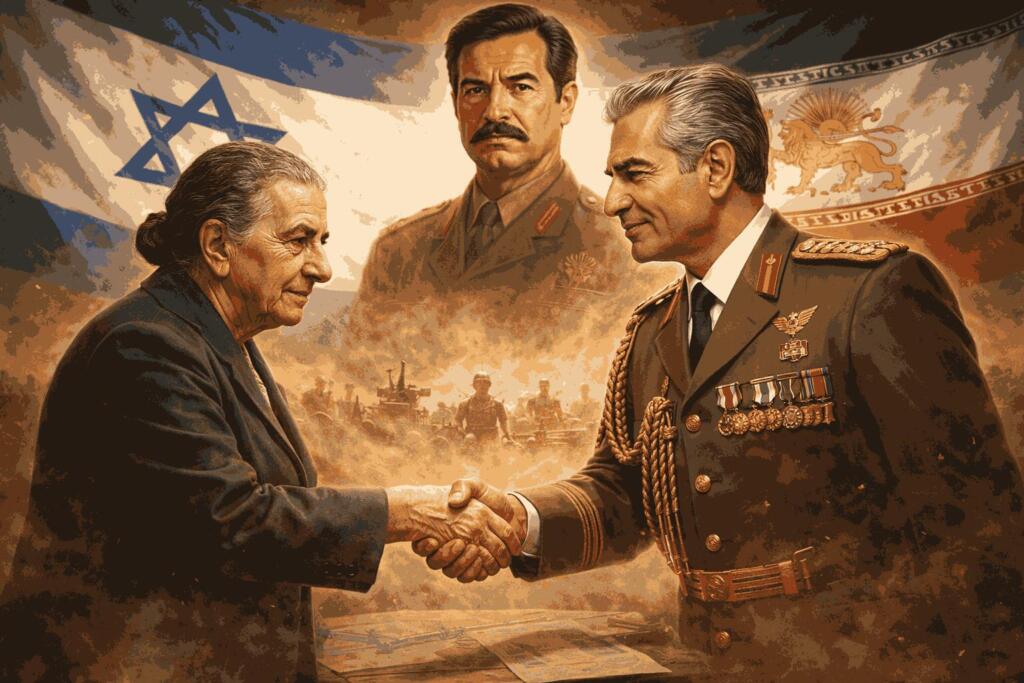
The modern hostility between Israel and Iran often dominates headlines, but history reveals a far more complex relationship. Long before their rivalry defined Middle Eastern geopolitics, Israel and Iran were strategic partners united by a shared concern: the expansionist ambitions of Saddam Hussein’s Iraq. The story of Israel and Iran is therefore not merely one of enmity, but of shifting alliances shaped by survival, ideology, and regional power struggles.
During the reign of Shah Mohammad Reza Pahlavi, Iran maintained discreet but meaningful ties with Israel. Both nations were non-Arab states in a region largely dominated by Arab powers, many of whom were hostile toward Israel. This common geopolitical position created an understanding between Israel and Iran, especially as Iraq under Saddam Hussein sought to project military dominance across the region. Intelligence sharing, economic cooperation, and limited security coordination formed the backbone of their quiet partnership.
The 1979 Islamic Revolution dramatically altered Iran’s political landscape. Ayatollah Ruhollah Khomeini’s rise to power brought an official ideological shift that branded Israel as an adversary. Yet even after this transformation, the dynamics between Israel and Iran remained more complicated than public rhetoric suggested. When Iraq invaded Iran in 1980, launching the brutal Iran-Iraq War, Tehran found itself facing a formidable enemy with substantial regional backing. Iraq’s military strength posed a direct threat not only to Iran but also to broader regional stability.
It was during this turbulent period that Israel and Iran found themselves aligned once again by strategic necessity. Despite Tehran’s public denunciations of Israel, reports and historical accounts indicate that Israel provided limited military assistance to Iran in the early years of the war. The logic was straightforward: a decisive Iraqi victory could embolden Saddam Hussein and destabilize the region further, potentially threatening Israeli security. In this narrow but critical context, Israel and Iran shared overlapping interests.
The partnership was not rooted in ideology or mutual affection, but in pragmatic calculations. Israel viewed Iraq’s growing military capabilities, including its pursuit of advanced weapons, as a significant threat. Iran, isolated and under heavy pressure, needed access to spare parts and military supplies. This convergence of interests allowed Israel and Iran to cooperate indirectly, even as public hostility intensified.
However, the end of the Iran-Iraq War in 1988 marked a turning point. With Saddam’s ambitions temporarily curtailed and regional alignments shifting, the fragile logic that had connected Israel and Iran began to unravel. Over the following decades, ideological hostility hardened into strategic rivalry. Iran’s support for groups opposed to Israel and its expanding regional influence deepened tensions. Meanwhile, Israel increasingly viewed Iran’s military and nuclear ambitions as existential threats.
The transformation of Israel and Iran from tactical partners to entrenched adversaries reflects the fluid nature of international relations in the Middle East. Alliances in the region have often been driven by immediate threats rather than enduring ideological compatibility. The shared opposition to Saddam Hussein provided a temporary bridge between two fundamentally different political systems. Once that common enemy faded from the equation, deeper ideological and strategic divisions resurfaced.
Understanding this historical episode is essential for grasping the complexity of today’s regional tensions. It challenges the simplistic narrative that Israel and Iran have always been sworn enemies. Instead, their relationship has evolved in response to shifting power balances, wars, and leadership changes. The Iran-Iraq War created a moment when survival instincts outweighed ideological confrontation, demonstrating how geopolitical necessity can override public rhetoric.
Today, open hostility dominates the discourse surrounding Israel and Iran. Yet the memory of their past cooperation underscores an important lesson: in geopolitics, permanent enemies are rare, and strategic interests often dictate unexpected alignments. The period of cooperation against Saddam Hussein’s Iraq serves as a reminder that regional politics are rarely static.
As the Middle East continues to navigate uncertainty, the historical interplay between Israel and Iran remains a compelling case study. It reveals how nations can transition from quiet collaboration to deep antagonism within a generation. More importantly, it highlights the role of shared threats in shaping unlikely partnerships. The story of Israel and Iran, once strategic partners against a common foe, stands as a testament to the ever-changing landscape of power, ideology, and survival in one of the world’s most volatile regions.