
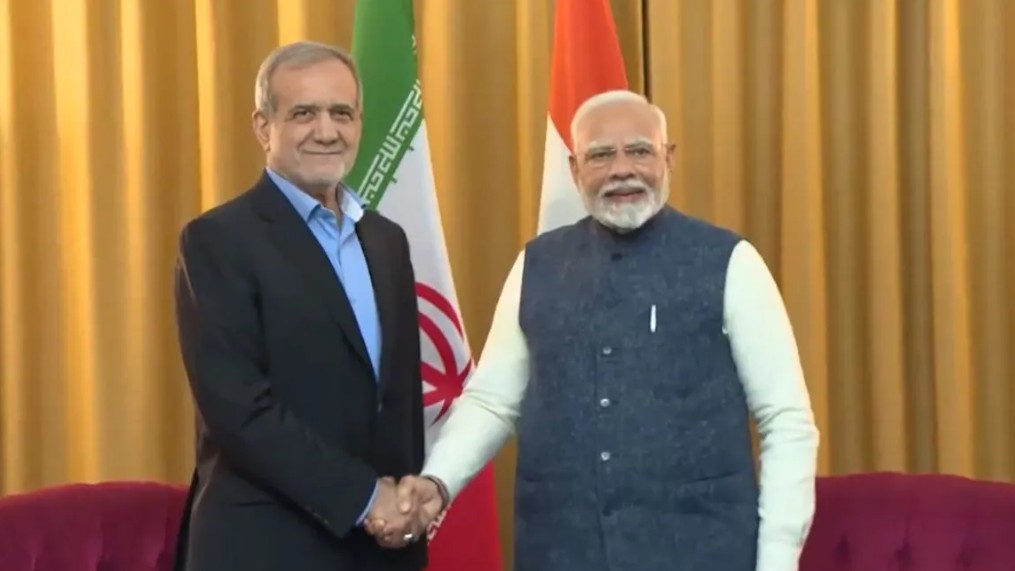
In fresh developments amid West Asia tensions, Iran has indicated it will allow Indian ships safe passage through the Strait of Hormuz, even as hostilities continue following attacks involving the US, Israel and Iranian forces.
The assurance came after a phone conversation between Prime Minister Narendra Modi and Iranian President Masoud Pezeshkian late on Thursday, during which Modi stressed that India considers Iran a friend and will work to advance diplomacy, said media reports.
According to Iranian officials, this marks one of the closest instances of India expressing solidarity with Tehran since the conflict escalated. Pezeshkian also appreciated India’s “balanced and constructive positions” on international issues and its efforts to reduce tensions.
Amid fears of an energy crisis, New Delhi has intensified diplomatic engagement with Tehran in recent days, urging the need for uninterrupted movement of goods and energy supplies through the strategic waterway.
India Assures Iran of Friendship Amid Strait of Hormuz Tensions
Iranian ambassador Mohammad Fathali confirmed that India-flagged ships would be allowed to pass through the strait.
“Yes, because India is our friend. You will see it withing 2 or 3 hours. We believe India and Iran share common interests in the region,” Fathali said on Friday evening as per TOI.
About 28 Indian ships had remained stranded in the Persian Gulf after Iran blocked access to the strait. Reports late on Friday indicated that two of these ships carrying gas had already been allowed to cross.
According to an Iranian readout of the conversation, Pezeshkian said Iran remains committed to expanding cooperation with New Delhi through multilateral frameworks such as BRICS, which is currently chaired by India. He also called on the grouping of emerging economies to play an active role in safeguarding peace and security in the region.
BRICS Role Highlighted as India Seeks Consensus
The conversation between Modi and Pezeshkian came shortly after External Affairs Minister S Jaishankar held his fourth discussion in two weeks with Iranian Foreign Minister Seyed Abbas Araghchi. During the talks, BRICS-related issues were again discussed.
Iran said Araghchi urged the grouping to condemn what he described as US-Israel “military aggression.”
“Referring to the importance of BRICS as a platform for expanding multilateral cooperation, he (Araghchi) said the grouping should play a constructive role at the present juncture in supporting regional and global stability and security,” said an Iranian readout of the foreign ministers’ talks.
Challenges in Forming a Unified BRICS Position
However, forging a common position has been difficult for India as chair of BRICS because both Iran and the United Arab Emirates are members of the bloc and hold differing views on the conflict.
“As Chair of BRICS, India has been facilitating discussions among members through the Sherpa channel. Last virtual BRICS Sherpa meeting was held on 12 March. In addition, Indian leadership has been engaging with leaders of BRICS members in the region. India will continue to engage,” a government source said on condition of anonymity.
Jaishankar Engages with Iran on Multilateral Cooperation
According to Iran, Jaishankar also expressed India’s readiness to expand bilateral and multilateral cooperation in regional and international forums. He emphasised the need to strengthen long-term stability and security in the region as a “collective necessity.” Jaishankar later said in a post on X that BRICS-related issues were discussed.
Iran joined BRICS in 2024 and is seeking support from India to ensure that the group condemns the US-Israel attacks. Unlike Russia and China, India has not formally condemned the strikes on Iran.
India Balances Concern Over Civilian Losses With Energy Interests
However, during his conversation with Pezeshkian, Modi expressed deep concern over the escalating tensions, the loss of civilian lives and damage to civilian infrastructure. Without naming Iran directly, the Prime Minister has also strongly criticised attacks in the Gulf region, where India has significant energy and diaspora interests.
According to Iran’s account of the call, Pezeshkian also referred to the killing of Supreme Leader Ali Khamenei and an attack on a girls’ school in which, he said, 168 students were killed.
“Indian Prime Minister Narendra Modi also expressed deep concern over the tensions in the Middle East and emphasized that India is a friend of Iran. New Delhi, he said, will make its maximum effort to play a role in advancing diplomacy, noting that escalation of conflict is not in the interest of any party,” the Iranian statement said.
As per TOI, Pezeshkian added that despite recent attacks on infrastructure, Iran remained committed to strengthening cooperation with India and other friendly countries through forums such as BRICS and the Shanghai Cooperation Organization. He also stressed that BRICS should play an active role in safeguarding peace, stability and security in the region.