
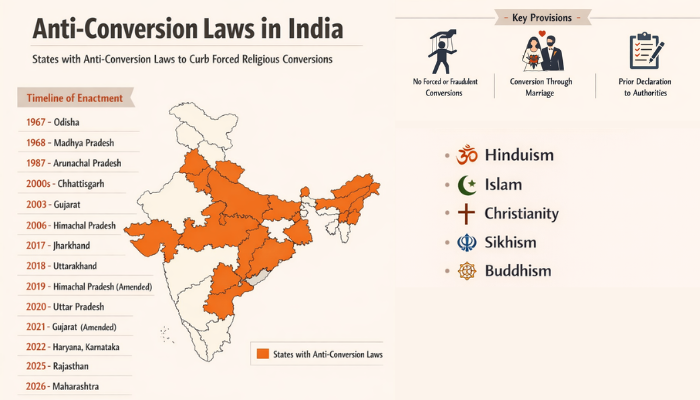
The Maharashtra Cabinet has cleared the Dharma Swatantrya Adhiniyam, 2026, a proposed law aimed at preventing religious conversions carried out through force, fraud or inducement. The Bill prescribes rigorous imprisonment of up to seven years and a fine of ₹5 lakh for individuals found guilty of facilitating unlawful religious conversions.
The move places Maharashtra among a growing number of states that have introduced legal frameworks to regulate religious conversion and curb practices that authorities say exploit vulnerable individuals. Over the past eight years, nine states have enacted similar legislation. These include Jharkhand in 2017, Uttarakhand in 2018, Himachal Pradesh in 2019, Uttar Pradesh in 2020, Gujarat and Madhya Pradesh in 2021, Haryana and Karnataka in 2022, and Rajasthan in 2025.
Although enacted at different points in time, the statutes share a strikingly similar legal structure. From definitions of unlawful conversion to administrative procedures and penalties, the laws follow a common template designed to ensure that religious conversions occur through informed and voluntary choice.
Defining Coercion and Inducement
A central element of these laws is the broad definition of practices considered unlawful in the context of religious conversion. Legislation in Uttarakhand, Himachal Pradesh, Madhya Pradesh, Uttar Pradesh, Karnataka and Haryana defines “allurement” in expansive terms.
The definition includes not only direct financial incentives or promises of employment but also intangible inducements such as assurances of a “better lifestyle” or “divine pleasure”. Lawmakers argue that such provisions are necessary to address subtle forms of pressure that may influence individuals to change their religion.
Rajasthan’s law extends the scope further by incorporating digital methods. It criminalises conversions carried out through “online solicitation” as well as the dissemination of religious propaganda through social media platforms, reflecting the increasing role of online spaces in religious outreach.
Marriage-Linked Conversions Under Scrutiny
Several states have also introduced provisions dealing with religious conversion linked to marriage. Laws in Madhya Pradesh, Gujarat, Haryana and Rajasthan declare marriages conducted solely for the purpose of conversion to be void.
Supporters of these provisions say they are intended to prevent cases where marriage is allegedly used as a mechanism to influence or pressure individuals into adopting a different faith. By invalidating such marriages, the laws attempt to discourage coercive practices while protecting the autonomy of individuals entering into relationships.
Mandatory Declarations and Administrative Oversight
Another common feature across these statutes is the requirement for individuals to inform authorities before converting to another religion. Proponents argue that this measure promotes transparency and allows authorities to verify that the decision is voluntary.
In Uttarakhand and Himachal Pradesh, individuals seeking to convert must submit a declaration to the district magistrate at least 30 days in advance. Subsequent laws expanded this timeline. Uttar Pradesh, Madhya Pradesh, Haryana and Karnataka require a 60 day notice to the district magistrate, while Rajasthan mandates a declaration 90 days before conversion.
These provisions empower district magistrates to order inquiries to determine whether a proposed conversion is voluntary. Failure to comply with the notification process can lead to legal consequences for both the individual undergoing conversion and the priest or religious figure conducting the ceremony.
Tougher Penalties Over Time
Punishments under these laws have become progressively stricter. The law enacted in Jharkhand in 2017 prescribed imprisonment of up to three years for unlawful conversion.
Later statutes introduced stronger penalties. Following a 2024 amendment, the Uttar Pradesh law allows imprisonment of up to 14 years in cases involving minors, women, members of Scheduled Castes or Scheduled Tribes, or instances described as “mass conversion”. Rajasthan’s legislation prescribes rigorous imprisonment of up to 20 years in such cases.
Across these states, unlawful conversion is classified as a cognisable and non bailable offence, enabling law enforcement authorities to intervene swiftly when allegations arise.
Courts Examine Select Provisions
Some provisions of these laws have faced judicial scrutiny. In August 2021, the Gujarat High Court stayed sections of the state’s amended anti conversion law that assumed religious conversions for marriage were inherently fraudulent or forced. The court said the step was necessary to protect inter faith couples from unnecessary harassment.
In November 2022, the Madhya Pradesh High Court struck down a provision that required individuals to submit a 60 day prior declaration before converting, ruling that compelling citizens to disclose such personal religious decisions interfered with the fundamental right to privacy.
Similarly, the Karnataka High Court last year quashed a case filed under the state’s anti conversion law against individuals distributing pamphlets about Islam. The court observed that the mere distribution of religious literature did not constitute an offence under the statute.
Constitutional Challenge Before the Supreme Court
The broader constitutional validity of these laws is now before the Supreme Court, where petitions challenging them have been pending since 2020.
In September 2025, the court transferred petitions pending before various High Courts to itself and tagged them together for hearing.
The petitioners include Citizens for Justice and Peace, the People’s Union for Civil Liberties, the Jamiat Ulama i Hind, the Catholic Bishops Conference of India, the National Council of Churches in India and several individual citizens. They argue that the statutes are vague and grant excessive powers to the police.
Supporters of the legislation maintain that the laws are necessary to protect individuals from coercion and exploitation while ensuring that the constitutional guarantee of freedom of religion is exercised through genuine and informed choice.