
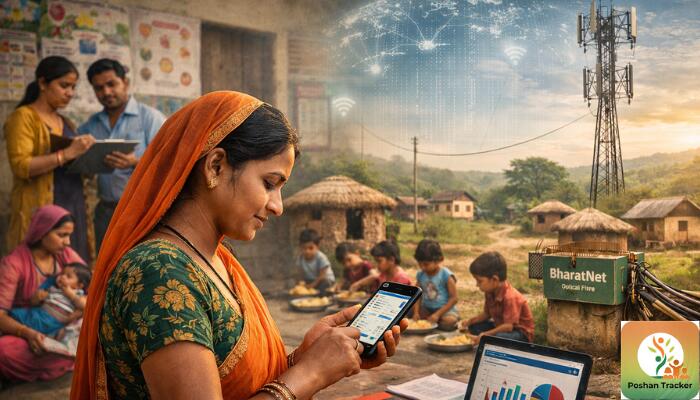
India’s initiative to combat malnutrition is being re-engineered through a digital backbone, as the Centre scales up Mission Saksham Anganwadi and Poshan 2.0 with a sharper focus on data-driven governance and last-mile delivery. The scheme, led by the Ministry of Women and Child Development, targets children below six years, pregnant women, lactating mothers, and adolescent girls aged 14 to 18 in aspirational districts and the North-East.
At the heart of this overhaul is the Poshan Tracker, an ICT-based application that is redefining how Anganwadi services are monitored and delivered. Designed to track activities across Anganwadi centres, workers, and beneficiaries through defined indicators, the platform enables instant data capture, replacing cumbersome manual registers and reducing administrative load.
Real-time monitoring meets ground realities
The deployment of smartphones to Anganwadi workers has strengthened this digital shift, allowing frontline workers to record and upload service data seamlessly. To support connectivity, each worker receives ₹2,000 annually for internet expenses, ensuring that data flow remains consistent.
Crucially, the application has been built to function beyond connectivity constraints. With offline data entry capabilities, workers can continue recording daily operations such as centre openings, attendance of children, distribution of take-home rations and hot cooked meals, pre-school education, and hygiene sessions without disruption. This ensures continuity in service delivery even in areas with unstable networks, directly benefiting communities that rely on these services.
Support systems and accountability on the ground
Implementation is reinforced through a structured support system. Block and District Coordinators work closely with Anganwadi workers and supervisors, offering guidance on using the application and addressing technical issues. This layered oversight aims to improve adoption and ensure that the technology translates into measurable outcomes on the ground.
Bridging the digital divide to strengthen welfare delivery
The government’s broader digital infrastructure push is being aligned with this effort. The Department of Telecommunications, through the Digital India Fund, is working to expand stable broadband access and reduce disparities in connectivity, particularly in rural and remote regions.
Flagship initiatives such as the BharatNet project are extending broadband connectivity to gram panchayats and villages. Complementary schemes are delivering high-speed internet and mobile services, including 4G, to underserved areas such as the North-East, island territories, Left Wing Extremism-affected regions, aspirational districts, and border villages.
Under the revised BharatNet programme, priority connectivity is being provided to public institutions, including schools, primary health centres, Anganwadi centres, and Panchayat offices, ensuring that essential services are digitally enabled.
Minister of State for Women and Child Development Savitri Thakur shared these details in the Lok Sabha, underlining the government’s strategy to integrate technology with welfare delivery. The approach signals a shift from scheme expansion to system efficiency, where real-time data, accountability, and connectivity are expected to drive tangible improvements in nutrition outcomes.