
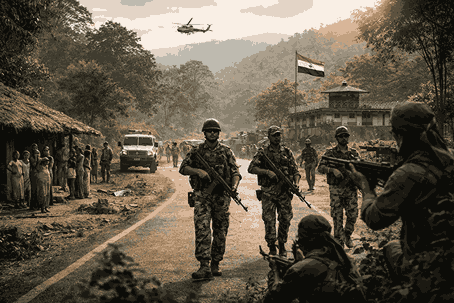
India stands at a historic inflection point in its long battle against the Naxal insurgency, with the government’s March 31, 2026 deadline symbolising not just a security objective but a broader transformation of some of the country’s most isolated regions. What was once a vast “Red Corridor” stretching across multiple states has now shrunk dramatically, both in territorial spread and operational strength.
At the heart of this shift lies Chhattisgarh’s Bastar region, once considered the epicentre of the Naxal insurgency. Today, the region is witnessing an unprecedented combination of military pressure and developmental outreach. According to recent reports, intensified operations, combined with infrastructure projects led by agencies like the Border Roads Organisation (BRO), have improved troop mobility and extended all-weather road connectivity to previously inaccessible villages.
This dual strategy—security and development—has proven critical. Security forces have not only neutralised key Maoist leaders but also facilitated a wave of surrenders. Over the past few years, the number of districts severely affected by the Naxal insurgency has fallen sharply, reflecting a sustained erosion of the insurgents’ capacity to operate.
Equally significant is the collapse of the insurgents’ organisational backbone. Leadership attrition, loss of recruitment pipelines, and shrinking territorial influence have weakened the movement fundamentally. Analysts note that what remains today are fragmented groups rather than a coordinated insurgent network.
Recent ground reports reinforce this narrative. In Bastar, large swathes of territory have been reclaimed, with roads, welfare schemes, and governance mechanisms reaching areas that were once under parallel Maoist control. Villages that were earlier cut off are now connected, and state services—from healthcare to ration distribution—are becoming accessible.
The transformation is not merely physical but psychological. For decades, fear and coercion defined life in these regions. Today, the establishment of police outposts, schools, and healthcare centres signals a return of state authority and public confidence. Plans to convert former security camps into hospitals and schools further illustrate this transition from conflict to development.
A crucial component of this success has been intelligence-driven operations. Major offensives such as Operation Black Forest and Operation Kagar have dismantled key Maoist strongholds, eliminated senior leadership, and disrupted logistical networks. These operations have pushed insurgents deeper into remote forested pockets, limiting their ability to launch large-scale attacks.
At the same time, rehabilitation policies have encouraged hundreds of cadres to surrender. These policies, coupled with development incentives, have created pathways for former insurgents to reintegrate into mainstream society. This approach has significantly reduced the appeal of the Naxal insurgency among local populations, particularly tribal communities who were once its primary support base.
However, the final phase of the campaign remains complex. Regions like Abujhmarh, with dense forests and difficult terrain, continue to pose operational challenges. Even as the number of active cadres has dwindled to a fraction of its peak, the terrain and residual networks require sustained vigilance.
Importantly, the government’s approach underscores that the end of the Naxal insurgency is not merely about eliminating armed cadres. It is about addressing the structural issues—poverty, isolation, and lack of infrastructure—that allowed the movement to take root in the first place. Development initiatives, therefore, are not an adjunct but a central pillar of the strategy.
The near-eradication of the Naxal insurgency also carries broader implications. It marks a significant enhancement of internal security, opens up mineral-rich regions for economic development, and strengthens governance in areas that were once beyond the state’s reach. Moreover, it sends a strong signal about the effectiveness of a coordinated, multi-pronged approach to insurgency.
As India approaches its self-imposed deadline, the contours of victory are already visible. The Naxal insurgency, once a formidable challenge spanning decades, is now reduced to isolated pockets. The combination of decisive security action, infrastructure expansion, and socio-economic integration has altered the landscape irreversibly.
Yet, the final lesson may be the most important: enduring peace will depend not just on the defeat of the Naxal insurgency, but on ensuring that the conditions which gave rise to it never return.