
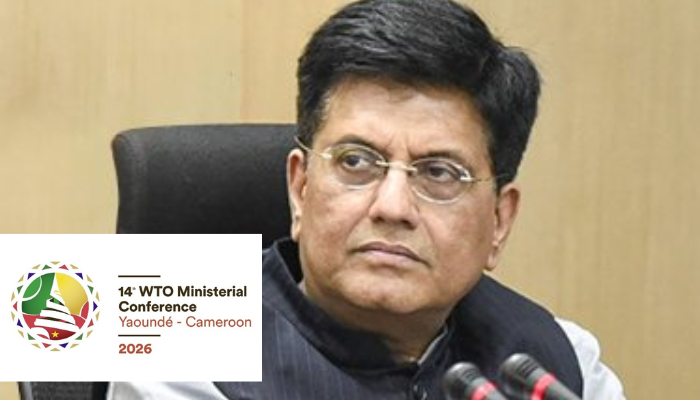
India has assertively argued for a more equitable and development-centric global trade framework, with Commerce and Industry Minister Piyush Goyal leading the country’s delegation at the 14th Ministerial Conference of the World Trade Organization, which opened in Yaoundé, Cameroon, on 26 March 2026.
At the centre of India’s intervention was a clear message that reform of the WTO must not come at the cost of its foundational principles. Addressing ministerial discussions, Goyal called for reforms to be carried out through a transparent, inclusive, and member-driven process, with development placed firmly at its core. He emphasised the need to preserve key pillars such as non-discrimination, consensus-based decision-making, and fairness, positioning India as a vocal advocate for balance within an increasingly contested global trade architecture.
India underscores development as non-negotiable in WTO reforms
The conference commenced with a formal inaugural session chaired by Cameroon’s Minister of Trade, attended by WTO Director-General Ngozi Okonjo-Iweala and senior trade representatives from member nations. India was represented at the opening session by Commerce Secretary Rajesh Agrawal.
In the subsequent ministerial deliberations focused on core institutional issues, India’s stance stood out for its insistence that reform discussions must remain rooted in the developmental concerns of member states. Goyal’s remarks reflected a broader resistance to any shift away from consensus-led processes, signalling India’s intent to safeguard the multilateral character of the WTO at a time of growing fragmentation in global trade.
A brief ceremony was also held following the inaugural session to mark the implementation of the Fisheries Subsidies Agreement on 15 September 2025, highlighting ongoing efforts to regulate harmful trade practices through collective action.
Bilateral meetings signal parallel push for trade expansion
Alongside multilateral engagements, India used the platform to deepen its bilateral outreach. Goyal met Cameroon’s Prime Minister Joseph Dion Ngute to discuss avenues for strengthening India–Cameroon cooperation, while also engaging on wider bilateral and multilateral concerns.
He also held discussions with the WTO Director-General on key agenda items shaping the conference. Further bilateral meetings with counterparts from the Netherlands, France and Ethiopia focused on enhancing trade ties and exploring new avenues for economic cooperation.
Commerce Secretary Rajesh Agrawal, in parallel, held extensive discussions with representatives from Chile, Paraguay, the United States, Nepal, the Philippines, Saudi Arabia, Mexico, Peru, Russia, New Zealand and the European Union, as well as a delegation from the European Parliament.
These engagements centred on both the MC14 agenda and strengthening bilateral trade frameworks. With Chile and Peru, both sides reviewed progress in ongoing free trade agreement negotiations. Discussions with the European Union and New Zealand focused on advancements towards finalising recently concluded FTA negotiations and moving closer to formal signing.
Strategic positioning amid shifting global trade dynamics
The opening day concluded with a formal reception and state banquet hosted by Cameroon, providing an informal setting for continued diplomatic engagement among global trade leaders.
India’s assertive articulation at the WTO underscores a calibrated strategy that combines defence of multilateral principles with active pursuit of bilateral trade gains. As global trade faces increasing uncertainty, New Delhi’s approach signals an attempt to shape outcomes rather than merely respond to them, reinforcing its role as a key voice for developing economies within the international trading system.