
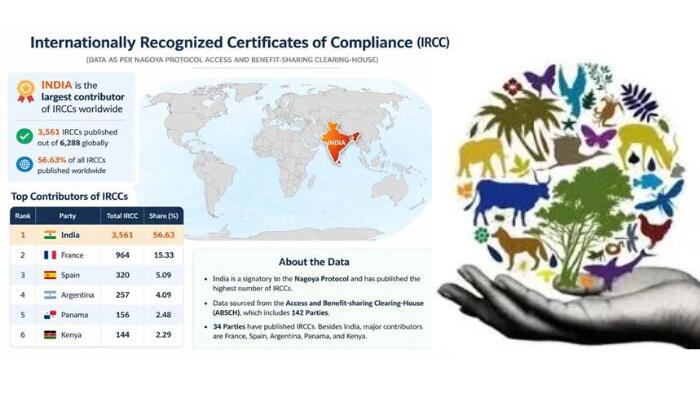
India has taken the top position globally in issuing Internationally Recognised Certificates of Compliance under the Nagoya Protocol on Access and Benefit-Sharing, accounting for more than 56 percent of all certificates issued worldwide. The latest data published by the ABS Clearing-House shows that India has issued 3,561 certificates out of a global total of 6,311, placing it far ahead of other countries participating in the protocol.
The figures highlight the country’s strong administrative capacity in regulating access to genetic resources and associated traditional knowledge. The certification process confirms that users of biological resources have secured prior informed consent from the provider country and have agreed upon mutually negotiated conditions governing their use.
Wide global participation, limited certification
Despite widespread participation in the protocol framework, only a fraction of countries have begun issuing these certificates. Out of the 142 nations registered with the ABS Clearing-House, just 34 have issued Internationally Recognised Certificates of Compliance so far.
India’s total stands significantly higher than the next closest countries. France has issued 964 certificates, followed by Spain with 320 and Argentina with 257. Panama has issued 156 certificates while Kenya has recorded 144. The gap between India and other countries reflects the scale at which India has operationalised the access and benefit-sharing mechanism.
These certificates function as an official record of compliance with international biodiversity regulations. Once issued, their details are uploaded to the ABS Clearing-House platform to ensure transparency and traceability in the use of genetic resources.
Monitoring research, innovation and commercial use
Internationally Recognised Certificates of Compliance play a central role in monitoring the lifecycle of genetic resources. From scientific research and technological innovation to eventual commercial development, the certificates help ensure that biological resources are used responsibly.
The system also guarantees that benefits arising from such use are shared fairly with the country or community providing access to those resources. This framework seeks to prevent exploitation while promoting responsible global collaboration in biodiversity research.
Institutional framework strengthens implementation
India’s leading performance is closely linked to the country’s biodiversity governance structure established under the Biological Diversity Act, 2002. Implementation is coordinated by the National Biodiversity Authority at the national level.
State Biodiversity Boards and Union Territory Biodiversity Councils supervise implementation at the regional level, while Biodiversity Management Committees operate at the grassroots level to oversee access to local biological resources.
These layered institutional mechanisms, combined with streamlined procedures, have enabled efficient handling of applications and ensured compliance with international commitments.
Reinforcing India’s role in global biodiversity governance
India’s achievement reflects its active engagement in global biodiversity management and environmental governance. By issuing the largest number of compliance certificates under the Nagoya Protocol, the country has strengthened its position as a key player in implementing international agreements related to conservation and sustainable use.
The milestone also underlines India’s continuing efforts to promote fairness and accountability in the use of biological resources while supporting broader global goals for biodiversity protection and sustainable development.