
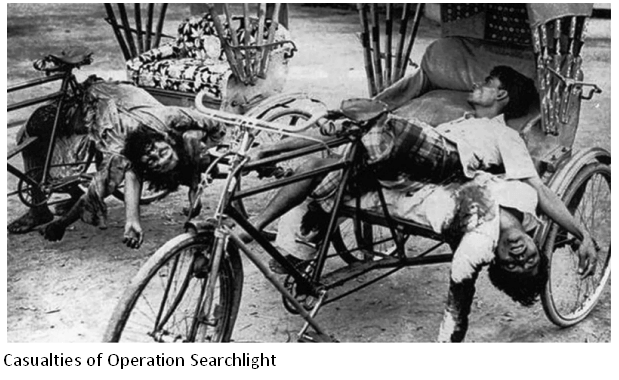
The remembrance of Pakistan’s Operation Searchlight continues to shape Bangladesh’s political and historical consciousness, even more than five decades after the traumatic events of 1971. Recent statements by Bangladesh’s leadership on Genocide Day signal a possible recalibration of earlier diplomatic overtures toward Pakistan, bringing the legacy of Pakistan’s Operation Searchlight back into sharp national focus.
On 25th March each year, Bangladesh observes Genocide Remembrance Day, marking the beginning of Pakistan’s Operation Searchlight in 1971—a brutal military crackdown launched by the Pakistani army to suppress the Bengali nationalist movement. The operation, which began in Dhaka, quickly spread across East Pakistan, targeting students, intellectuals, civilians, and particularly the Hindu minority. Historians widely consider Pakistan’s Operation Searchlight to be the opening phase of a larger campaign of mass violence that ultimately led to the Bangladesh Liberation War.
Recent developments indicate a shift in tone from Dhaka. Bangladesh’s leadership, while commemorating the victims, has emphasized the need to confront historical truth rather than dilute it for geopolitical convenience. This marks a departure from earlier attempts under the interim regime to improve ties with Islamabad, even as Pakistan continues to resist calls for a formal apology for the atrocities committed during Pakistan’s Operation Searchlight.
The brutality of Pakistan’s Operation Searchlight is well documented. Beginning on the night of 25th March 1971, the Pakistani military launched coordinated attacks on key urban centers, including Dhaka University and densely populated neighborhoods. Thousands were killed within days, and the violence escalated into a broader campaign involving mass killings, sexual violence, and the systematic targeting of Bengali intellectuals and minorities.
Despite the passage of time, the legacy of Pakistan’s Operation Searchlight remains deeply embedded in Bangladesh’s national identity. The events of 1971 are not merely historical; they are central to the country’s founding narrative. The declaration of independence, the rise of the Mukti Bahini, and the eventual intervention by India all followed in the wake of the initial crackdown. The genocide that began with March 25 genocide ultimately culminated in the creation of Bangladesh as a sovereign nation.
However, political narratives around this history have not remained static. Under the interim leadership of Muhammad Yunus, there were visible attempts to soften the portrayal of Pakistan and recalibrate Bangladesh’s foreign policy priorities. Critics argued that such moves risked undermining the memory of Pakistan’s Operation Searchlight and the sacrifices made during the liberation struggle.
The latest statements on Genocide Day suggest that this approach may be changing. By explicitly invoking Pakistan’s worst persecutions and emphasizing its genocidal nature, Bangladesh’s leadership appears to be reaffirming its commitment to historical accountability. This shift also reflects broader public sentiment, as the memory of 1971 continues to resonate strongly across generations.
Internationally, there has been a growing recognition of the events associated with Pakistan’s Operation Searchlight. Legislative efforts in countries like the United States have sought to formally acknowledge the 1971 atrocities as genocide, highlighting the enduring global relevance of the issue.
At the same time, Pakistan’s continued reluctance to issue an unequivocal apology has remained a point of contention. While expressions of “regret” have been made in the past, Bangladesh has consistently demanded a formal acknowledgment of responsibility for the crimes committed during Pakistan’s worst human rights violations.
The renewed emphasis on Genocide Day, therefore, is not merely symbolic. It reflects a deeper struggle over memory, justice, and national identity. By foregrounding Pakistan’s Operation Searchlight in official discourse, Bangladesh is asserting its historical narrative in the face of competing political pressures.
In conclusion, the legacy of Pakistan’s Operation Searchlight continues to influence Bangladesh’s domestic and foreign policy choices. As the nation commemorates the victims and reexamines its past, the question remains whether historical justice can be reconciled with contemporary diplomacy. What is clear, however, is that Pakistani atrocity is not just a chapter in history—it is a defining moment that continues to shape the moral and political trajectory of Bangladesh today.