
India’s state finances have come under renewed focus after NITI Aayog released the second edition of the Fiscal Health Index 2026 in New Delhi, offering a detailed assessment of the fiscal performance of states and underlining the importance of sound financial management for sustaining economic growth.
The report was unveiled by Suman Bery, Vice Chairman of NITI Aayog, along with Nidhi Chhibber, Chief Executive Officer of the policy think tank. The index provides a systematic, data-driven framework designed to evaluate fiscal soundness across states, promote transparency and guide evidence-based fiscal policymaking.
At a time when global public finances are under mounting pressure, the fiscal stability of sub-national governments has assumed growing importance. In India, state governments play a central role in delivering public services and implementing development programmes. They also account for nearly one third of the country’s general government debt, making their fiscal trajectory critical for maintaining macroeconomic stability and ensuring long-term development.
Expanded Framework for Evaluating State Finances
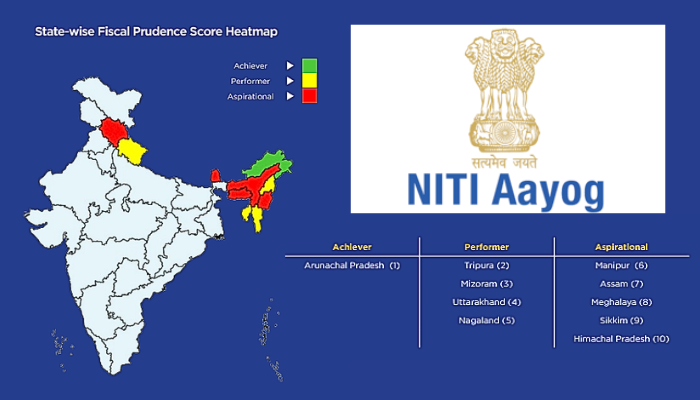
The Fiscal Health Index seeks to provide a comprehensive and comparable assessment of state finances by benchmarking fiscal performance across regions. While the first edition assessed 18 major states, the 2026 edition expands its coverage to include ten North Eastern and Himalayan states, making the framework more inclusive and representative of India’s fiscal diversity.
Recognising structural and economic differences, the newly added states have been evaluated separately from the major states. This approach allows for more accurate comparisons while reflecting the unique fiscal challenges faced by geographically and economically distinct regions.
Five Pillars of Fiscal Health
The index evaluates fiscal performance through five key pillars that collectively determine the financial stability of states. These include the quality of expenditure, revenue mobilisation, fiscal prudence, the debt index and debt sustainability. Together, these indicators provide a structured framework to assess how effectively states generate revenue, manage expenditure and control their debt obligations.
To simplify comparisons, the index categorises states into four tiers based on their fiscal performance. States with strong fiscal discipline, high own tax revenues, low deficits and manageable debt levels are classified as achievers. Those maintaining broadly sound finances but falling short on one or more indicators are placed among front-runners. Performers represent states with mixed outcomes across the five indicators, while aspirational states face greater fiscal stress marked by persistent deficits, high debt and limited revenue capacity.
Key Findings and State Rankings
Among the 18 major states evaluated in the report, Odisha, Goa and Jharkhand have emerged as achievers, reflecting strong fiscal discipline and effective financial management. Odisha has retained the top position in the index for the second consecutive year.
The report also notes shifts in the fiscal standings of several states. Karnataka and Telangana have moved from the front-runner category to performers, indicating a relative decline in their fiscal indicators. Kerala and Tamil Nadu have slipped further into the aspirational category, signalling rising fiscal pressures.
Among the North Eastern and Himalayan states, Arunachal Pradesh has secured the top position in the index. It is followed by Uttarakhand, Tripura, Meghalaya, Assam and Mizoram, highlighting significant variations in fiscal performance within the region.
Strengthening Fiscal Governance
The report identifies several policy priorities aimed at improving the fiscal health of states. These include enhancing revenue mobilisation and strengthening the capacity of states to generate their own tax revenues. It also calls for rationalising committed expenditure to restore fiscal flexibility and improving the composition and quality of capital expenditure.
The index further emphasises the importance of adopting medium-term fiscal planning frameworks to manage deficits and debt more effectively. Strengthening public financial management systems, improving transparency through verified fiscal data and closely monitoring off-budget borrowings are also highlighted as crucial reforms.
Addressing the release of the report, Suman Bery noted that stronger fiscal governance at the state level will be essential for maintaining macroeconomic stability and sustaining India’s growth trajectory. Nidhi Chhibber emphasised that improving fiscal resilience across states will play a vital role in reducing regional disparities and supporting the country’s long-term development aspirations.
By providing a transparent and data-driven assessment of state finances, the Fiscal Health Index 2026 aims to serve as an important resource for policymakers, researchers and stakeholders working to strengthen the foundations of sustainable public finance in India.