
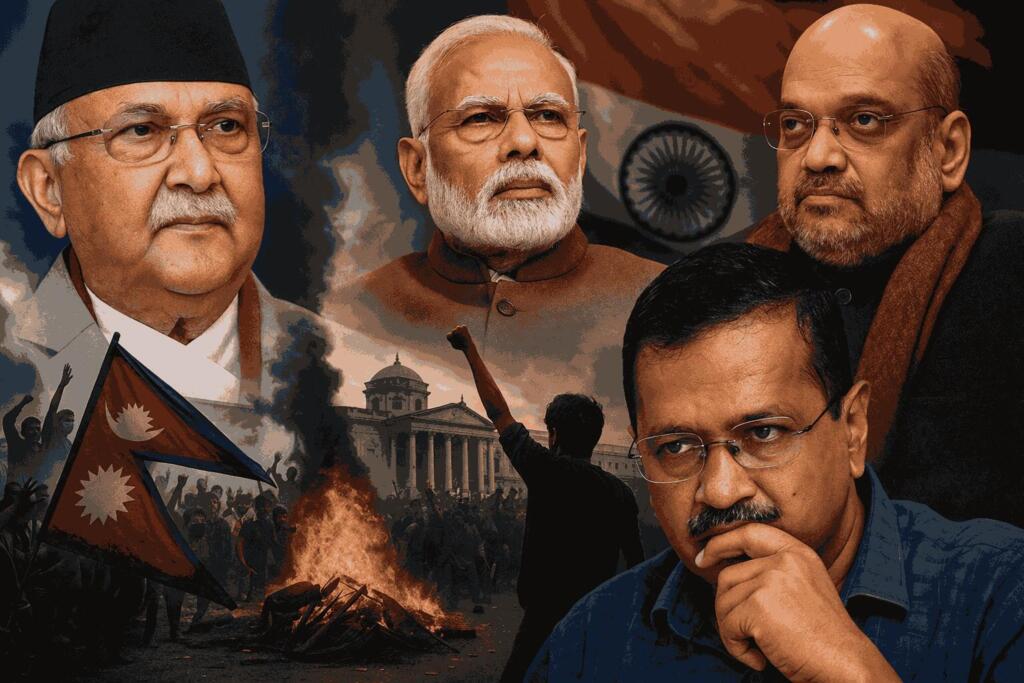
A political debate has intensified across social and digital platforms, with claims that an Ecosystem is attempting to link recent developments in Nepal with India in order to shape public perception and provoke emotional reactions. The arrests of former Nepal Prime Minister K P Sharma Oli and former Home Minister Ramesh Lekhak have become the focal point of this narrative, with some voices suggesting that parallels are being deliberately drawn to India’s political environment.
According to the argument being circulated, this Ecosystem is framing the arrests in Nepal as a potential preview of what could unfold in India under a hypothetical political shift. The narrative allegedly points toward current Indian leaders such as Narendra Modi and Amit Shah, suggesting that if a dramatic change in power were to occur—possibly through a mass movement or upheaval—and if Rahul Gandhi were to come to power, similar actions might be taken against the present leadership.
Supporters of this view argue that the Ecosystem is not merely presenting a comparison but actively shaping a political narrative designed to influence public opinion. By drawing a connection between Nepal’s internal developments and India’s political future, they claim, such messaging aims to create apprehension and mobilize sentiments among citizens. This framing, they suggest, goes beyond analysis and enters the realm of political persuasion.
At the same time, critics of this perspective caution against overgeneralization. They argue that Nepal’s political and legal circumstances are distinct and should not be simplistically mapped onto India’s context. The arrests of K P Sharma Oli and Ramesh Lekhak are linked to specific घटनाएँ (events) and investigations within Nepal, and interpreting them through the lens of Indian politics may overlook crucial differences in governance, law, and institutional frameworks.
Another dimension of the debate revolves around the idea of a “Gen Z revolution.” According to the narrative, the same Ecosystem had earlier envisioned or supported the possibility of a youth-driven political upheaval in India, similar to movements seen in other parts of the world. Proponents of this claim argue that such thinking reflects a desire for rapid, disruptive change rather than a gradual, democratic process.
This leads to a broader question about faith in democratic institutions. Those critical of the Ecosystem contend that such narratives undermine confidence in established systems by suggesting that meaningful change can only occur through extraordinary or revolutionary means. In contrast, defenders of democratic norms emphasize that electoral processes, public debate, and institutional checks remain the primary avenues for political transformation in India.
A key argument highlighted in the discussion is that if India were to follow the same path being suggested, the country’s political history would already reflect such actions. Supporters of the current leadership point out that Narendra Modi has been in power for over a decade, and yet opposition parties continue to operate actively within the democratic framework. They argue that this demonstrates a commitment to institutional norms, countering claims that India could easily replicate scenarios from other nations.
The Ecosystem debate also underscores the role of information flows in shaping political understanding. In an era dominated by social media and rapid communication, narratives can spread quickly, often blending facts with interpretation. This makes it increasingly important for audiences to critically evaluate the sources and intentions behind such messaging.
Ultimately, the controversy highlights a deeper tension between competing visions of political change. On one side are those who see parallels and warnings in international developments, while on the other are those who stress the uniqueness of India’s democratic journey. Whether the claims about an Ecosystem are accurate or overstated, the discussion itself reflects the dynamic and often contested nature of political discourse in the region.
As the debate continues, it serves as a reminder that political narratives—whether rooted in fact, interpretation, or speculation—can have significant influence. The challenge lies in distinguishing between analysis and advocacy, ensuring that public discourse remains informed, balanced, and grounded in democratic principles.