
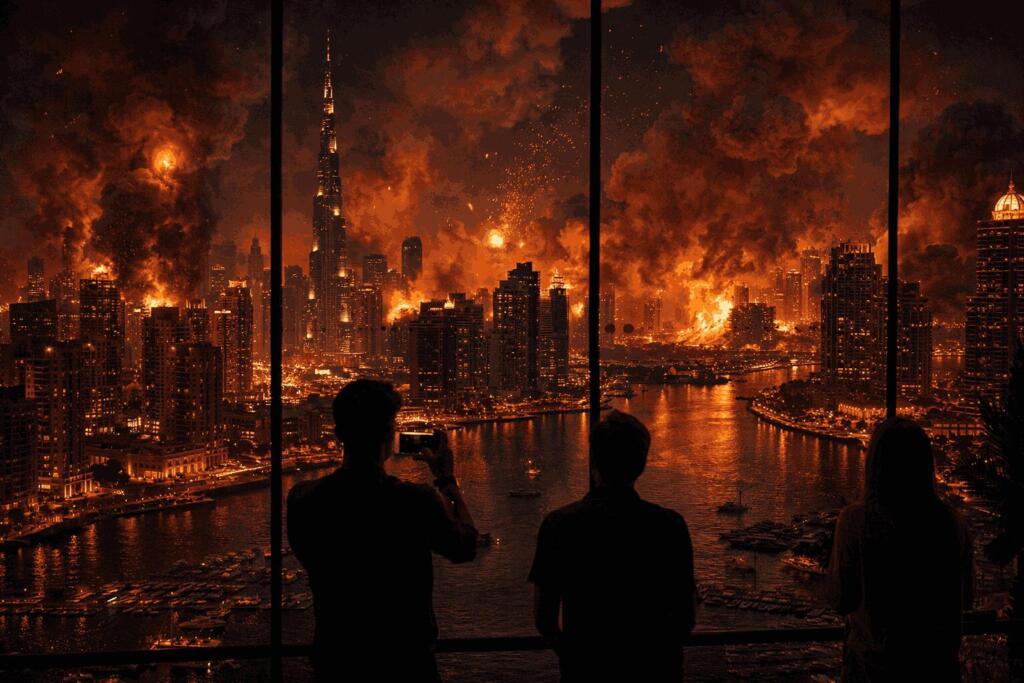
Tonight, Dubai assailed is not a phrase drawn from fiction or a geopolitical simulation. It is a description echoing across social media feeds and encrypted chat groups as flames and smoke rise against one of the most recognizable skylines on earth. This is not a conflict state or an established war zone. It is Dubai—the city that sovereign wealth funds, technology magnates, and global luxury brands selected as the safest address in the Middle East. Yet, in these startling images, Dubai assailed appears in a way few believed possible.
Fires climb between residential towers. Smoke columns drift over the Marina district. Videos captured on mobile phones show flashes in the night sky and debris falling toward some of the most expensive real estate on the planet. These are not curated military briefings or state-issued statements. They are raw recordings from apartments and hotel balconies. Families who relocated capital and children to the United Arab Emirates are documenting a moment that challenges their most fundamental assumption: that Dubai assailed was a scenario reserved for distant headlines, never their own.
For three decades, Dubai engineered perhaps the most successful city brand of modern times. Zero income tax. Immaculate infrastructure. A seamless fusion of desert ambition and global finance. The implicit promise was simple but powerful: geography could be overcome by architecture, diplomacy, and relentless development. Situated roughly 150 kilometers across the Gulf from Iran, the emirate insisted that proximity to volatility did not equate to vulnerability. Stability was not just a condition; it was the product being sold. Now, as Dubai assailed circulates in real time, that product faces its sternest test.
The images travel faster than official reassurances. Every clip is forwarded to boardrooms in London, family WhatsApp groups in Mumbai, and investment committees in Singapore. Expatriates who chose the UAE over Singapore, over London, over Zurich are reassessing the calculation that brought them here. In that calculation, safety ranked alongside returns and lifestyle. Tonight, Dubai assailed forces a repricing of that formula as residents watch their skyline burn through bedroom windows.
Demographics amplify the stakes. Approximately 3.5 million expatriates reside in Dubai, accounting for around 85 percent of the population. They hold no citizenship and possess no permanent right to remain. They are in the city because the mathematics worked: low taxation, high opportunity, and an unspoken guarantee of security. When the math shifts, they do not organize protests or seek constitutional reform. They book flights. But this time, flights are grounded. Airports are closed. In this extraordinary moment, Dubai assailed means not only visible flames but also immobilized residents—people who cannot simply depart a city built on mobility.
Strategically, the calculus extends beyond physical damage. Even if air defenses performed as designed, even if interceptions prevented catastrophic destruction, perception exerts its own power. In global finance, optics often move markets as decisively as material events. Iran did not need to flatten skyscrapers to alter sentiment. The mere sight of Dubai assailed on