
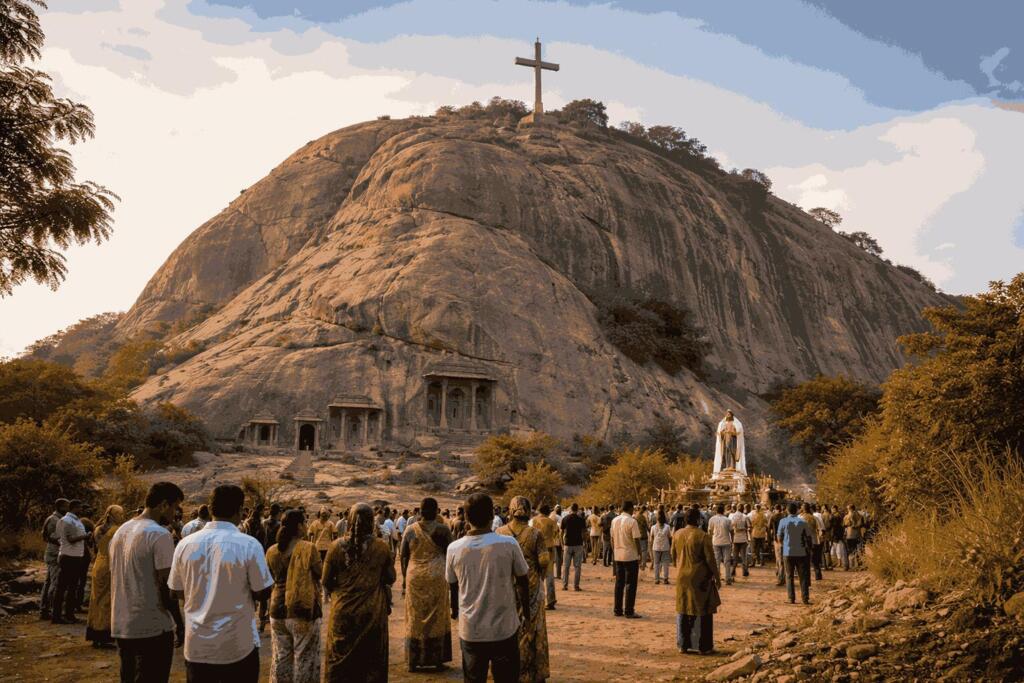
A controversy has emerged in Madurai after reports of cross worship being conducted at the historically significant Yanai Malai hill triggered protests and political reactions. The issue gained attention after local leaders of the Bharatiya Janata Party (BJP) filed a police complaint alleging that religious activities linked to cross worship were being carried out on what they claim is a sacred Hindu site.
Yanai Malai, located on the outskirts of Madurai in Tamil Nadu, is widely regarded as a heritage site with deep historical and religious significance. The hill, whose name translates to “Elephant Hill” because of its elephant-like shape, is home to ancient Jain carvings, inscriptions, and monuments dating back centuries. Archaeological findings indicate that the hill served as a place of meditation and spiritual practice for Jain monks, making it an important cultural landmark in the region.
The recent controversy began when visuals and reports surfaced claiming that groups had gathered at the hill to conduct cross worship ceremonies. According to local BJP leaders, the appearance of a cross and the conduct of cross worship at the site were inappropriate because the hill has long been associated with Hindu and Jain heritage. Party members alleged that such activities could alter the traditional character of the hill and potentially create tensions among communities.
Following these reports, BJP representatives submitted a formal complaint to the local police authorities demanding immediate intervention. In the complaint, the party claimed that the cross worship activities were being organized without proper permission and requested the authorities to investigate the matter and ensure that the sanctity of the heritage site is preserved.
The BJP also urged the state administration to prevent any attempts to convert or repurpose historically significant religious sites. Party leaders argued that Yanai Malai is not merely a hill but a symbol of the region’s ancient spiritual traditions. They warned that allowing cross worship at the location could set a precedent that might lead to further disputes over heritage spaces.
Local activists supporting the complaint echoed similar concerns. They pointed out that Yanai Malai houses rock-cut sculptures and inscriptions believed to be more than a thousand years old. According to them, any new religious practices such as cross worship at the site could lead to conflicts over ownership, identity, and preservation of cultural heritage.
At the same time, the incident has sparked debate in the region. Some residents have called for a balanced approach, urging authorities to carefully verify the claims and ensure that the matter is handled in a way that prevents communal tensions. They emphasize that Madurai has long been known for its diverse religious traditions and that any issue involving cross worship or other religious activities should be addressed with sensitivity.
The police have acknowledged receiving the complaint and stated that they will review the evidence and assess whether any laws or regulations were violated. Officials indicated that heritage sites often fall under specific administrative and archaeological protections, meaning that any religious activity—including cross worship—may require prior approval from authorities.
Yanai Malai itself has been the focus of preservation concerns for years. Heritage activists have repeatedly highlighted the need to protect the hill’s ancient structures, inscriptions, and caves from damage or encroachment. They argue that maintaining the historical integrity of the site should be the priority, regardless of political or religious disputes.
The controversy surrounding cross worship at Yanai Malai reflects a broader debate taking place in several parts of India, where historical sites intersect with contemporary religious practices. As communities continue to assert their cultural and spiritual identities, questions about heritage preservation and religious freedom frequently arise.
For now, authorities are expected to conduct a detailed inquiry into the allegations. Their findings will likely determine whether any action will be taken regarding the reported cross worship activities at the hill. Meanwhile, the issue continues to attract attention from political groups, heritage activists, and local residents who are closely watching how the matter unfolds.
The outcome of the investigation may also influence future policies on how religious activities are regulated at protected or historically significant locations such as Yanai Malai. Until then, the debate over cross worship at the sacred hill remains a sensitive and closely monitored issue in Madurai.