
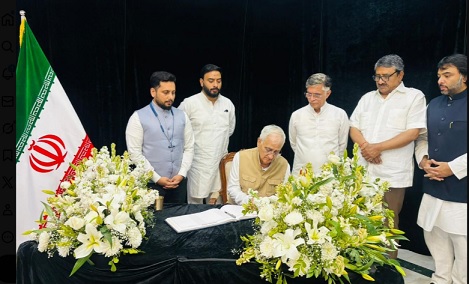
A delegation from the Indian National Congress attended a condolence meeting at the Iranian embassy in New Delhi on Friday to mourn the killing of Iran’s Supreme Leader Ayatollah Ali Khamenei. The visit, led by former external affairs minister Salman Khurshid, has triggered criticism in political circles and raised questions about the message such a gesture conveys.
According to a statement issued by the Congress party, Khurshid attended the gathering in his capacity as Chairperson of the Foreign Affairs Department of the All India Congress Committee. The delegation conveyed condolences on behalf of the party to the Supreme Leader’s Representative to India, Ayatollah Dr. Abdul Majeed, and the Ambassador of the Islamic Republic of Iran to India, Dr. Mohammad Fathali.
Senior Congress Figures Part of Delegation
The delegation included several Congress leaders who accompanied Khurshid to the embassy. Among those present were party spokesperson Pawan Khera and former legislator Hasan Ahmed, along with other party colleagues.
The leaders attended the condolence meeting organised at the embassy and formally expressed sympathy to Iranian representatives in India following the death of Khamenei.
Political Optics Raise Questions
While the Congress described the visit as a gesture of condolence and diplomatic courtesy, the decision has drawn criticism from some observers who argue that such participation carries political symbolism beyond a routine expression of sympathy.
Critics say that the presence of senior leaders from a major national party at a condolence meeting for a foreign political and religious authority inevitably raises questions about the political optics of the move. They argue that public gestures involving international figures can be interpreted in multiple ways and often attract scrutiny in the domestic political arena.
The episode has therefore sparked debate over whether the Congress leadership exercised sufficient caution in attending the event in an official capacity.
For the party, the visit was framed as a straightforward act of condolence. However, the reaction that followed highlights how even symbolic diplomatic gestures can quickly become a subject of political contestation in India’s highly charged public discourse.