
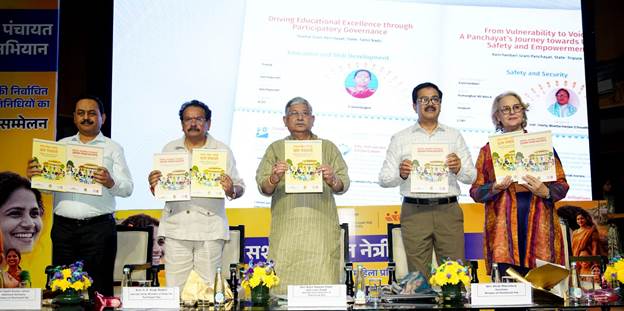
The Union government has launched the “Nirbhay Raho” initiative to strengthen women’s safety in rural India and highlighted the growing leadership of women in Panchayati Raj Institutions during the National Conference of Women Elected Representatives of Panchayats in New Delhi. The event also marked one year of the Sashakt Panchayat-Netri Abhiyan, an initiative aimed at empowering women representatives and strengthening their role in grassroots democracy.
The conference was organised by the Ministry of Panchayati Raj and was attended by Union Minister of Panchayati Raj and Fisheries, Animal Husbandry and Dairying, Shri Rajiv Ranjan Singh, also known as Lalan Singh, along with Union Minister of State for Panchayati Raj Prof. S. P. Singh Baghel. Secretary of the Ministry of Panchayati Raj Shri Vivek Bharadwaj and other senior officials of the Government of India were present at the event, which brought together more than 700 participants, the majority of them women elected representatives from various tiers of Panchayati Raj Institutions across the country.
Women at the centre of grassroots governance
Addressing the gathering, Shri Rajiv Ranjan Singh said the Sashakt Panchayat-Netri Abhiyan reflects the country’s determination to place women at the centre of grassroots democracy. He noted that India’s more than 14.5 lakh women elected representatives are not merely participants in governance but active architects shaping rural administration.
He pointed out that women now account for around 46 per cent of all elected representatives in Panchayati Raj Institutions, reflecting the deepening presence of women in local governance. Referring to the government’s broader push for gender empowerment under the leadership of Prime Minister Shri Narendra Modi, he cited initiatives such as the Nari Shakti Vandan Adhiniyam.
The minister urged women representatives to strengthen their leadership, financial management, and governance capabilities through structured training programmes supported by the Centre and implemented by states. He also referred to the use of the AI-enabled SabhaSaar platform, which supports the functioning of Panchayats and helps improve institutional processes and decision-making.
Shri Singh highlighted that financial support to local bodies has also expanded significantly. The Sixteenth Finance Commission has recommended an allocation of ₹4,35,236 crore for Rural Local Bodies for the period 2026 to 2031, a substantial increase compared with ₹65,160 crore recommended under the Thirteenth Finance Commission.
Safety initiative and recognition of grassroots leaders
A key highlight of the conference was the launch of the “Nirbhay Raho” initiative under the Nirbhaya Fund, designed to strengthen women’s safety and empowerment in Panchayats. The programme focuses on capacity building of 14.5 lakh elected women representatives by training them on legal rights and leadership.
The initiative will also sensitise around 17.5 lakh male elected representatives to promote gender equality and accountability in rural governance. In addition, CCTV cameras will be installed at strategic locations in rural areas to strengthen technology-enabled safety infrastructure in women-friendly Panchayats.
During the event, the ministry released a Compendium of Best Practices of Model Women-Friendly Gram Panchayats along with a publication titled Championing Change: Stories of Women Leading Grassroots Democracy in India. The publication highlights the experiences and leadership journeys of women representatives working at the grassroots.
Outstanding Beacon Women Panchayat Leaders, one each from 24 states and union territories, were felicitated for their exemplary contributions to rural governance.
Training and development strengthening women-led Panchayats
Union Minister of State Prof. S. P. Singh Baghel said constitutional provisions and reservation policies have enabled women to assume leadership roles in Panchayati Raj Institutions, bringing new perspectives to grassroots governance. He noted that large-scale training initiatives under the Rashtriya Gram Swaraj Abhiyan are equipping elected representatives, particularly women, with the skills required for effective leadership and responsive local governance.
Shri Vivek Bharadwaj referred to the Union Cabinet decision of 10 March 2026, chaired by Prime Minister Narendra Modi, and highlighted the impact of the Jal Jeevan Mission. According to him, access to tap water has freed nearly nine crore rural women from the daily burden of fetching water, enabling them to participate more actively in education, livelihoods, and community life.
He added that more than 7.18 lakh women elected representatives were trained during 2025–26, while 744 Model Women-Friendly Gram Panchayats have been identified across 32 states and union territories, indicating steady progress in strengthening women-led local governance.
Ms. Andrea M. Wojnar, Country Representative of UNFPA India, observed that India’s Panchayati Raj system has significantly expanded women’s political participation, with over 1.4 million elected women representatives contributing to grassroots governance. She said initiatives such as Model Women-Friendly Gram Panchayats are helping translate representation into responsive governance by integrating gender equality into local planning and decision-making.
Panel discussions during the conference were chaired by Dr Pallavi Jain Govil, Secretary of the Department of Youth Affairs, and Smt Meeta Rajivlochan, Secretary of the National Commission for Backward Classes. The discussions brought together women representatives from across the country to share governance experiences and highlight how women-led Panchayats are increasingly shaping local development, public services and community decision making.