
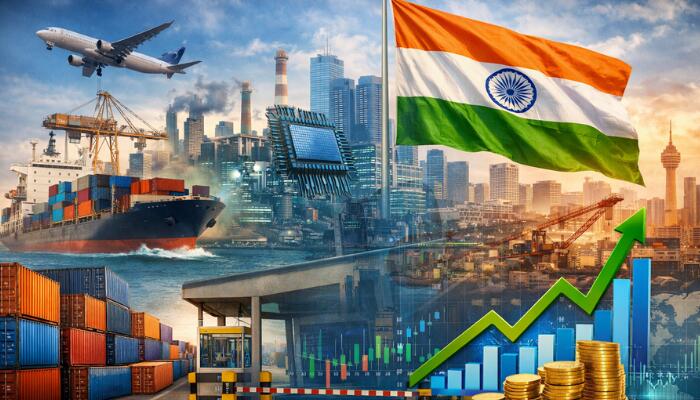
The Union Budget 2026–27 has unveiled a significant policy shift for Special Economic Zones (SEZ), proposing a one-time concessional framework that allows eligible manufacturing units to sell a portion of their output in the domestic tariff area at reduced duty rates. The move is designed to improve capacity utilisation while preserving the export-oriented nature of these zones, with the volume of such domestic sales capped as a proportion of total exports.
The announcement comes at a time when SEZs are demonstrating strong economic performance. As of February 28, 2026, India has 368 notified SEZs, with exports from operational zones crossing ₹11.70 lakh crore through December 2025–26, marking a sharp 32.02 per cent increase over the same period in the previous financial year.
A calibrated push to balance exports and domestic demand
The proposed concessional domestic sales provision marks a strategic intervention in the SEZ ecosystem. Under existing rules, goods supplied from SEZs to the domestic tariff area are treated as imports and attract full duties. The new measure temporarily relaxes this framework, allowing manufacturers to sell within India at concessional rates, subject to limits linked to export performance.
This is expected to address underutilised production capacities and improve profitability without undermining the core export mandate of SEZs. The government has indicated that necessary regulatory amendments will be introduced to ensure parity with domestic tariff area units and maintain a level playing field.
In addition, the extension of tax incentives for cloud and data centre operations within SEZs is aimed at attracting global technology players, reinforcing India’s position as a preferred investment destination.
Strong performance underpins policy confidence
SEZs continue to serve as a cornerstone of India’s trade and investment strategy. By December 2025, they had generated employment for over 31.73 lakh people and attracted cumulative investments of ₹7.86 lakh crore. These zones have not only driven export growth but also catalysed industrial expansion, infrastructure development, and local economic transformation.
Established as duty-free enclaves operating outside India’s customs territory for authorised activities, SEZs facilitate manufacturing, services, and warehousing under a simplified regulatory regime. Their role has expanded significantly since the enactment of the Special Economic Zones Act, 2005 and the accompanying rules in 2006, which introduced single-window clearances and a stable policy framework.
Policy evolution and sectoral expansion
India’s SEZ journey traces back to the establishment of Asia’s first Export Processing Zone in Kandla in 1965. However, structural inefficiencies led to the introduction of a more robust SEZ policy in 2000, culminating in comprehensive legislation in 2005.
Recent policy refinements underscore a shift towards high-technology manufacturing. In June 2025, new SEZs were notified in Sanand, Gujarat, and Dharwad, Karnataka, specifically for semiconductor and electronic component manufacturing. Amendments to SEZ rules have eased land requirements, enabled domestic supply eligibility for semiconductor products, and refined foreign exchange calculations to support these capital-intensive industries.
These measures aim to reduce import dependence, create high-skilled employment, and strengthen India’s capabilities in critical technology sectors.
SEZs positioned as engines of future growth
With a competitive mix of fiscal incentives, duty-free procurement, and simplified approvals, SEZs offer a business-friendly environment that continues to attract domestic and foreign investors. Supplies to SEZs are treated as zero-rated under the GST framework, further enhancing their appeal.
As India sharpens its focus on exports, advanced manufacturing, and integration into global value chains, SEZs are being repositioned as strategic growth drivers. The latest budget reforms signal a clear intent to reinforce this framework, ensuring that SEZs remain central to India’s ambition of becoming a global economic powerhouse.