
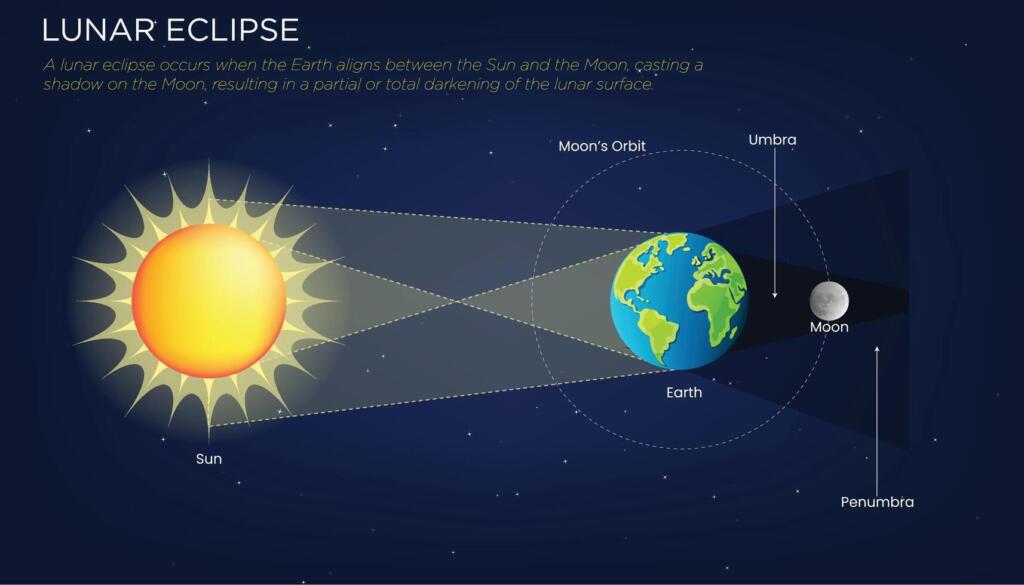
India will witness the Chandra Grahan, or total lunar eclipse, on Tuesday, March 3, 2026. The eclipse begins at 3:20 PM IST and concludes at 6:47 PM IST, lasting three hours and 27 minutes. This extraordinary event coincides with Holi, adding a unique layer to the festival of colours as millions look up to witness the Moon bathed in the Earth’s shadow.
Timing, Sutak, and Observance
The Sutak period, a traditional prelude to lunar eclipses, will commence at 6:20 AM and continue until the eclipse concludes. During Sutak, all auspicious and ceremonial activities, including cooking and religious rituals, are traditionally avoided. Many households prepare in advance by adding tulsi or kusa to liquids such as water, milk, ghee, and honey to maintain purity and minimise negative influence. Temples in states like Uttarakhand will remain closed during this period, with devotees advised not to touch deities or perform ceremonies until after the eclipse.
Visibility Across India
For most regions, including Delhi, Mumbai, Bengaluru, and Chennai, the Moon will rise while the eclipse is already underway, allowing observers to see only its final stages. Northeastern states such as Assam, Arunachal Pradesh, Meghalaya, and West Bengal will enjoy better visibility, as the Moon rises earlier. The penumbral phase begins at 4:58 PM IST, with totality lasting approximately 58 minutes and ending around 5:32 PM IST. Maximum eclipse, when the Moon is fully immersed in Earth’s shadow, occurs between 5:10 PM and 5:25 PM IST, depending on location.
States experiencing a total eclipse include Andaman and Nicobar Islands, Assam, Arunachal Pradesh, Manipur, Meghalaya, Mizoram, Nagaland, Tripura, and West Bengal, while partial eclipses will be visible in Delhi, Maharashtra, Karnataka, Tamil Nadu, Punjab, and several other regions. The Moon’s striking red hue, often called the Blood Moon, occurs as sunlight bends through Earth’s atmosphere before reaching the Moon.
Watching the Blood Moon
Skywatchers are encouraged to step outside at dusk and face the eastern horizon. While telescopes or binoculars can enhance details, they are not necessary to appreciate the spectacle. Elevated areas, rooftops, beaches, and less illuminated locations provide the best vantage points.
The Chandra Grahan 2026 represents a rare fusion of astronomical science and centuries-old cultural practice. As the Moon transforms into a Blood Moon, it not only captures the imagination of skywatchers but also resonates deeply with traditional observances, allowing devotees to witness an event that bridges faith, folklore, and the awe-inspiring mechanics of the universe. Amid the Holi festivities, this celestial display offers a memorable reminder of the beauty and interconnectedness of nature, science, and tradition.