
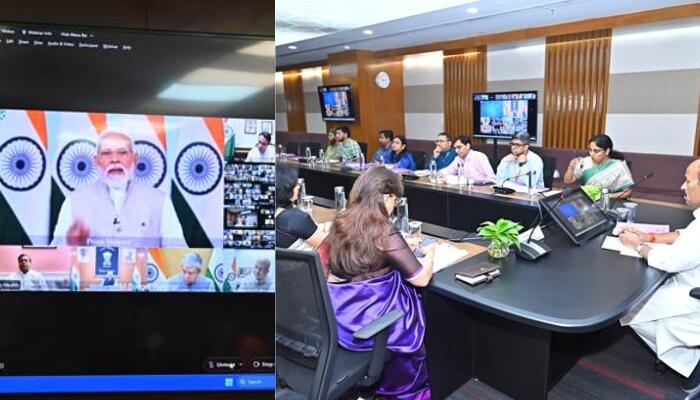
Prime Minister Narendra Modi called for accelerating efforts to connect India’s education sector with the real-world economy, urging institutions to align academic learning with emerging technologies such as artificial intelligence and automation. Addressing a post-Budget webinar attended by stakeholders from various government ministries, departments and the private sector, Modi said fulfilling the aspirations of citizens remains the central objective of his government and that sectors such as education, skill development, health, tourism, sports and culture play a critical role in achieving it.
“Fulfilling the aspirations of the people is not just a subject, but it is the core objective and the resolution of this Government,” the Prime Minister said, stressing that these sectors are fundamental pathways through which public expectations can be realised.
Linking education to employment and enterprise
Modi said the country has been making continuous efforts to connect education with employment and entrepreneurship. He pointed to the National Education Policy as the framework that enables curricula to stay aligned with market demands and the realities of the modern economy, particularly in areas such as artificial intelligence, automation and the digital economy.
Highlighting the relationship among education, employment, and enterprise, the Prime Minister referred to the potential of emerging industries such as Animation, Visual Effects, Gaming, and Comics. These sectors, he noted, are increasingly becoming important contributors to India’s expanding digital economy.
Calling for deeper collaboration between academia and industry, Modi urged educational institutions to transform their campuses into centres of industry partnership and research-driven learning. Such collaboration, he said, would help provide students with meaningful real-world exposure and practical skills.
Encouraging innovation and women’s participation in STEM
The Prime Minister emphasised the need for a robust research ecosystem that allows young scholars to experiment and innovate freely. Institutions must create environments where researchers can explore new ideas without barriers, he said.
He also highlighted the growing interest of girls in science, technology, engineering and mathematics. According to Modi, when India speaks about future technologies and innovation, it is essential to ensure that no daughter of the country is held back due to a lack of opportunities.
Health infrastructure and the rise of the care economy
The Prime Minister also spoke about developments in the health sector, stating that initiatives such as Ayushman Bharat and the establishment of Arogya Mandirs have expanded the reach of health services, particularly in rural areas. He noted that the country has opened new medical colleges in hundreds of districts, strengthening healthcare infrastructure.
Referring to the emerging care economy, Modi said the growing population of senior citizens will increase the demand for trained caregivers. He urged stakeholders to develop new training models that can prepare professionals to meet these needs.
Youth power, sports and tourism opportunities
Modi said the country’s youth power becomes national power only when young people are healthy, disciplined and confident. In this context, he described sports as an important stream of national development. Initiatives such as Khelo India, he said, have infused new energy into the country’s sports ecosystem, while sports infrastructure is being strengthened across India.
The Prime Minister also highlighted the economic potential of tourism and culture. Developing destinations beyond traditional tourist hubs, he said, can enhance a city’s identity and drive broader development. Trained guides, hospitality skills, digital connectivity and community participation are becoming key pillars of the tourism sector, alongside cleanliness and sustainable practices.
Inclusive skilling and participatory governance
The post-Budget consultations also highlighted the government’s focus on inclusive skill development through initiatives such as the Divyangjan Kaushal Yojana announced in the Union Budget. Union Minister for Social Justice and Empowerment Virendra Kumar said the programme aims to strengthen employment-linked skills for persons with disabilities, emphasising that a nation’s progress is measured by how effectively it empowers its most vulnerable citizens.
Experts participating in the discussion stressed the importance of aligning market-linked skills with industry demand while integrating persons with disabilities into mainstream education, STEM learning and employment ecosystems. The discussions highlighted the need for inclusive hiring practices, accessible training tools, entrepreneurship opportunities and digital platforms, including artificial intelligence-enabled remote work.
The webinar on Divyangjan Kaushal Yojana, held on 9 March at the Dr. Ambedkar International Centre in New Delhi, focused on building a demand-driven and industry-linked skilling ecosystem with special attention to rural areas and specialised vocational training through Centres of Excellence.
Concluding the deliberations, Additional Secretary in the Department of Empowerment of Persons with Disabilities Manmeet Kaur Nanda said, “discussions revolved around five pillars: passion, perseverance, possibilities, potential and pilot initiatives.” She emphasised that skilling programmes must remain demand-driven, accessible and closely connected to employment outcomes, reflecting a collective national commitment to transforming disability-inclusive skill development into measurable impact.