
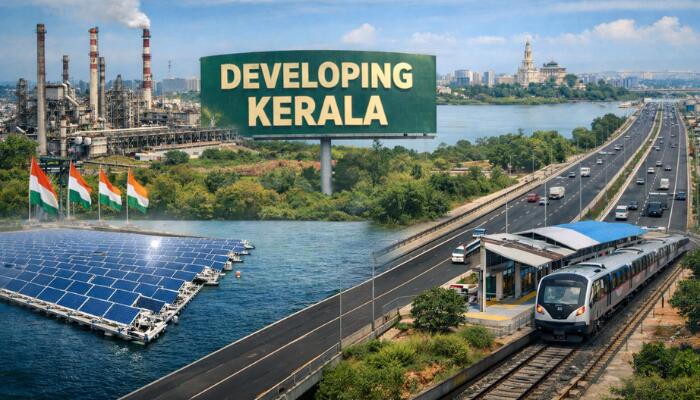
Prime Minister Narendra Modi inaugurated and laid the foundation stone for a series of development projects worth around ₹11,000 crore in Kochi, marking a significant push towards strengthening infrastructure, boosting tourism, and accelerating industrial growth in Kerala.
Addressing a rally in Ernakulam district, the Prime Minister said the projects would enhance connectivity, promote clean energy, and create employment opportunities while contributing to the broader vision of a developed state. “Coming to Kochi is always a magnificent experience,” he said, congratulating the people of Kerala and expressing confidence that the initiatives would accelerate the state’s development.
Major investment in petroleum and manufacturing
A key highlight of the programme was the foundation stone for a polypropylene unit at the Kochi Refinery operated by Bharat Petroleum Corporation Limited. The project involves an investment of more than ₹5,500 crore and will have a production capacity of 400 kilo tonnes per annum.
Polypropylene is a critical industrial material widely used in sectors such as packaging, automotive components, medical devices, textiles and household products. The new facility is expected to strengthen domestic manufacturing supply chains and support multiple downstream industries.
The Prime Minister noted that strengthening the petroleum sector remains vital for advancing national initiatives such as Make in India and Atmanirbhar Bharat, adding that expanding domestic manufacturing capacity will further strengthen India’s industrial ecosystem.
Renewable energy expansion
The Prime Minister also laid the foundation stone for a 50 megawatt floating solar power project at West Kallada. Highlighting Kerala’s large number of water bodies, he said the state possesses significant potential for floating solar power generation.
He observed that as India expands in emerging sectors such as artificial intelligence and semiconductor manufacturing, the demand for clean and sustainable energy will continue to rise. The government’s effort, he said, is to ensure Kerala advances further in solar energy production while supporting the country’s broader renewable energy transition.
Railway modernisation under the Amrit Bharat Station Scheme
Several railway infrastructure projects were also announced to improve passenger facilities and regional connectivity. Railway stations, including Shoranur Junction railway station, Kuttippuram railway station and Changanassery railway station, will be modernised under the Amrit Bharat Station Scheme.
In addition, electrification of a major section of the Shoranur–Nilambur railway line has been completed. A new train service between Palakkad and Pollachi was also launched to strengthen rail connectivity between Kerala and neighbouring Tamil Nadu.
Highway projects and improved port connectivity
The Prime Minister also inaugurated two major highway infrastructure projects aimed at improving regional mobility. The six-laning of the Thalapady–Chengala section of National Highway 66 has been completed at a cost of over ₹2,650 crore. The corridor forms part of the Mumbai–Kanyakumari Economic Corridor and will strengthen connectivity between Kasaragod and Kannur districts while linking nearby regions such as Mangalore and Muzhapilangad.
Another key project is the six-laning of the Kozhikode Bypass between Vengalam and Ramanattukara, built at a cost of around ₹2,140 crore. The bypass is expected to reduce travel time and ease traffic congestion along the busy route.
The Prime Minister also highlighted infrastructure efforts aimed at improving connectivity to Azhikkal Port, which are expected to support trade and logistics in the region.
Infrastructure investment aimed at jobs and growth
Highlighting the wider impact of infrastructure spending, the Prime Minister said the global community is increasingly recognising India’s commitment to building modern infrastructure. He noted that the latest Union Budget has allocated record funding for infrastructure development, with states such as Kerala benefiting from these investments.
“Every rupee invested in infrastructure generates employment and opportunities for youth,” he said, adding that such projects will support farmers, strengthen tourism, and expand industrial activity across the state.
He expressed confidence that the initiatives will contribute to the national vision of Viksit Bharat 2047 while helping Kerala move closer to the goal of becoming a “Viksit Kerala.”