
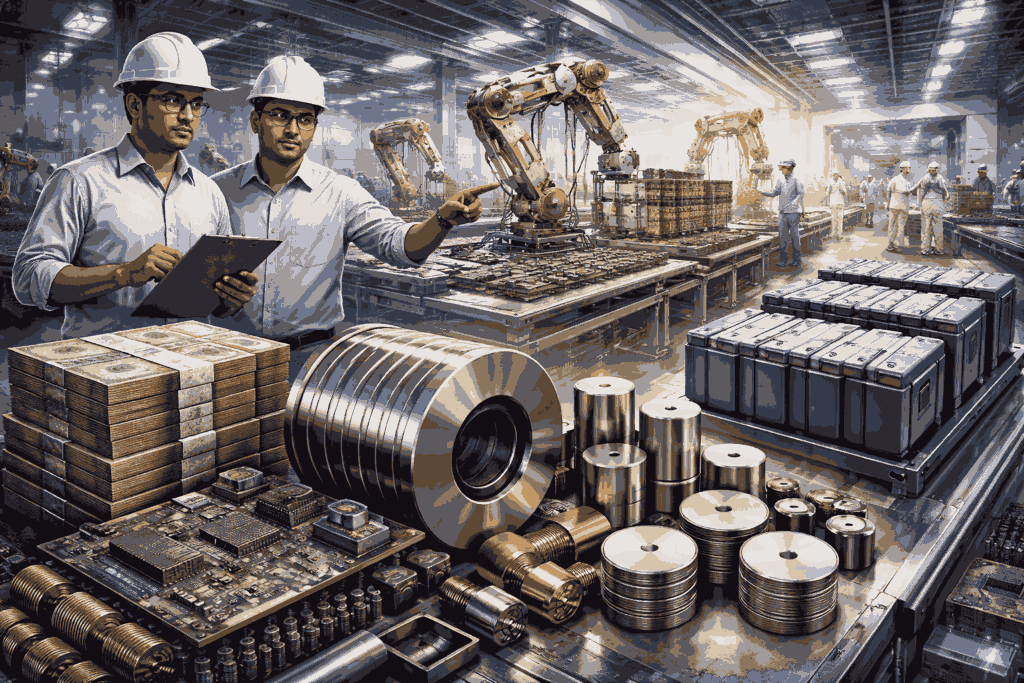
India’s industrial policy has taken a decisive leap forward with the Centre clearing a new wave of PLI projects worth ₹7,104 crore, marking a major milestone in the country’s journey toward technological self-reliance. At the heart of this approval lies a breakthrough initiative—the establishment of India’s first rare earth permanent magnet manufacturing unit—signalling a strategic shift from assembly-led growth to deep manufacturing capabilities.
Announced on March 30, 2026, the government approved 29 PLI projects under the Electronics Component Manufacturing Scheme (ECMS), covering a wide range of high-value segments. These include lithium-ion cells, flexible printed circuit boards (PCBs), connectors, and display modules. The approvals span eight states, reflecting a geographically distributed push toward industrial expansion.
The most notable highlight among these PLI projects is the ₹700 crore rare earth magnet facility, expected to be set up in Uttar Pradesh. This unit is particularly significant because it is based entirely on indigenous technology and intellectual property—an aspect emphasised by policymakers as a cornerstone of India’s long-term industrial strategy.
Rare earth magnets are critical components in a wide array of modern technologies, including electric vehicles, wind turbines, consumer electronics, and defence systems. Currently, the global supply chain for these materials is heavily concentrated, with China dominating nearly 90% of production. Against this backdrop, India’s push through these PLI projects is not merely economic—it is deeply strategic, aimed at reducing dependence on external suppliers and strengthening national security.
The government estimates that domestic production enabled by these PLI projects could meet around 25% of India’s demand for rare earth magnets. This is a significant step forward, considering the country’s current reliance on imports for such critical components.
Beyond the magnet unit, the broader set of PLI projects reflects a deliberate effort to build the “core” of electronic manufacturing. Instead of focusing solely on assembling finished products, India is now investing in the components that constitute 60–70% of product value. This shift is crucial for achieving true self-reliance, as it addresses the most import-dependent segments of the supply chain.
The economic impact of these PLI projects is expected to be substantial. Government projections suggest that the approved investments will generate production worth over ₹84,000 crore while creating more than 14,000 jobs across various sectors. These figures underline the multiplier effect of such initiatives, where initial investments catalyse broader industrial growth and employment generation.
Importantly, these developments are part of a larger policy continuum. In late 2025, the Union Cabinet had already approved a ₹7,000+ crore scheme specifically targeting rare earth permanent magnets, aiming to build an integrated domestic ecosystem from raw materials to finished products. The current round of PLI projects builds on that foundation, translating policy intent into tangible industrial capacity.
The strategic implications extend to multiple high-growth sectors. Electric vehicles, renewable energy, aerospace, and defence all rely heavily on rare earth magnets and advanced electronic components. By strengthening domestic capabilities through these PLI projects, India is positioning itself to become a key player in global supply chains for these industries.
Another notable aspect of these PLI projects is their emphasis on localisation. The government has set ambitious targets, including 50% localisation in PCBs and over 60% in lithium-ion batteries. Achieving these goals would significantly reduce India’s import bill while enhancing its competitiveness in global markets.
However, the success of these PLI projects will depend on effective execution. Industry experts have pointed out that companies must invest in design and innovation, not just manufacturing capacity. The government has also indicated that firms failing to develop strong in-house capabilities may face limitations in future approvals and incentives.
This focus on design-led manufacturing represents a critical evolution in India’s industrial strategy. It signals a move away from being a low-cost production base toward becoming a hub for high-value innovation and technology development. In this context, the rare earth magnet unit stands out as a symbol of what the country aims to achieve—a fully integrated, indigenous capability in a globally strategic sector.
The geographical spread of these PLI projects also deserves attention. States like Karnataka and Maharashtra are leading in terms of project count, but the benefits are being distributed across multiple regions, fostering balanced industrial growth. This decentralised approach ensures that the gains from industrialisation are not confined to a few pockets but are shared more broadly.
As India continues to scale up its manufacturing ambitions, the latest round of PLI projects marks a turning point. It reflects a clear recognition that future economic power will be determined not just by the ability to assemble products, but by control over the technologies and components that underpin them.
In conclusion, the ₹7,104 crore approval of PLI projects represents far more than a financial commitment—it is a strategic blueprint for India’s industrial future. By focusing on critical components like rare earth magnets and advanced electronics, the country is laying the groundwork for sustained growth, technological independence, and global competitiveness.