
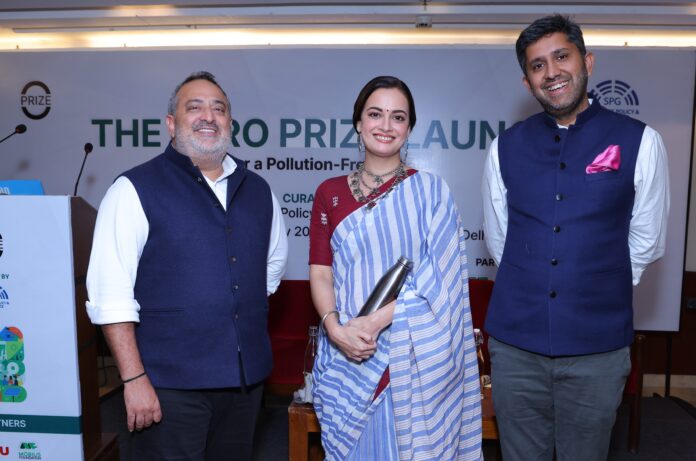
In a major push for accountable environmental action, India has unveiled the Zero Prize, the country’s first national results-based environmental award. Announced at the India Habitat Centre, the initiative offers a total corpus of ₹5 crore, with ₹1 crore earmarked for each category: air, water, and land. The prize is designed to recognise projects that achieve independently verified improvements in environmental quality across defined urban and peri-urban areas.
Prioritising Verified Outcomes Over Promises
The Zero Prize is convened by the School of Policy and Governance and supported through philanthropic contributions, corporate CSR partnerships, and institutional stakeholders. Its unique framework links financial rewards directly to measurable environmental impact rather than announcements or projected commitments. Eligible participants include start-ups, non-governmental organisations, corporates, municipal bodies, research institutions, and individual innovators. Only projects that implement a real-world pilot and undergo independent third-party validation will qualify, while concept-stage proposals without on-ground execution are excluded.
Saket Burman, Co-Founder of the Zero Prize and Vice Chairman of Dabur India Ltd., highlighted the initiative’s practical focus: “We are looking for the proven innovations that will make India’s air, water, and land measurably cleaner for the next generation. It’s time to move beyond the boardrooms and into the field. No promises. Only results.”
Scientific Assessment for Credible Impact
The prize employs rigorous scientific protocols to ensure transparency and accountability. Air quality improvements will be measured through reductions in particulate exposure using fixed-location monitoring systems, adjusted for meteorological variations. Water pollution reduction, including parameters such as Biological Oxygen Demand, Chemical Oxygen Demand, Total Suspended Solids, and nutrient load, will be assessed at defined discharge points using Central Pollution Control Board-aligned protocols. Land pollution mitigation will be evaluated through traceable, weight-based audits and documented verification of waste management practices.
Ruchir Punjabi, Chair of the School of Policy and Governance, underlined the transformative potential of results-based incentives: “Innovation is often messy, but in the fight against pollution, it needs to be abundant. By offering India’s first performance-linked environmental award, we are mobilising the country’s brightest problem-solvers—from tech start-ups to civic researchers—to tackle our environmental crisis with urgency and creativity.”
Timeline and Performance-Linked Funding
Applications for the Zero Prize will open in March 2026 and close in August 2026. Winners are expected to be announced in February 2027 following technical evaluation, pilot implementation, and independent verification. Fund disbursement will follow a milestone-based framework linked to measurable results.
Alignment with National Missions
The Zero Prize aligns with India’s key environmental programmes, including the National Clean Air Programme, the National Mission for Clean Ganga, and Swachh Bharat Mission 2.0. By embedding performance-based accountability into national strategies, the initiative represents a decisive shift from aspirational pledges to actionable, verifiable environmental outcomes.
The launch of the Zero Prize marks a landmark moment in India’s environmental governance, providing both recognition and financial incentive for innovations that tangibly improve the nation’s air, water, and land quality.