



















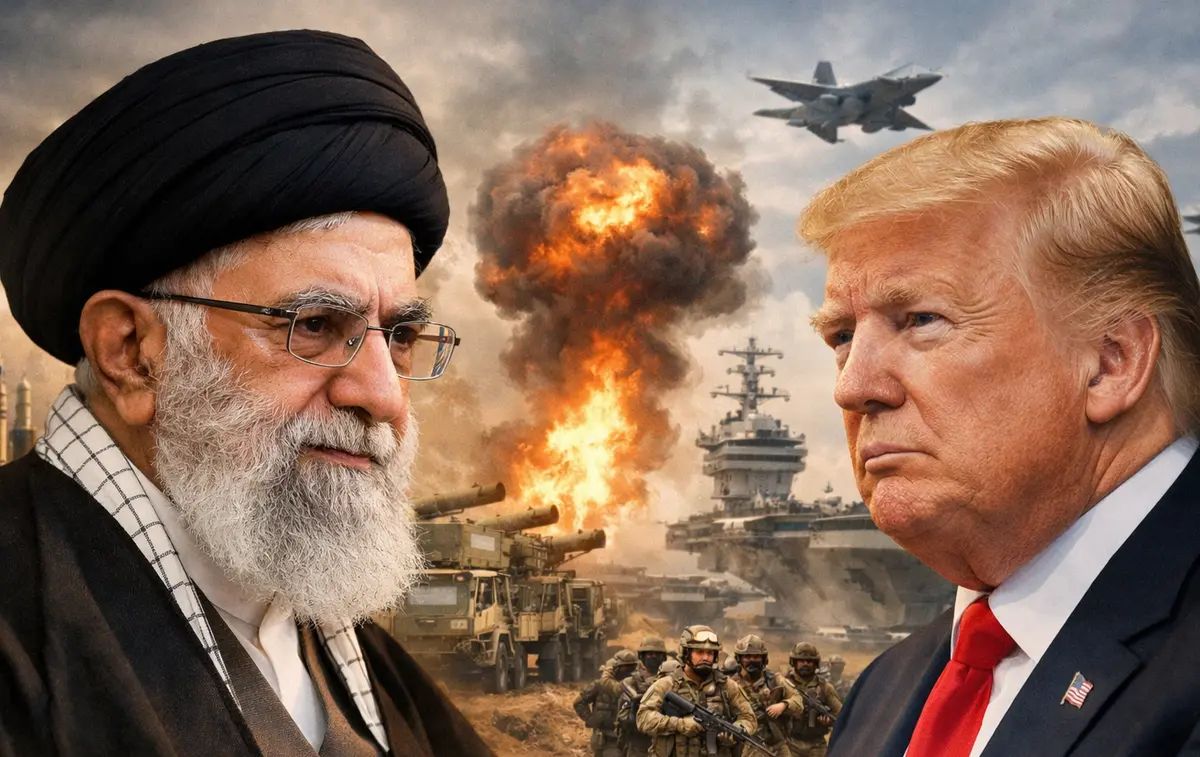
Amid rising tensions in the Gulf, Iran’s Supreme Leader, Ayatollah Ali Khamenei, issued a stark warning to the United States, stating that even the “strongest military force in the world” could be struck so hard “that it cannot get up again,” and suggesting that a warship could be sent “to the bottom of the sea.”
Khamenei’s statements coincided with Washington’s reinforcement of its naval presence in the region, including the deployment of the USS Gerald R Ford, the US Navy’s most advanced aircraft carrier. This has sparked questions about whether Iran could realistically sink a modern American supercarrier.
Why the USS Gerald R Ford Is Extremely Hard to Sink
The USS Gerald R Ford (CVN-78) is a 100,000-tonne nuclear-powered supercarrier built with extensive survivability features. Its hull is divided into multiple watertight compartments, allowing flooding to be contained even if some sections are breached.
As per reports, critical systems including power, firefighting, and aircraft launch and recovery are redundant, enabling the carrier to continue operating even after sustaining damage.
During shock trials, 40,000 pounds of explosives were detonated underwater near the hull to simulate combat conditions. The carrier remained structurally sound, with no catastrophic flooding or uncontrolled fires, demonstrating its ability to withstand severe underwater blasts from mines or torpedoes.
Naval analysts widely agree that the idea of a single missile sinking a supercarrier is largely a myth. Modern carriers are engineered to survive and fight through substantial damage.
Iran’s “Carrier-Killer” Strategy
Iran has invested heavily in asymmetric naval warfare, focusing on anti-access and area-denial strategies, particularly in narrow waterways like the Strait of Hormuz. Tehran fields anti-ship cruise and ballistic missiles, armed drones, naval mines, and fast-attack craft. While Iranian rhetoric often mentions “carrier-killer” concepts, actually hitting a moving carrier in open waters remains extremely challenging.
Carrier strike groups travel at high speed and change course unpredictably. To successfully hit one with long-range missiles, an adversary needs real-time intelligence, persistent surveillance from satellites, maritime patrol aircraft, or drones, and secure data links to update targeting mid-flight. Without continuous tracking, even advanced missiles may miss entirely.
The more realistic threat comes from a coordinated saturation attack rather than a single missile. Hypersonic weapons, capable of travelling faster than Mach 5 and maneuvering unpredictably, could inflict significant damage if they penetrate layered air and missile defenses. But multiple hits on vital areas, such as ammunition storage, aviation fuel, or key structural points, would likely be necessary to sink a carrier.
Iran claims to have operationalized hypersonic systems like the Fattah-2 and has modified some ballistic missiles for anti-ship roles. The 2024 attacks by Houthi forces on Gulf of Aden shipping, using Iranian-supplied missiles and drones, demonstrated elements of this approach. A potential strike on a US carrier could involve waves of lower-cost drones and missiles to exhaust defenses, followed by higher-value weapons to try for a breakthrough.
Khamenei Directly Challenges US Naval Power
Khamenei’s most provocative rhetoric targeted US naval power directly. He acknowledged the danger posed by American warships but countered, “Of course an aircraft carrier is a dangerous device, but more dangerous than the carrier is the weapon that can send it to the bottom of the sea.”
In other statements, he taunted that even the “strongest army in the world” could be “slapped so hard” it “cannot get up,” implying Iran possesses the means likely advanced anti-ship missiles, drones, or hypersonic weapons to challenge US dominance in the Gulf.
These threats coincided with Iranian military exercises, including live-fire missile drills in the Strait of Hormuz by the Islamic Revolutionary Guard Corps (IRGC) Navy. The IRGC has long boasted about its ability to close the strategic waterway, through which roughly 20% of global oil passes, and recent war games demonstrated strikes on mock naval targets.
US Responds with Naval Buildup in the Gulf
The backdrop to these statements is a significant US military buildup. Reports indicate at least one aircraft carrier, the USS Abraham Lincoln, positioned in the region, with a second on the way, alongside additional air defense systems and forces to counter potential Iranian missile or drone attacks.
This escalation follows earlier US actions, including responses to Iran’s nuclear advancements and regional proxy activities. Satellite imagery has shown US carriers operating hundreds of kilometers from Iran’s coast, yet still within reach of Tehran’s growing arsenal of precision-guided munitions.
Tehran Maintains Defiant Stance in Negotiations
Iran’s position remains defiant. Foreign Minister Abbas Araghchi and other officials have emphasized that missiles are off-limits in negotiations, with Tehran insisting talks focus narrowly on nuclear issues.
Khamenei reinforced this by portraying US demands as interference in sovereign affairs, accusing Washington of irrationality amid its own perceived decline.
He also referenced Trump’s past admissions that the US has failed to eliminate the Islamic Republic over 47 years, declaring that America “will not succeed” in doing so now.





