










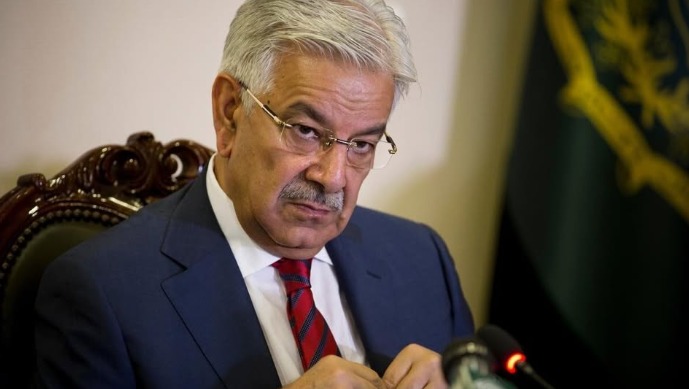
In an unusually candid and self-critical address in Parliament, Pakistan’s Defence Minister Khawaja Asif has acknowledged that Islamabad allowed itself to be repeatedly exploited by the United States during the Afghan conflicts, resulting in irreversible political, social, and security damage. Describing Pakistan’s role in Washington’s regional strategy, Asif said the country was treated “worse than toilet paper,” used for strategic purposes and then discarded when no ltooleronger needed.
Speaking during a parliamentary session, Khawaja Asif said Pakistan’s decision to align itself with the US, particularly after its realignment in 1999 and following the September 11, 2001, attacks, proved to be a grave miscalculation whose consequences are still unfolding. He admitted that successive governments permitted Washington to use Pakistani territory, intelligence networks, and military resources for its operations in Afghanistan, believing that such cooperation would bring long-term diplomatic and economic benefits. Instead, he said, the alliance left Pakistan facing terrorism, radicalisation, economic strain, and international pressure.
Background:
The Defence Minister Khawaja Asif said terrorism in contemporary Pakistan is a direct “blowback” of these past mistakes. He noted that the country should never have involved itself in two Afghan wars, during the Soviet occupation in the 1980s and the US-led war on terror after 2001. Calling both decisions fundamental errors. According to Asif, the damage caused by these policies is irreversible, and no amount of compensation can undo the losses suffered by the nation.
Khawaja Asif directly blamed former military rulers Zia-ul-Haq and Pervez Musharraf for drawing Pakistan into foreign conflicts in an effort to appease Washington. He said their decisions were motivated by the pursuit of American approval rather than national interest and had nothing to do with genuine religious or ideological commitments. Challenging long-standing official narratives, he argued that the concept of “jihad” was deliberately misused to justify Pakistan’s involvement in these wars, describing it as misleading, destructive, and politically motivated.
He further stated that Pakistan had fought what he termed a “Made in America” jihad, shaped primarily by US geopolitical priorities. According to the minister, religious sentiment was exploited to mobilise fighters and public support, while the broader consequences were ignored. He added that Pakistan’s education system was also reshaped during this period to legitimise these conflicts, embedding ideological narratives that continue to influence society today and remain difficult to reverse.
Referring to the post-2001 period, Khawaja Asif said Pakistan turned against the Taliban to support the US-led war on terror, only to be left isolated after Washington withdrew its forces from Afghanistan. He noted that the United States exited the region without eliminating the Taliban threat, leaving Pakistan to manage the resulting security challenges alone. As militant violence, cross-border attacks, and refugee pressures intensified, Islamabad was left to fend for itself, he said, while its former ally moved on to other strategic priorities.
“The losses we suffered can never be compensated,” Khawaja Asif told lawmakers, describing Pakistan’s role as that of a rented ally and a pawn in conflicts driven by external powers. He said the country was used for a specific purpose and then abandoned, adding that Pakistan continues to deny parts of its own history instead of fully accepting responsibility for past decisions.
Reactions:
The defence minister’s remarks came amid rising political tensions and renewed debates over Pakistan’s internal security. Only days earlier, Interior Minister Mohsin Naqvi had alleged that India was providing financial support to militant groups operating inside Pakistan, though he did not present evidence to support the claim. Naqvi’s statement followed a deadly blast at a Shia mosque in Islamabad that killed dozens and injured more than 160 people.
India strongly rejected the allegations, calling them baseless and condemnable. The Ministry of External Affairs said Pakistan was attempting to deflect attention from its internal problems by blaming external actors for homegrown extremism. Despite this, Khawaja Asif also echoed similar claims, alleging without evidence that India and Afghanistan were linked to militant activities targeting Pakistan.
Analysis:
Observers noted a contradiction in Khawaja Asif’s speech. While he openly acknowledged Pakistan’s historical mistakes and dependence on foreign sponsorship, he simultaneously revived familiar narratives that place responsibility on neighbouring countries. Analysts say this reflects a deeper strategic dilemma within Pakistan’s security establishment, caught between admitting past failures and continuing the habit of external blame.
From India’s perspective, commentators said the remarks underline Islamabad’s reluctance to confront the full consequences of its own policies. While acknowledging that Pakistan was exploited by global powers, they argue that meaningful reform requires abandoning long-standing patterns of denial and deflection.
Political analysts also pointed out that many of the individuals and institutions responsible for shaping these policies remain influential today, raising questions about accountability and the likelihood of genuine change. Without structural reforms in foreign and security policymaking, critics warn that Pakistan risks repeating similar errors in future geopolitical rivalries.
Implications:
Public reaction to comments of Khawaja Asif has been divided. Many citizens welcomed the rare admission of mistakes and viewed it as an overdue recognition of the country’s sacrifices. Others, however, saw the remarks as an attempt to manage public frustration without offering concrete solutions or policy shifts.
As Pakistan grapples with economic challenges, political instability, and persistent security threats, Asif’s blunt assessment has reopened a national conversation on sovereignty, strategic autonomy, and the costs of foreign dependence. His speech serves as a stark reminder that alliances built on short-term convenience can leave long-lasting scars, and that confronting uncomfortable truths may be essential for shaping a more independent and stable future.
Whether this moment of honesty will translate into lasting policy reform remains uncertain. For now, it has exposed both the depth of Pakistan’s past miscalculations and the continuing struggle to move beyond them in an increasingly complex regional and global environment.