
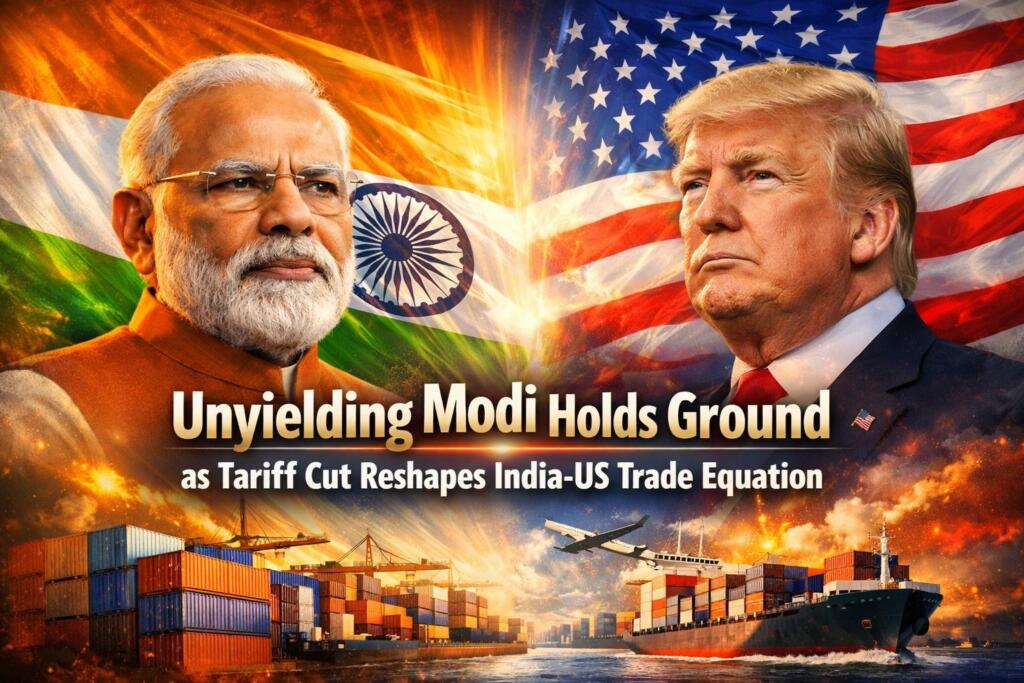
A significant shift in the trade atmosphere between India and the United States has drawn global attention after President Donald Trump rolled back a 25 percent penalty that had been imposed over India’s purchase of Russian oil. The effective tariff burden now stands at 18 percent, a move widely seen as a diplomatic and economic recalibration. At the center of the narrative is the image of Unyielding Modi, portrayed by supporters as having stood firm on India’s position that meaningful progress in negotiations could happen only after the tariff pressure was eased.
The background to this development lies in the tension that emerged when the United States had earlier linked trade penalties to India’s continued energy engagement with Russia. For India, energy security is a strategic necessity tied to price stability and supply reliability. New Delhi maintained that its oil procurement decisions were guided by national interest rather than geopolitical signaling. In this context, Unyielding Modi became a phrase used by many commentators to describe the Prime Minister’s refusal to accept trade conditions that New Delhi considered unfair or unilateral.
According to discussions circulating in diplomatic and policy circles, India’s stance in recent talks was consistent and clear. The message conveyed was that removing punitive tariffs had to precede any serious movement toward a broader trade understanding. This sequencing mattered symbolically and practically. By insisting on this order, Unyielding Modi signaled that India would negotiate as an equal partner rather than under pressure. Supporters argue that this approach helped reframe the tone of engagement from confrontation to negotiation.
A report by Bloomberg had earlier added weight to this narrative by noting that India’s National Security Adviser Ajit Doval met U.S. Senator Marco Rubio. During that interaction, it was indicated that tariff removal was a prerequisite for advancing any deal. The suggestion that India would otherwise wait out political changes in Washington underscored the firmness of the position. For observers, this reinforced the image of Unyielding Modi as a leader willing to absorb short term friction to secure what he sees as long term strategic space for India.
The rollback of the 25 percent penalty, bringing the total tariff to 18 percent, is being interpreted in multiple ways. Economically, it reduces cost pressures and opens room for renewed trade conversations. Politically, it is being framed by supporters as validation of India’s negotiating posture. In this telling, Unyielding Modi did not bend to external pressure but instead waited for conditions to align more favorably. Critics, however, caution that trade diplomacy is rarely a story of one side winning and the other losing, and that such outcomes usually reflect layered bargaining on both ends.
Energy has been at the heart of the dispute. India, as a fast growing economy with vast energy needs, has diversified its oil sources to manage costs. Discounted Russian crude became attractive in a volatile global market. Western pressure to curtail such purchases collided with India’s argument that its primary duty is to ensure affordable energy for its citizens. The posture associated with Unyielding Modi therefore resonates domestically, where economic stability and sovereignty in decision making are politically powerful themes.
The episode also highlights the evolving nature of India U.S. ties. The relationship spans defense cooperation, technology partnerships, and strategic coordination in the Indo Pacific. Trade frictions periodically surface, yet both sides recognize the broader value of the partnership. In this sense, the tariff adjustment may be seen as an effort to prevent one issue from overshadowing a much wider agenda. Even so, the domestic narrative in India continues to emphasize that Unyielding Modi ensured negotiations took place on terms that respected India’s core interests.
There is also a signaling element in how this development is being discussed. By projecting firmness, New Delhi communicates to multiple global partners that it will not easily shift policy under pressure. This matters in a world where economic tools are increasingly used for strategic leverage. The portrayal of Unyielding Modi thus extends beyond the U.S. context and feeds into a broader image of India seeking a more autonomous role in global affairs.
At the same time, seasoned analysts point out that diplomacy often involves quiet compromises not visible in public narratives. The reduction of tariffs could reflect calculations in Washington as much as resolve in New Delhi. Still, perception shapes politics, and the perception taking hold among many Indian observers is that steady insistence on fair terms yielded results. In that perception, Unyielding Modi becomes shorthand for a negotiating style that prioritizes national interest and patience over quick concessions.
As discussions move toward possible broader agreements, the immediate tension appears to have eased. The tariff rollback has created breathing space, and both sides now have an opportunity to reset the tone. Whether this leads to a comprehensive trade arrangement or remains a limited adjustment will depend on future talks. For now, the episode stands as a case study in how trade, geopolitics, and domestic political narratives intersect, with the image of Unyielding Modi occupying a central place in how the story is being told within India.