
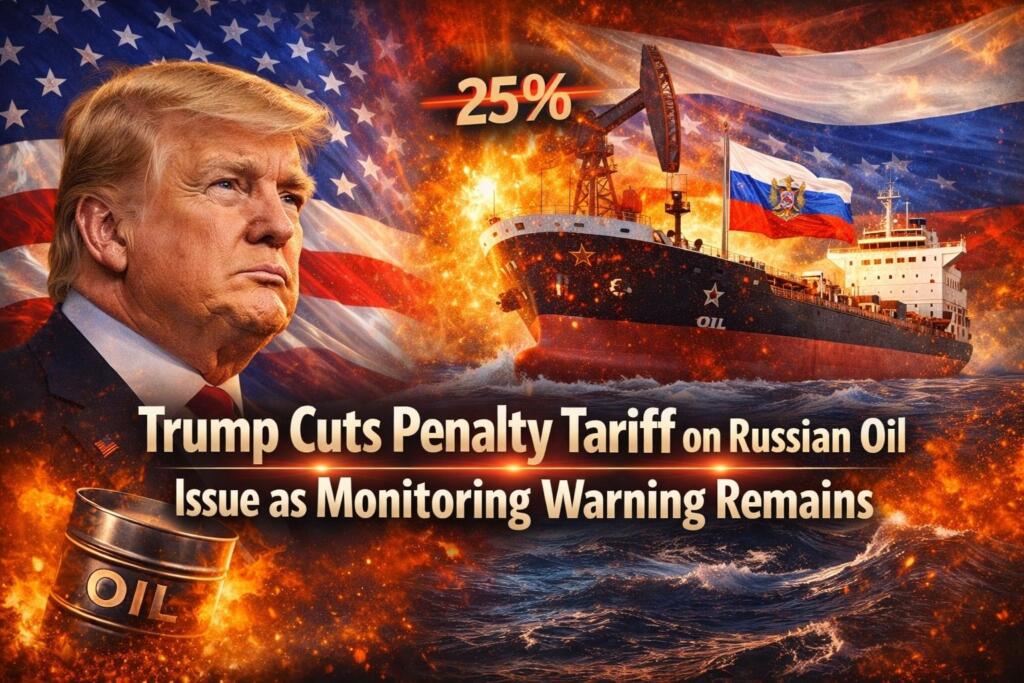
A major shift in trade signaling has emerged after U.S. President Donald Trump moved to slash the penalty tariff that had been associated with India’s purchase of Russian oil. While the reduction marks a softening of immediate economic pressure, the development comes with a clear caution from Washington that future purchases will still be watched closely. Interestingly, the interim trade framework between the two countries makes no formal reference to the penalty tariff, creating a layered situation where official documents and political messaging appear to operate on separate tracks.
The rollback of the penalty tariff represents more than a technical adjustment in customs duties. It reflects the complex intersection of geopolitics, energy security, and trade diplomacy. India’s decision to buy discounted Russian crude had drawn criticism in Western capitals, especially amid broader efforts to isolate Moscow economically. The earlier penalty tariff was widely seen as a signal of U.S. displeasure. Its reduction now suggests a recalibration, but not a complete withdrawal of concern, as Trump has publicly stated that the United States will continue to monitor the situation.
One of the most striking aspects of this episode is that the interim trade framework between the two countries reportedly does not explicitly mention the penalty tariff. Trade frameworks typically lay out areas of agreement, dispute resolution mechanisms, and sectoral priorities. The absence of direct language on this issue indicates that the matter may have been handled through parallel diplomatic channels rather than formal trade text. Even so, the shadow of the penalty tariff continues to influence perceptions about the balance of leverage in the relationship.
Energy security is central to understanding why India maintained its oil purchases despite pressure. As a fast growing economy with rising fuel demand, India seeks to secure supplies at stable and affordable prices. Discounted Russian crude became an attractive option during a period of global price volatility. From New Delhi’s perspective, these purchases were driven by economic necessity rather than political alignment. The earlier penalty tariff therefore became a point of friction, symbolizing the tension between national interest and external expectations.
Trump’s statement that the U.S. will monitor future purchases adds an element of strategic ambiguity. On one hand, cutting the penalty tariff eases immediate trade stress and opens space for broader economic cooperation. On the other, the monitoring language signals that the issue has not disappeared. This dual message allows Washington to reduce overt confrontation while retaining a tool of influence. In effect, the penalty tariff has shifted from being an active economic burden to a potential pressure point that could be revisited.
For trade negotiators, this creates a delicate environment. Businesses prefer predictability, yet the continued political focus on energy sourcing introduces uncertainty. Even if the penalty tariff is no longer as heavy as before, the fact that it can be raised in political discourse keeps it relevant. Investors and exporters must therefore factor in not only formal trade rules but also the broader geopolitical climate shaping bilateral ties.
The episode also underscores how modern trade policy extends beyond goods and services into strategic behavior. Sanctions, tariffs, and monitoring mechanisms are increasingly used to influence decisions that once fell squarely within sovereign economic policy. The debate around the penalty tariff illustrates this shift. What began as a response to energy trade has evolved into a symbol of how interconnected global politics and commerce have become.
At the same time, the absence of explicit reference in the trade framework offers both sides flexibility. Without binding language, diplomats can manage the issue through dialogue rather than legal commitments. This can reduce the risk of immediate escalation, but it also means that future tensions could resurface without clear procedural guardrails. The penalty tariff thus remains part of the background landscape rather than a settled chapter.
Domestic political narratives in both countries will likely interpret the development differently. Some will view the reduction as a sign that firm negotiation worked. Others may see it as a temporary pause in a longer strategic contest. Trump’s emphasis on monitoring ensures that the issue retains political visibility, preventing it from being quietly folded away. In this sense, the penalty tariff continues to function as both an economic measure and a political message.
Ultimately, this situation highlights the evolving nature of international economic relations. Trade agreements no longer operate in isolation from security and foreign policy concerns. The story of the penalty tariff shows how a single policy tool can carry symbolic weight far beyond its numerical value. As India and the United States move forward with their broader trade engagement, the handling of energy related sensitivities will remain a key test of how both sides balance partnership with strategic caution.