


















The Principles of Warfare
Warfare throughout time has stood on a handful of principles. The technology has evolved, sure, but the thinking behind war has barely changed.
These principles are speed, deception, precision, and invisibility.
Now let’s focus on invisibility the one advantage that can flip the battlefield on its head.
Imagine this: you attack your enemy… and you’re never seen.
One hell of an advantage, is it not?
That is exactly what Stealth Tech tries to achieve, especially in air combat.
The idea is simple: hide your jet from the enemy’s sight.
And in modern warfare, “sight” refers to radar.
What does RADAR do?
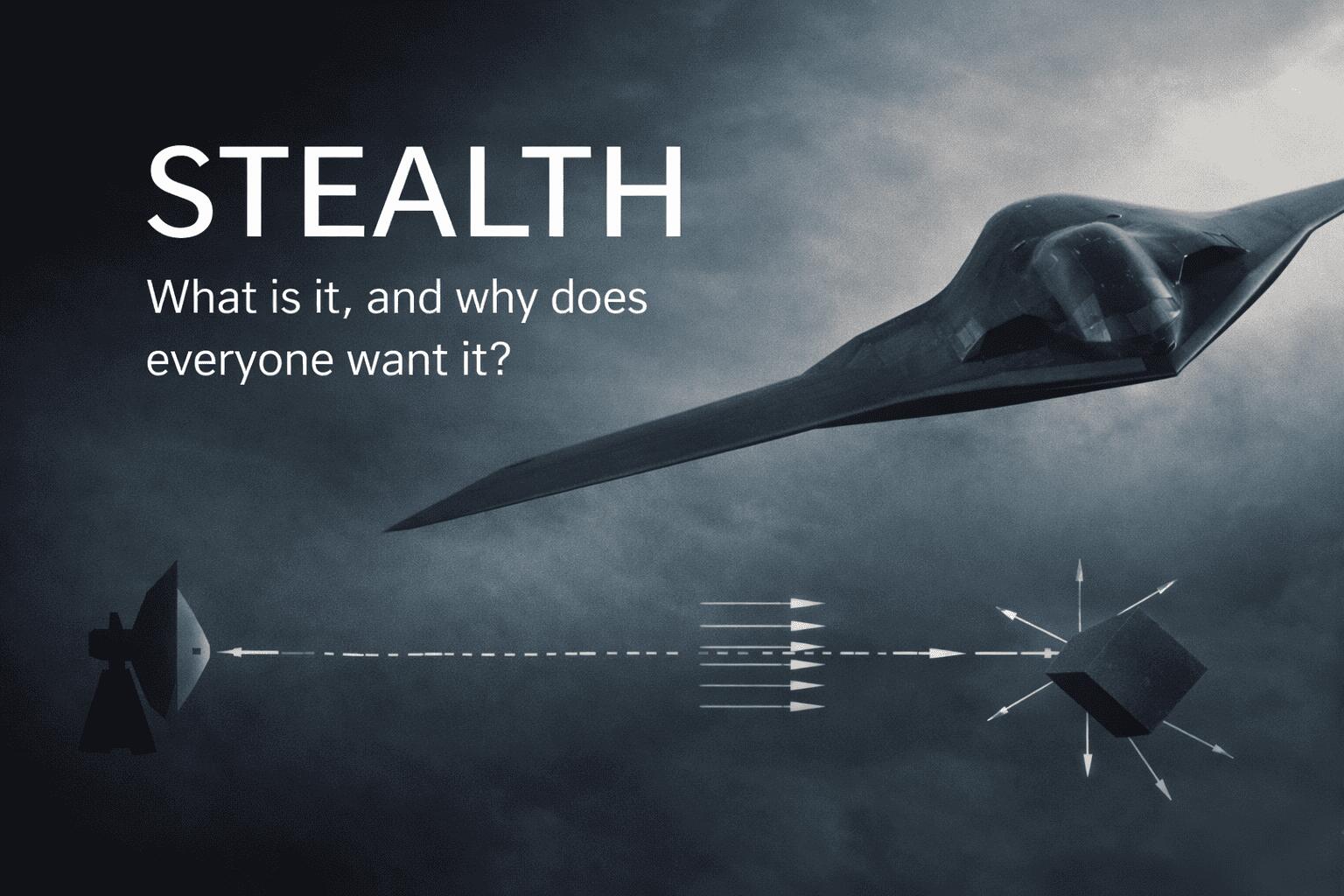
Radar sends out electromagnetic waves. Those waves hit a surface, and based on how they bounce back, the radar can figure out:
the position of the object
its velocity
and very importantly, its shape
Shape is the dead giveaway.
A round surface returns a strong, clean signal. A messy one returns noise.
So how do you overcome this?
You fool the radar.
Make it believe the fighter jet it just pinged… wasn’t a fighter jet at all.
How do they achieve that?
While stealth traces its roots back to German engineering experiments in World War I, the modern blueprint rests on two core ideas:
1. Absorption
The trick is to use special paints and coatings that absorb radar waves.
If the surface absorbs the signal instead of reflecting it, the radar gets almost nothing in return leaving it clueless.
This method works beautifully, but it’s extremely expensive to develop and maintain.
2. Reflection
More recent approaches partly because of cost depend heavily on shape.
Take a moment and notice something:
The more circular a surface is, the better it reflects radar waves back to the source.
That’s exactly why civilian aircraft show up so easily on radar.
Now compare that to the B-2 Bomber.
Look at its geometry and you’ll find almost no round surfaces. Instead, you see:
sharp edges
blended angles
long smooth curves
This shape intentionally redirects radar waves in odd directions, preventing them from returning cleanly to the radar receiver.
The system gets scattered signals not enough to identify the aircraft.
Here’s the simple idea:
Round = detectable.
Angular = confusing.

The hyper-modern layer
In cutting-edge designs, engineers take things even further. They bury engines deeper inside the body, hide weapons behind internal bay doors, and reduce heat signatures so even infrared scanners struggle.
Every exposed surface is a liability.
Every smooth edge is an advantage.
In essence
Stealth is not invisibility in the Hollywood sense.
It’s misdirection.
It’s psychology against machines.
Be seen as something smaller.
Be seen as something harmless.
Or better… don’t be seen at all.