

















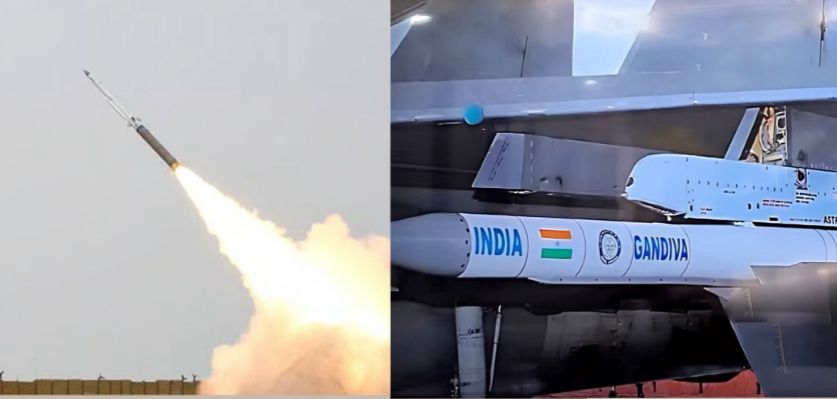
A successful demonstration of Solid Fuel Ducted Ramjet (SFDR) technology was carried out on the morning of February 3 at around 10:45 am from the Integrated Test Range in Odisha, according to the Defence Research and Development Organisation (DRDO).
With this test, India has entered the select group of nations that possess this highly complex and strategically critical propulsion technology.
During the test, all key subsystems of the missile including the nozzle-less booster, the solid fuel ducted ramjet motor and the fuel flow controller—performed exactly as expected.
This confirms that the demonstration was fully successful from a technological and operational standpoint. However, the larger question is why this test is considered so important, and why a missile launched from the ground is being discussed primarily in the context of air-to-air combat.
Understanding SFDR: Why Ramjet Changes the Game?
In reality, this was a test of the SFDR missile, or Solid Fuel Ducted Ramjet missile. As the name itself indicates, the missile uses a ramjet engine for propulsion, while relying on solid fuel.
Although the test involved a ground launch, the missile itself is designed as an air-to-air weapon. It is also known as Astra Mark-3, or Gandiv.
This means the demonstration was effectively a key milestone in the development of the Gandiv missile, whose expected operational range is around 300 kilometres.
To understand the significance of this achievement, it is essential to first examine how the SFDR or solid fuel ducted ramjet propulsion system works.
Any missile requires propulsion to move forward, and most conventional missiles rely on solid fuel motors. In such systems, oxygen is required for combustion, so oxidisers are pre-mixed with the fuel.
These oxidisers provide oxygen during propulsion, allowing the fuel to burn rapidly and generate the thrust needed to propel the missile.
However, this traditional propulsion method comes with two major limitations. The first is related to fuel capacity. Due to design constraints, a missile can carry only a limited amount of fuel, and a significant portion of that space is taken up by oxidisers. This reduces the amount of usable fuel and, as a result, limits the missile’s overall range.
The second challenge lies in the burn rate of solid fuel motors. Once ignited, the motor cannot be controlled and continues burning until the fuel is exhausted. This leads to very high speed in the initial phase of flight, but the missile tends to lose energy as it approaches the target.
A Massive No-Escape Zone in the Making
SFDR technology addresses both of these issues. In a solid fuel ducted ramjet system, the missile draws the oxygen required for combustion directly from the surrounding air.
To enable this, air intake ducts—similar to those seen on fighter aircraft—are incorporated into the missile’s front section. As a result, the space previously occupied by oxidisers can instead be used to carry additional fuel, significantly increasing the missile’s range.
Moreover, the burn rate in an SFDR system can be controlled to a certain extent. This allows the missile to sustain its energy well into the terminal phase of flight, dramatically reducing the target’s chances of escape. This is why the “no-escape zone” of the Gandiv missile is expected to be exceptionally large.
That said, SFDR technology also presents its own set of challenges. It involves extremely complex engineering, and a ramjet engine can function only when the incoming airflow is at very high speed.
This condition can be met only after the missile has already achieved supersonic velocity. For this reason, during the ground-launched test, a booster was used to accelerate the missile to the required supersonic speed before the ramjet engine was ignited.
According to the NOTAM issued for this test, the declared test range was about 180 kilometres, while the missile’s actual range is believed to be close to 350 kilometres.
This suggests that the demonstration may not have been a full-range test. Even so, achieving a range of 160–170 kilometres from a surface launch is a strong indicator of the missile’s potential.
In an air-launch scenario, performance would be significantly enhanced. At high altitudes, air is thinner and resistance is much lower.
If launched from an altitude of 40,000 to 50,000 feet, the missile could easily reach ranges of 300 kilometres or more. In a lofted trajectory, the effective range could increase even further. Overall, the no-escape zone of this missile is expected to exceed 200 kilometres.
This is precisely why the SFDR-powered Gandiv missile is being viewed as a game changer for India. It is often described as India’s own equivalent of the Meteor missile, and in several respects, it is expected to be even more capable.
The missile is likely to feature an advanced AESA seeker, proximity fuse and datalink, making it highly effective in heavy anti-jamming environments and a powerful asset in network-centric warfare.
When Can Gandiv Enter Service?
Since Gandiv is part of the Astra missile family, its integration is not expected to pose major challenges. Aircraft that are already cleared to carry Astra missiles should be able to accommodate Gandiv with relative ease.
As trials continue, air-launch tests are expected in the near future, including launches from platforms such as the Su-30MKI. If progress continues as planned, the missile could be inducted into service by around 2028.
Once operational, Gandiv is expected to be integrated not only on indigenous platforms like Tejas, but also on foreign platforms such as Rafale. Overall, this successful SFDR demonstration represents a major boost for India’s defence industry and highlights the steady advancement of the Astra programme.
With Astra Mark-1 already in service and Mark-2 expected to enter service this year, the eventual induction of Mark-3 will give the Indian Air Force a fully indigenous BVR capability spanning ranges from 100 to 350 kilometres—exactly the kind of self-reliance the defence sector urgently requires.