




















A political controversy erupted this week after allegations surfaced that government funds were improperly used to support an event organised by Sanatan Sanstha. The Hindu organisation has categorically denied the charges, asserting that the financial assistance in question was sanctioned strictly for a cultural exhibition and not for the broader ideological programming of its December event in New Delhi.
The row began when the Indian National Congress accused the Union government of channeling public money to what it described as a controversial gathering. According to Congress leaders, the funding was linked to the larger “Sanatan Rashtra Shankhnaad Mahotsav,” and they questioned whether taxpayer funds should support events where certain political or religious viewpoints are expressed. The party alleged that speeches delivered during the programme promoted ideas inconsistent with constitutional values.
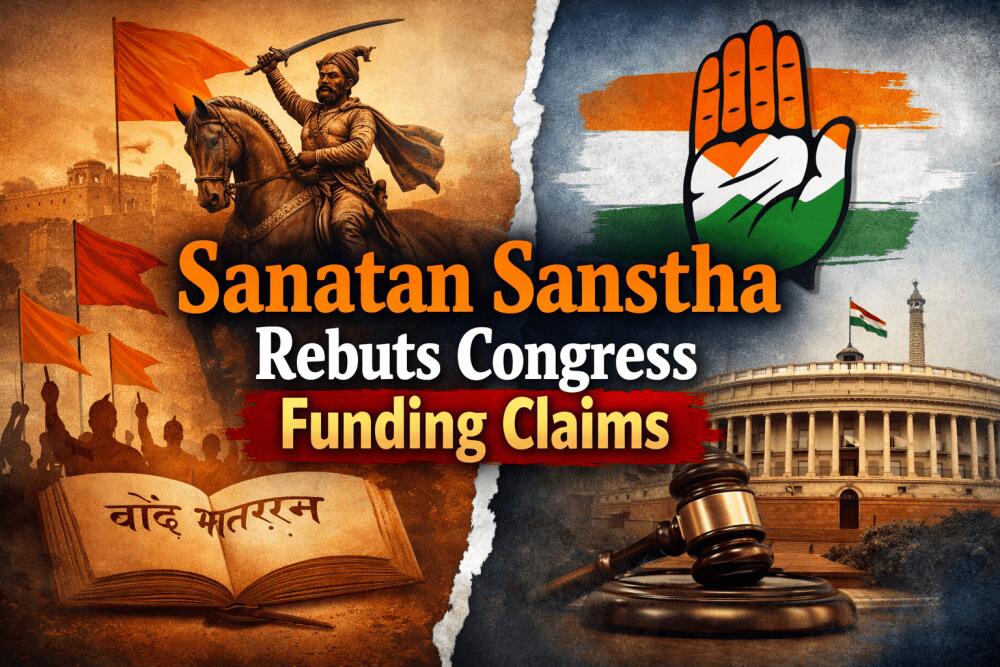
In response, Sanatan Sanstha clarified that the ₹63 lakh grant from the Ministry of Culture was specifically allocated for an exhibition dedicated to the history of Vande Mataram and the legacy of Chhatrapati Shivaji Maharaj. The organisation emphasised that this exhibition formed only one segment of a larger three-day event and that the sanctioned funds were used solely for the approved cultural display.
The exhibition was hosted at Bharat Mandapam, a prominent venue that frequently accommodates government-backed conferences and cultural programmes. Organisers maintained that all procedural requirements were followed and that the proposal underwent due scrutiny before approval. According to Sanatan Sanstha, conflating the exhibition grant with the entire event amounts to a distortion of facts.
Speaking on behalf of the organisation, Abhay Vartak rejected the allegations as politically motivated. He stated that the funding was transparently processed and tied exclusively to the exhibition highlighting India’s historical and cultural heritage. He further asserted that no anti-constitutional or anti-national speeches were part of the exhibition segment that received government support. Sanatan Sanstha insists that critics have deliberately blurred the distinction between the cultural component and other aspects of the event.
The controversy has unfolded against a broader backdrop of intense debate over cultural funding and ideological neutrality. Opposition leaders argue that state support must remain strictly non-partisan and free from any association with polarising narratives. They contend that even indirect funding can be interpreted as endorsement. Sanatan Sanstha counters that promoting national icons and historical narratives should not be viewed through a partisan lens and that such cultural commemorations fall well within constitutional parameters.
Central to the debate is the symbolic resonance of Vande Mataram and Shivaji Maharaj. For many Indians, these figures and expressions represent resistance, pride, and civilisational continuity. The exhibition reportedly showcased archival material, historical interpretations, and displays of traditional weaponry linked to the Maratha ruler’s military campaigns. Sanatan Sanstha maintains that celebrating these aspects of history is neither exclusionary nor sectarian but part of preserving India’s heritage.
Critics, however, argue that context matters. They claim that when cultural exhibitions are embedded within events where controversial rhetoric is aired, questions naturally arise. Sanatan Sanstha has strongly rejected this line of reasoning, stating that each component of a programme must be assessed independently. The organisation maintains that the exhibition was educational in nature and aligned with the objectives outlined in the funding proposal.
In addition to clarifying the financial aspects, Sanatan Sanstha has indicated it may pursue legal remedies against individuals and outlets that label the group with unproven or defamatory descriptions. The organisation asserts that no court has convicted it of unlawful activities and that repeated allegations without judicial backing harm its reputation. According to its representatives, protecting institutional credibility is essential in an era of rapid information dissemination and political polarisation.
The episode also underscores the increasingly blurred lines between culture and politics in contemporary India. Public funding for cultural initiatives often becomes contentious when the organising body holds explicit ideological positions. While supporters argue that pluralism includes the right to celebrate majority traditions, detractors caution against any appearance of state favoritism. Sanatan Sanstha has positioned itself firmly within the former argument, stating that cultural pride and constitutional loyalty are not mutually exclusive.
As the debate continues, calls have emerged for greater transparency in the allocation of cultural grants. Some commentators suggest clearer communication from government departments about the scope and conditions of funding to prevent misunderstandings. Sanatan Sanstha, for its part, has reiterated that it welcomes scrutiny so long as it is based on documented facts rather than conjecture.
Ultimately, the controversy highlights enduring tensions in India’s democratic discourse. Questions about identity, heritage, and the appropriate use of public resources are unlikely to fade anytime soon. Whether the matter escalates into a prolonged legal and political battle or subsides after clarifications remains to be seen. For now, Sanatan Sanstha stands by its assertion that the exhibition was a lawful, culturally focused initiative—and that the allegations against it stem from political rivalry rather than financial impropriety.





