
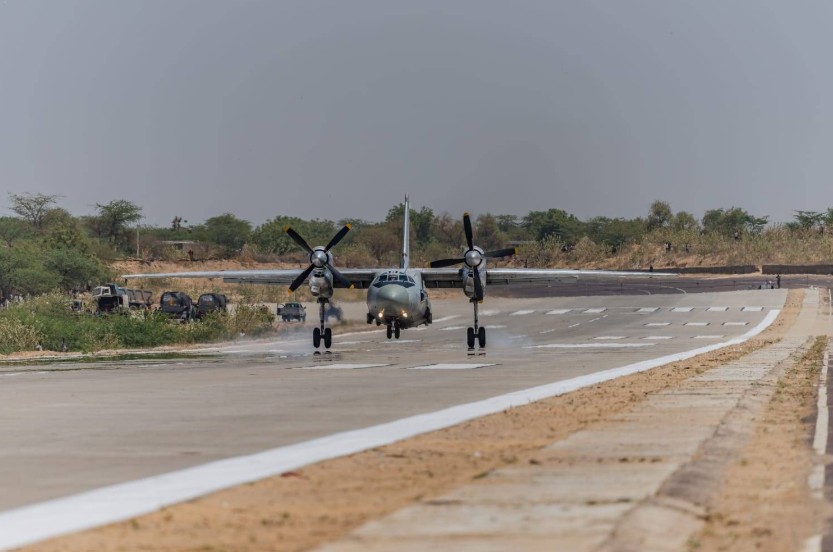
In a bold expansion of defence and dual-use infrastructure, India is rapidly transforming stretches of national highways into Emergency Landing Facilities (ELFs), strategically engineered strips that can function as air force runways during crises.
The latest of these, inaugurated by Prime Minister Narendra Modi on February 14, 2026, in Moran, Assam, marks a significant shift in the country’s preparedness calculus near the Line of Actual Control (LAC) with China
In a powerful demonstration of this capability, Prime Minister Narendra Modi landed at the newly developed Emergency Landing Facility (ELF) in Moran, Assam, aboard a C-130J Super Hercules aircraft, marking a significant milestone in India’s border infrastructure push and its growing focus on operational readiness near sensitive frontier zones.
The touchdown took place at one of the 28 Emergency Landing Facilities (ELFs) being developed across the country, reinforced highway stretches designed to function as operational airstrips.
Which Highways Have Been Turned into Runways?
The Indian Air Force and the Ministry of Road Transport and Highways have identified nearly of 28 Emergency Landing Facilities (ELFs) on national highways across India, of which about 15 are reported ready or active.
These strips of highways allow fighter jets and heavy aircraft to land during emergencies or wartime contingencies and such ELFs are designed to serve as alternate runways if airbases are targeted or rendered unusable. Most of India’s ELFs are situated in western, northern and central parts of the country.
This facility in Assam, the first in the Northeast and close to the Chabua Air Force Station (AFS), assumes added significance given its proximity to the Line of Actual Control with China. India has, in recent years, stepped up border infrastructure in the Northeast following tensions in eastern Ladakh.
Some other highways that have been turned into runways include the Taj Expressway (Uttar Pradesh) which already served as a dual-use runway, the Ganga Expressway (UP) and NH-925A in Barmer (Rajasthan), both equipped with ELF facilities and the Purvanchal Expressway (UP) was earlier developed with runway capability and inaugurated with an IAF air show.
Beyond these, ELFs are under development or planning in West Bengal, Rajasthan, Andhra Pradesh, Gujarat, Tamil Nadu, Bihar, Jammu & Kashmir, Haryana, Punjab and Uttar Pradesh, underscoring a pan-India strategy to disperse landing capacity.
Why Are Highway Runways Used?
The ELF concept originates from a simple strategic need, airbases are vulnerable in high-intensity conflict. Conventional airfields can be targeted or rendered non-operational by missile strikes, cyberattacks, or disasters. In those scenarios or during large-scale emergencies alternative runways ensure sustained air operations.
The Highway ELFs serve three major strategic purposes, which include operational redundancy, rapid deployment and dual-use utility.
If primary airbases near borders like Chabua, Tezpur, Jorhat become unavailable, ELFs enable aircraft to land or take off elsewhere complicating an adversary’s planning. These stretches position India’s aerial combat assets closer to frontier areas, reducing response time in both defence and disaster relief missions.
Beyond military contingencies, highway runways can aid civilian emergency landings, Humanitarian Assistance and Disaster Relief (HADR) operations especially in remote regions, and offer temporary back-up to commercial airports.
For instance, the Moran ELF not only supports military aircraft but could act as an alternate landing option if the nearby Dibrugarh Airport is unavailable due to weather or safety constraints.
How Do Highway Airstrips Work?
The highway airstrips have a reinforced pavement, which means that concrete surface is constructed with high-strength specifications to withstand intense loads from fast-moving jets and heavy transport aircraft.
These airstrips have the feature of temporary closure, which means that Upon operational need, the highway section is cleared of civilian traffic, roadside structures are removed, and the strip is secured for aircraft operations.
There is no central median, design choices like removing medians ensure uninterrupted runway width for safe aircraft movement. =
Additionally, ELFs can be equipped with navigation aids, lighting systems, and communication gear similar to a conventional runway, enabling all-weather capability and integration with IAF command structures.
In essence, such a highway runway functions operationally like a conventional airfield — capable of landings, take-offs, rearming, refuelling, and rapid turnaround if the supporting logistics are in place.
Which Indian Fighter Jets Can Operate from Highways?
According to Firstpost, this ELF (Emergency Landing Facility) in Assam was designed for both civil and military aircraft to take off and land. It was built at a cost of around Rs 100 crore. Rafale fighter jets and C-17 Globemaster transport aircraft will also be able to take off and land here.
As per an NDTV report, fighter jets with a capacity of 40 tons can land on the ELF. Additionally, transport aircraft weighing up to 74 tons will also be able to land. During a 40-minute air show, fighter jets like Tejas, Sukhoi, and Rafale performed maneuvers.
Modern IAF aircraft designed for flexible operations are compatible with these ELF strips. This includes the Dassault Rafale, these multi-role fighters have been showcased operating from highway ELFs during air shows.
The Sukhoi Su-30MKI heavy fighters participate in drills involving highway landings and touch-and-go sorties. It also includes HAL Tejas light combat aircraft, known for agility, are also capable of operating from shorter, well-prepared emergency strips.
In addition, heavy transports like the C-130J Super Hercules and Antonov An-32 have already landed and taken off from these facilities during trials and inauguration events, proving the concept’s robustness.
Meanwhile, Brahma Chellaney, a geostrategist and professor of strategic studies at the Centre for Policy Research in New Delhi, described the landing as strategic shift in India’s airpower planning.
https://x.com/chellaney/status/2022564649913466985?s=46
In a post on X, he wrote, “Modi’s high-profile landing on a national highway in Moran, Assam, one of 28 Emergency Landing Facilities (ELFs) being built across India highlights a quiet but consequential shift in India’s airpower doctrine, the creation of real operational redundancy. The aim is to ensure the Indian Air Force can continue to fight even if an adversary succeeds in striking its major airbases.”
Chellaney explained that this approach reflects a fundamental principle of air warfare and said, “Wars in the air begin by neutralising the enemy’s air defenses and airfields and said that the network of highway airstrips is meant to reduce that vulnerability.
“Their operational value is considerable. In wartime, they provide the IAF with the flexibility to disperse assets and continue operations even if primary bases are damaged. The Moran strip, for instance, can serve as a direct backup to Chabua Air Force Station and Dibrugarh Airport. In a conflict scenario, highway strips are far harder to disable permanently and far quicker to repair,” he added.