
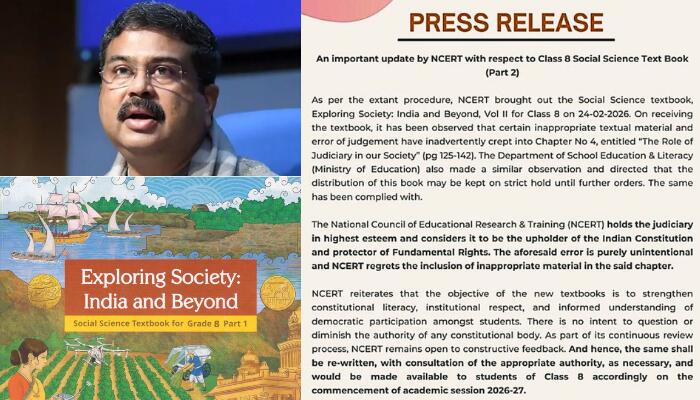
The National Council of Educational Research and Training (NCERT) has withdrawn its newly released Class 8 Social Science textbook following strong objections from the Supreme Court of India, the Union government, and senior members of the legal fraternity over a chapter discussing corruption and systemic challenges within the judiciary.
The textbook, Exploring Society: India and Beyond, Volume II, was published on 24 February 2026. Soon after its release, Chapter 4, “The Role of Judiciary in Our Society”, came under scrutiny for highlighting corruption, case backlogs, and shortages of judges. NCERT later acknowledged that inappropriate material and an error of judgment had inadvertently entered the chapter.
Supreme Court’s Suo Motu Intervention
Chief Justice Surya Kant took suo motu cognisance of the issue after concerns were raised by senior advocates Kapil Sibal and Abhishek Manu Singhvi. Describing the inclusion as a “calculated move”, the Chief Justice said the judiciary’s credibility would not be allowed to be undermined.
He noted that members of the bar, the bench, and several High Court judges had expressed serious unease over the content. The court subsequently ordered a ban on the circulation of the book and directed deeper scrutiny into how the chapter had been approved.
The bench warned that accountability would be fixed and termed the episode a possible “deep conspiracy”. It also issued show-cause notices to officials of the Department of School Education and Literacy and NCERT Director Dinesh Prasad Saklani. NCERT was asked to submit detailed records of the committee that vetted the material.
What the Chapter Contained
The disputed section examined challenges in justice delivery, listing corruption, heavy pendency, and judicial vacancies. It cited around 81,000 pending cases in the Supreme Court, 62.4 lakh in High Courts, and 4.7 crore in district and subordinate courts.
The chapter stated that corruption disproportionately affects the poor and disadvantaged, limiting access to justice. It also referred to grievance mechanisms such as CPGRAMS and quoted former Chief Justice B R Gavai on restoring public trust through transparency. Critics argued that earlier editions had focused on judicial independence and delays without emphasising corruption.
Government Reaction and Minister’s Remarks
Union Education Minister Dharmendra Pradhan publicly criticised NCERT and welcomed the Supreme Court’s observations, calling them “very agreeable”. He described the episode as unfortunate and said immediate steps were taken once the issue came to light.
Pradhan stated that the mention of the Supreme Court and judicial system in the textbook was a matter of concern. He directed NCERT to withdraw all copies and promised action against officials responsible. He added that the government had no intention of showing contempt towards the judiciary and would fully comply with court directions.
NCERT’s Apology and Revision Plan
In its official statement, NCERT reiterated its respect for the judiciary as the guardian of the Constitution and Fundamental Rights. It described the lapse as unintentional and expressed regret for the error of judgment.
The council said the chapter would be rewritten in consultation with appropriate authorities and experts. A revised version is expected to be released at the start of the 2026–27 academic session. Until then, the book will remain unavailable for sale.
By withdrawing the textbook, apologising publicly, and outlining corrective measures, NCERT has sought to reassure students, parents, and educators that institutional integrity and constitutional values remain central to its educational mission.