
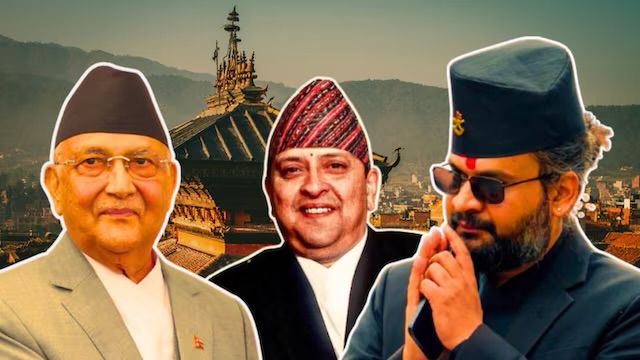
Nepal is heading into high-stakes elections on March 5, just months after massive Gen Z-led protests toppled Prime Minister KP Sharma Oli’s government.
The political battlefield, already crowded with young reformers and entrenched party veterans, has been jolted again, this time by the re-entry of former King Gyanendra Shah.
Capital Shows Affection to Former Monarch
On Valentine’s Day, February 14, thousands gathered outside Tribhuvan International Airport in Kathmandu, not for their loved ones, but to welcome the former king. The pro-monarchy supporters turned up despite prohibitory orders, signaling the enduring affection for Shah and a show of strength from the supporters.
The gathering came amid the aftershocks of the September 2025 Gen Z protests, which had ousted PM Oli and left Nepal’s political scene deeply fractured. The demonstration highlighted the symbolic role Gyanendra still plays for sections of the population who see the monarchy as a source of stability.
Gyanendra Questions Election Timings
The 78-year-old former king released an eight-minute video message days later on the eve of Democracy Day. In his February 18 address, Gyanendra paid tribute to King Tribhuvan and the bravehearts of democracy, before turning to contemporary issues.
Shah questioned whether elections should proceed before Nepal resolves its ongoing crisis and said, “While periodic elections for the selection of representatives are a natural process in a democratic system, the prevailing public sentiment at this time is that it would be more appropriate to first resolve the nation’s pressing problems before proceeding with the upcoming elections.”
He described the country as trapped in an “unusual whirlwind of distress” and urged to “forge a national consensus and a broad understanding that includes everyone, and then proceed to the polls.
Ending on a unifying note, he concluded with “Jai Nepal” and a call to adopt “the good and positive aspects of any system.”
Big Players in March 5 Elections
Nepal has nearly 1.9 crore registered voters, including 8 lakh first-timers. About 3,500 candidates are contesting across 165 parliamentary constituencies, with 33% of seats reserved for women.
The traditional heavyweights, the Deuba-led Nepali Congress and Oli-led CPN-UML are no longer the central focus. Oli, the leader of the Communist Party of Nepal (Unified Marxist–Leninist) or (CPN-UML), once dominant, now campaigns largely within his Jhapa constituency, weakened by youth-led unrest.
At the forefront of the generational challenge is 35-year-old Balen Shah, the former rapper-turned-Kathmandu mayor. He has resigned as mayor to contest Jhapa 5 against Oli, positioning himself as a voice for accountability, clean governance, and breaking the cartel of established parties.
At rallies, Shah’s rock star-like presence and use of the ghanti (bell) energize youth voters, making him the face of systemic reform.
Meanwhile, the Nepali Congress presents a contrast as veteran Sher Bahadur Deuba represents the old guard, while 49-year-old Gagan Thapa appeals to younger, reform-minded voters.
Monarchy’s Shadow Over the Polls
Nepal was officially a Hindu kingdom until 2008, ruled by the Shah dynasty. After a decade-long Maoist insurgency and the 2006 People’s Movement, King Gyanendra relinquished absolute power. The monarchy was formally abolished in 2008, and Nepal became a secular federal democratic republic.
Gyanendra, the last reigning king, remains a central figure in current pro-monarchy movements. Though the monarchy’s restoration has limited support, it resurfaces during periods of political instability. During the September 2025 protests, some saw the former king as a symbol of order, with hundreds gathering to greet him on his birthday amid unrest.
Sociologists note that while Balen Shah backs the republic, he has been described as having monarchist tendencies, illustrating the complex political landscape.
September 2025 Gen Z Protests
In September 2025, Nepal saw massive Gen Z-led protests after the government of KP Sharma Oli banned 26 social media platforms on September 4, citing concerns over unregistered sites and misinformation.
The move triggered immediate backlash, particularly among young Nepalis, whose digital lives and activism depended on these platforms. The protests quickly expanded to a broader anger over corruption, inequality, nepotism, and economic stagnation.
Social media circulated reels highlighting the privileged lives of politicians’ children abroad while ordinary citizens struggled. By September 8, demonstrations intensified across Kathmandu and other cities, leading to clashes with security forces. Tear gas and live rounds were reportedly used; over 70 people were killed and more than 300 injured.
Though the social media ban was lifted, protests continued until Oli resigned, and an interim administration under PM Sushila Karki assumed control on September 14. Karki’s government declared those killed as martyrs and promised reforms, temporarily pausing the agitation ahead of the upcoming elections.
Young, Fractured Electorate Faces a Historic Choice
As Nepal heads to the polls, the ballot will test several dynamics, if whether Balen Shah can translate youth anger into electoral victories, whether Oli can retain his Jhapa stronghold and whether Gyanendra’s intervention will shift public sentiment, however subtly.
With a young electorate, a splintered old guard, and rising anti-establishment energy, Nepal’s March 5 elections promise a defining moment in its political evolution.
How Monarchy Shaped Nepal’s Early Development
For much of its history, Nepal was ruled by monarchs whose leadership played a formative role in unifying and shaping the Himalayan kingdom. The Shah dynasty, in particular, is credited with creating the modern state of Nepal and laying foundations for governance, diplomacy and infrastructure that endured for centuries.
The unification of Nepal began under King Prithvi Narayan Shah, who founded the Kingdom of Nepal in 1768 by bringing together over two dozen smaller principalities into a single state. His consolidation of the Kathmandu Valley and surrounding regions established Nepal’s territorial integrity and identity as a sovereign Himalayan nation.
Subsequent monarchs built on this legacy. Under King Mahendra (reigned 1955–1972) and King Birendra (reigned 1972–2001), Nepal expanded diplomatic ties, joined international organisations, and developed key infrastructure that helped integrate the country economically and socially:
Although Nepal’s monarchy was abolished in 2008 after a long civil conflict and democratic movements, many supporters still recall periods of stability and national coherence tied to the Shah kings especially the unifying achievements of Prithvi Narayan Shah and the diplomatic and development strides under Mahendra and Birendra as defining chapters in the nation’s history.