
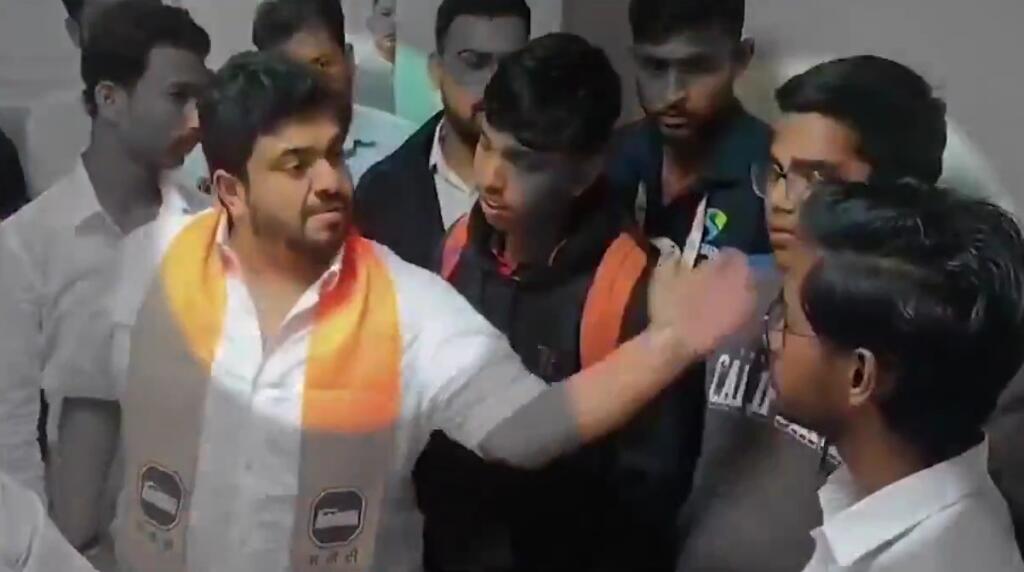
In a fresh incident highlighting tensions over the Marathi versus non-Marathi divide in the state, Maharashtra Navnirman Sena (MNS) workers allegedly assaulted a teacher of a prominent coaching centre in Nashik, Maharashtra, over claims that he had insulted the Marathi language.
The matter came to public attention after a video of the incident purportedly went viral on social media, wherein the MNS workers are seen confronting and thrashing the man inside the coaching centre premises.
According to the video and reports surrounding the incident, students at a Physics Wallah branch on Nashik’s Sharanpur Road alleged that the employee member had called some children who were speaking Marathi “gaonthi” (rustic) and “mannerless”.
As per reports, the aggrieved students approached members of the Raj Thackeray-led MNS and complained regarding the teacher’s remarks.
Following this, atleast four members of the Raj Thackeray-led outfit then showed up at the coaching centre to confront the employee.
The viral video shows the men asking the students what had happened. When the employee begins to speak, one of the MNS workers interrupts him and tells him to talk in Marathi, after which the MNS workers then begin raining slaps on him, hitting him at least four times.
“You come here to earn, you live here, and you insult the local language? Don’t you have any shame?” the MNS workers asked the employee.
The men then turned to another employee and issued a warning, stating that the coaching institute had eight days to appoint Marathi-speaking staff. They cautioned that they would launch an “MNS-style” protest if the demand was not met.
In a similar development last week, an MNS leader had reportedly confronted a bank official in Mumbai’s Mahim for allegedly refusing to speak in Marathi.
Intimidating the bank official, the MNS leader had said, “You are working in the Bank of Maharashtra in Mumbai and you don’t know Marathi? If you want to stay in Maharashtra, you have to learn Marathi.”
The politician later claimed that the official had submitted a written apology and that the bank had assured him that appropriate action would be taken.
Targeting of Non-Marathi Speakers
In recent times, there have been multiple reported instances in Maharashtra where individuals perceived as non-Marathi speakers were allegedly confronted or attacked over language-related issues. Such incidents have sparked wider debates about regional identity, freedom of expression, and the limits of cultural assertion.
The recurrence of these episodes has raised concerns among civil society groups and observers, who argue that repeated acts of vigilantism in the name of linguistic pride risk normalising intolerance.
In a similar incident last year in July, a migrant auto-rickshaw driver was brutally beaten in broad daylight in Maharashtra’s Palghar district by supporters of Uddhav Thackeray’s Shiv Sena (UBT) and Raj Thackeray’s Maharashtra Navnirman Sena (MNS), after a prior confrontation video over the use of the Marathi language went viral on social media.
India Today reported, that in the the video, the driver can be heard forcing the youth to speak in Hindi and Bhojpuri instead. In the video, the rickshaw driver can be seem screaming at a man, saying “main Hindi bolunga, main bhojpuri bolunga. Mujhe Marathi nahi aata hai (I will speak in Hindi, I will speak in English. I don’t know Marathi)”.
The footage sparked outrage among local political outfits, with Shiv Sena and MNS workers tracking down the driver after which he was assaulted on camera in full public view near the same station.
In another incident, on July 2025, a security guard at L&T Powai was allegedly assaulted by MNS workers after an argument with a Marathi-speaking individual. Reports said that the altercation escalated because the guard could not speak in Marathi, leading to the attack by the members of MNS.
In August 2025, MNS workers in Kalyan assaulted an idli vendor over alleged derogatory remarks about Marathi-speaking people, while a video from a local train showed two women locked in a heated argument over the language.
The Kalyan incident took place outside the Royal Star Idliwala eatery. The vendor, known locally as Anna, was accused of using offensive language against Marathi speakers, reported TOI.
In April last year, two women, one of them carrying a baby in her arms, were beaten up in Dombivli in the district for allegedly saying “excuse me” instead of speaking in Marathi.
The incident took place when the women, who were on a two-wheeler, were entering the premises of the housing society where they lived. When the woman who was riding the scooter said “excuse me” to a young man who was obstructing the entrance, he allegedly took offence, demanding that she speak in Marathi, she claimed. The man, who lives on the ground floor of the same building, allegedly twisted the arm of the pillion rider.
Action Taken
Earlier in July 2025, taking cognisance of such incidents, three lawyers wrote a letter to the DGP seeking legal action against the MNS for recent attacks on non-Marathi speaking people by party workers.
The letter cited MNS chief Raj Thackeray’s speech at a rally in Worli on July 5. It claimed that Thackeray made inflammatory and inciting statements against non-Marathi people, which resulted in the party activists taking an aggressive stance against common citizens, assaulting local shopkeepers, and threatening them.
Stating that the unity, peace and integrity of the nation was being threatened due to such incidents, the letter requested the police to take action under the National Security Act (NSA) against the main conspirators and “anti-national” elements.
The letter, written by advocates Pankaj Mishra, Nityanand Sharma and Ashish Rai, described such incidents as “serious and unlawful situations that threaten social harmony and the law and order”.
The letter alleged that MNS workers have been involved in acts of assault, threats and public humiliation of non-Marathi speaking individuals residing in the state and urged the DGP to launch a probe into the speeches and violent actions of MNS leaders and party activists who have been given police protection.
Notably, on July 5, Shiv Sena (UBT) chief Uddhav Thackeray and MNS head Raj Thackeray shared a stage for the cause of the Marathi language, and vowed to oppose the “imposition” of Hindi in Maharashtra after the state govt rolled back the GRs on the introduction of Hindi as a third language in primary schools.
Violence Cannot Defend Language or Culture
While promoting and preserving one’s mother tongue is both valid and culturally important, resorting to intimidation or physical assault is morally and ethically indefensible. Violence not only harms individuals but also erodes the credibility of any movement, reducing a legitimate cause to fear and coercion.
Language is a source of identity, pride, and cultural heritage, and encouraging its respectful use can strengthen social cohesion and foster mutual understanding. Schools, workplaces, and public spaces can thrive when diverse linguistic communities coexist with respect. However, enforcing linguistic preference through threats, harassment, or violence undermines the very values of dignity, tolerance, and mutual respect that language movements aim to promote.
In a democratic society governed by the rule of law, disagreements, whether cultural, linguistic, or social must be addressed through lawful and peaceful means. Legal frameworks, inclusive policies, and community dialogue are the correct channels for promoting language use. Imposing a particular language through coercion not only violates individual rights but also alienates communities and deepens social divisions.
Moreover, such acts of aggression send a chilling message, especially to newcomers or non-native speakers, discouraging them from participating fully in society. Cultural preservation should inspire pride and participation, not fear or submission.
The advocacy for the Marathi language or any regional language must therefore be rooted in dialogue, education, and inclusion rather than in intimidation, force, or vigilantism.
Encouraging the learning and use of a mother tongue can be achieved through positive reinforcement—such as educational programs, cultural festivals, and workplace initiatives rather than punishment or public shaming. Ultimately, true cultural strength comes from the ability to share and celebrate a language, not to enforce it with violence.