
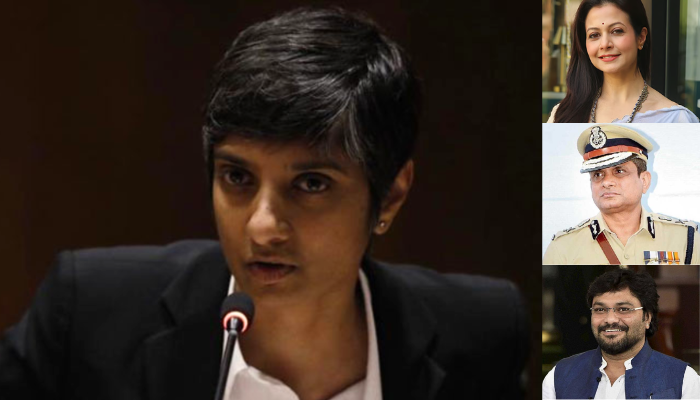
The nomination of Menaka Guruswamy as a Rajya Sabha candidate by the All India Trinamool Congress has brought a leading constitutional lawyer into the centre of West Bengal’s political landscape. Announced alongside Babul Supriyo, Rajeev Kumar and Koel Mallick, her candidature has attracted attention for marking a rare transition from high-profile legal practice to parliamentary politics.
Unlike her co-nominees, Guruswamy is not a career politician. She is best known for her work in constitutional and public interest litigation and for her association with several landmark cases before the country’s highest courts. Her entry into the Rajya Sabha race reflects the party’s decision to field a professional with strong legal credentials at a time when legislative and judicial issues are increasingly intertwined.
From Academic Excellence to Legal Prominence
Guruswamy studied law at the University of Oxford and later at Harvard Law School. She began her career under former Attorney General Ashok Desai and later practised in New York before returning to India.
She rose to national prominence for her role in the case that led the Supreme Court of India to strike down Section 377 of the Indian Penal Code in 2018. Along with Arundhati Katju, she argued that criminalising consensual same-sex relationships violated constitutional guarantees of equality and dignity.
Beyond the Section 377 verdict, Guruswamy has been involved in several major cases, including matters related to the AgustaWestland helicopter deal, the Right to Education Act, bureaucratic reforms and large-scale recruitment cancellations. She has also appeared in high-profile criminal cases, including proceedings linked to the Jessica Lal murder.
Work for the West Bengal Government
In recent years, Guruswamy has frequently represented the West Bengal government in sensitive legal matters. She has acted as counsel in cases arising from confrontations between the state administration and central agencies and has appeared in both the Calcutta High Court and the Supreme Court.
Most recently, she represented the state in proceedings related to Enforcement Directorate searches at political consultancy firm I-PAC and the residence of its chief. Her continued engagement with the state government has been cited by party leaders as a factor behind her nomination.
She has also served as amicus curiae in cases involving alleged extrajudicial killings and advised international organisations such as the United Nations Children’s Fund, adding to her professional profile.
Political Significance of the Nomination
If elected, Guruswamy is expected to become India’s first openly LGBTQ Member of Parliament. Her candidature has therefore acquired symbolic significance in addition to its professional dimension.
At the political level, the nomination reflects Chief Minister Mamata Banerjee’s preference for including legal and technical experts in the party’s parliamentary lineup. Party leaders have said they expect her to contribute to debates on constitutional law, federal relations, and civil liberties.
Opposition parties, however, have questioned whether such nominations blur the boundary between legal advocacy and political alignment, particularly when lawyers who represent governments are later fielded as candidates.
From Litigation to Legislation
For much of her career, Guruswamy has influenced public policy through court rulings and constitutional interpretation. A seat in the Rajya Sabha would place her within the legislative process, giving her a direct role in shaping laws rather than contesting them in court.
As the March 16 elections approach, her candidature stands out as one of the most distinctive in the Trinamool’s list. Rooted in academic achievement and legal practice, Menaka Guruswamy’s political entry highlights the growing presence of professionals in parliamentary politics and raises questions about how legal expertise translates into legislative responsibility.